
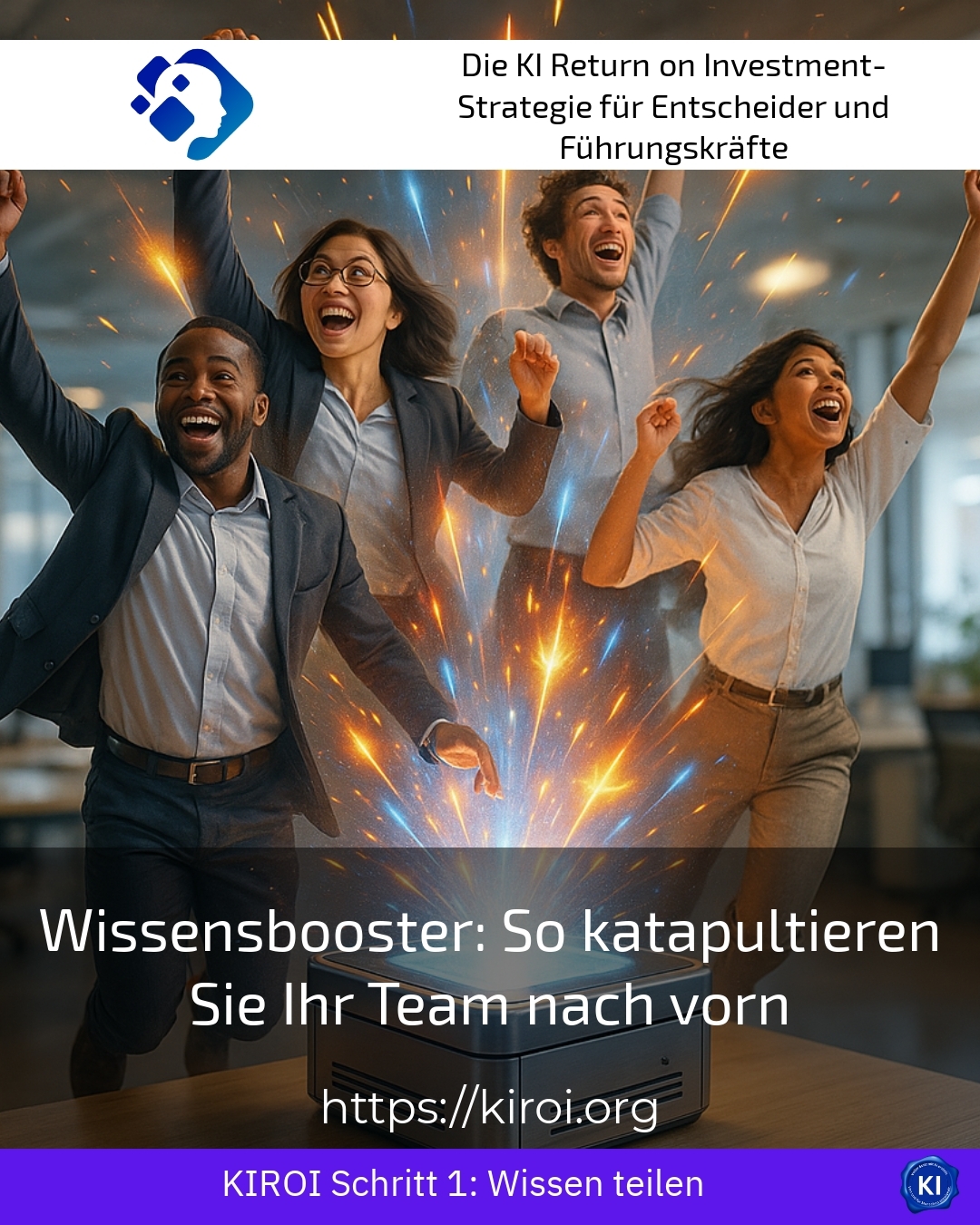
Imagine your employees evolving from routine specialists to genuine innovation drivers within months, tackling complex challenges with fresh perspectives. The Knowledge Booster: How to propel your team forward is no longer an abstract concept, but a concrete strategy that numerous companies are already successfully implementing. Many managers report that targeted knowledge transfer has fundamentally changed team dynamics. The crucial question is therefore no longer whether you should invest in competence development, but how you can do so most effectively. In this post, you will learn practically tested approaches that will advance your team sustainably.
The transformative power of structured competency development
In a world that is constantly changing due to technological upheavals and altered market conditions, continuous learning is taking on a completely new meaning. Companies that systematically invest in the further development of their teams gain decisive competitive advantages. Especially in the area of digital transformation, the importance of in-depth expertise becomes clear. For example, a medium-sized manufacturing company was able to reduce its throughput times by more than thirty percent through targeted training in process automation. At the same time, employee satisfaction increased because monotonous tasks were eliminated and more demanding activities came to the fore. Another example comes from the service sector, where a customer service team was able to significantly increase its first-contact resolution rate through communication training. However, such successes do not happen by chance, but require a well-thought-out strategy.
The key lies in the combination of theoretical knowledge and practical application. Abstract learning modules alone rarely bring about sustainable changes in everyday work. Instead, it is advisable to link learning content directly with concrete projects. A logistics company successfully implemented this approach by immediately applying new software skills in ongoing optimisation projects. This significantly accelerated the learning curve. Transruption coaching accompanies such processes and supports teams in translating theoretical knowledge into practical skills.
Best practice with a KIROI customer
An internationally operating trading company faced the challenge of upskilling its sales teams to handle new digital sales channels. Previous training measures had only shown moderate success because they were too theoretical. As part of an AIROI project, we developed a practice-oriented learning concept together with management, based on realistic case studies. Participants worked on genuine customer inquiries under the guidance of experienced mentors. After just six weeks, managers reported a noticeably higher closing rate among their teams. The conversion rate in the digital channel increased by more than twenty percent. It was particularly noteworthy that the employees themselves actively identified and requested further learning areas. This intrinsic motivation is a clear sign that the chosen approach has provided the right impetus. The company has since established a permanent peer-learning programme building on the experiences from this project.
Knowledge Boosters as a Strategic Instrument of Team Leadership
Leaders today face the challenging task of navigating their teams through complex change processes. A well-thought-out Knowledge booster can serve as a compass, providing orientation in uncertain times. This is not only about technical qualifications, but also about transferable skills such as critical thinking and problem-solving. For example, a technology company in the software sector recognised that while its developers were technically skilled, they struggled to understand customer needs. Through targeted customer-centric workshops, product quality improved significantly. Another example comes from the healthcare sector, where nursing teams were relieved of burdens through training in digital documentation. The time gained could be used for direct patient care. Such examples illustrate how targeted skills development is effective across industries.
The role of transruption coaching is particularly evident in supporting projects that need to combine technical and human factors. Clients often report initial scepticism as to whether training measures would actually deliver measurable results. However, after implementation, they experienced how team dynamics changed positively. A financial services provider was able to detect fraud cases more quickly through improved analytical skills of its employees. A construction company significantly reduced planning errors through training in 3D modelling. These examples show that knowledge can indeed act as an accelerator.
Individual learning paths as a success factor in the knowledge booster concept
Not everyone learns in the same way, which is why standardised training programmes often reach their limits. Modern learning concepts therefore take different learning types into account and offer flexible formats [1]. A pharmaceutical company has successfully implemented a blended learning concept that combines online modules with face-to-face workshops. Employees were able to work through theoretical fundamentals at their own pace and then deepen their knowledge in group exercises. A retail company, on the other hand, relied on microlearning units that could be integrated into busy daily working life. Checkout staff were able to watch short learning videos between customer rushes. The results were impressive because the psychological barrier to learning was significantly reduced. A third example comes from the automotive industry, where gamification elements increased learner motivation. Leaderboards and badges created a playful competition that increased engagement.
Best practice with a KIROI customer
An insurance group wanted to train its caseworkers in handling artificial intelligence, but encountered considerable resistance. Many employees feared becoming redundant through automation and displayed corresponding defensive attitudes. As part of our support, we first developed communication formats that addressed these fears and transparently informed about the actual goals. Only then did we start with technical training content that focused on practical application scenarios. The participants experienced how AI-supported tools could make their work easier instead of replacing it. Within three months, initial skepticism transformed into genuine enthusiasm. Some employees even became internal ambassadors for the new technology. Management reported a noticeably improved acceptance and a faster introduction of the new systems. This case illustrates the importance of the emotional dimension in learning processes and how transruption coaching can accompany such sensitive transitions.
Measurable results through systematic knowledge promotion
The effectiveness of competence development can be measured using various key performance indicators [2]. Companies that measure systematically often achieve better results. For example, a telecommunications provider uses regular knowledge tests to document the learning progress of its service staff. The results are incorporated into individual development plans. A mechanical engineering company, on the other hand, has defined the error rate as a key figure and was able to directly correlate its reduction with training measures. In the banking sector, consulting interviews are analysed to assess the impact of communication training. Such data-based approaches enable continuous optimisation of learning programmes.
The Knowledge Booster: How to propel your team forward unfolds its full potential only when learning is understood as a continuous process. One-off training events are rarely sufficient to bring about lasting behavioural changes. Instead, regular refreshers and in-depth sessions are recommended. A chemical company has recognised this and conducts quarterly competency updates. A media company uses weekly short formats to communicate current industry developments. An energy supplier relies on mentoring programmes, where experienced employees pass on their knowledge to junior staff. These diverse approaches show that there is no single right way, but that the appropriate solution depends on the specific context.
Cultural change as the basis for sustainable knowledge development
Genuine willingness to learn only arises in a corporate culture that understands mistakes as learning opportunities and encourages curiosity. However, many organisations struggle with a culture that demands perfection and punishes experimentation. One hotel group has embraced this challenge and explicitly created spaces for experimentation. Employees were allowed to try out new service ideas without fearing sanctions for setbacks. A food manufacturer introduced regular retrospectives where teams could openly discuss potential improvements. A consulting firm established the principle of knowledge sharing, where internal experts regularly gave presentations for colleagues. Such cultural changes take time, but they lay the foundation for sustainable success.
Transruption coaching can provide valuable input for such cultural change processes and support leaders in embodying new behaviours. Clients often report that external support helps to break established patterns. A logistics provider used this support to establish a more open feedback culture. An IT company was able to reduce silo thinking between departments through guided workshops. A retail company improved collaboration between headquarters and branches through moderated dialogue formats. These examples illustrate the broad range of possible application areas.
My KIROI Analysis
Developing team competencies is proving to be one of the most effective drivers for entrepreneurial success in dynamic markets. My experience from numerous KIROI projects shows that the success of such initiatives depends on several factors. Firstly, clearly linking learning objectives with business objectives is crucial, as this is the only way to secure the necessary support from management. Furthermore, the emotional dimension plays a central role, as learning is always associated with uncertainty and sometimes with anxieties. Companies that ignore these aspects often encounter resistance and fail to achieve their goals. Another critical success factor is continuity, as one-off interventions usually have no effect. Instead, systematic programmes are needed that establish learning as an integral part of everyday work. The technological possibilities for such programmes have expanded significantly in recent years. From adaptive learning platforms and virtual reality simulations to AI-supported tutor systems, a variety of tools are available [3]. However, it remains crucial that technology is merely a means to an end and that people must remain at the centre. Organisations that take this principle to heart and systematically develop their teams will be able to prevail in the competition.
Further links from the text above:
[1] McKinsey: Building workforce skills at scale
[2] Harvard Business Review: Learning and Development
[3] World Economic Forum: The Future of Jobs Report
For more information and if you have any questions, please contact Contact us or read more blog posts on the topic Artificial intelligence here.








 Deutsch
  English (UK)