
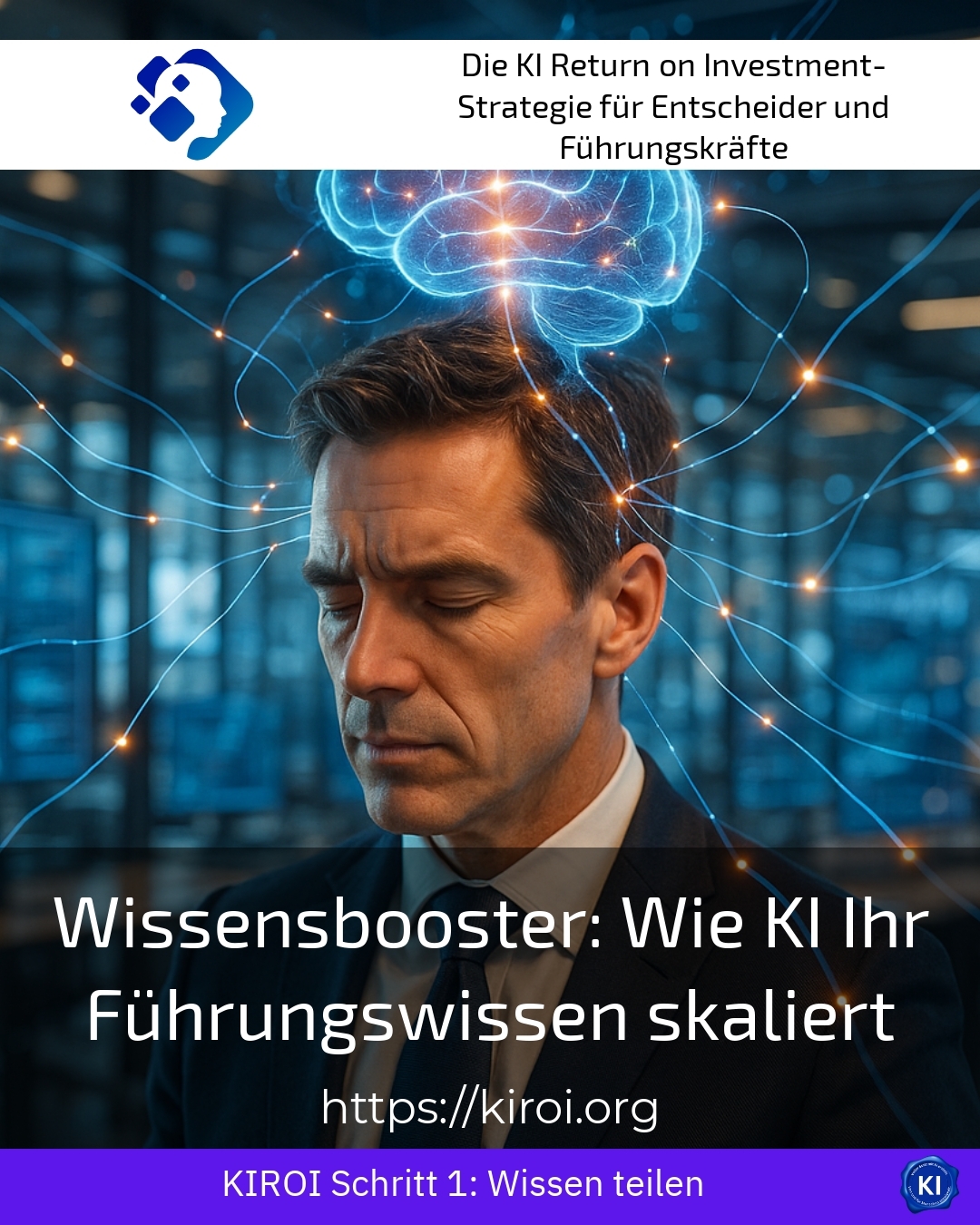
Imagine if you could multiply your entire leadership knowledge in the shortest possible time, while simultaneously elevating your strategic decisions to a completely new level of quality. This is precisely what the Knowledge Booster enables: how AI scales your leadership knowledge, not as a distant future vision, but as a tangible reality for decision-makers in companies of all sizes. Digital transformation has long since begun to revolutionise the way leaders learn, analyse, and act. This is not about replacing human intuition, but about enriching and strengthening it with data-based insights.
The Evolution of Learning in the Executive Suite
Traditional further training formats are reaching their limits today. While seminars, books, and conferences provide valuable impetus, they can barely keep pace with the speed at which markets and technologies are developing. Intelligent systems, on the other hand, continuously analyse relevant sources of information and distil practical insights from them. In the automotive and mobility sector, for example, we observe how executives from supplier companies are using these technologies to recognise market trends at an early stage. A medium-sized component manufacturer relies on automated market analyses that sift through hundreds of trade publications daily and produce condensed reports. Large OEMs are also experimenting with personalised learning platforms that present executives with precisely the content that is relevant to their current challenges.
The change is particularly evident in the field of electromobility. Here, decision-makers must rapidly acquire entirely new expertise. Battery technology, charging infrastructure, and software architecture require skills that played hardly any role just a few years ago. Intelligent assistance systems support this by presenting complex technical interrelationships in an understandable way. They identify knowledge gaps and specifically suggest learning materials that can close them.
Knowledge Booster: How AI Scales Your Leadership Knowledge – Concrete Application Scenarios
Practical implementation is evident in various dimensions. Firstly, intelligent systems enable real-time analysis of competitive strategies and market movements. Secondly, they support preparation for complex negotiations by compiling relevant background information. Thirdly, they help to extract actionable insights from internal data holdings that might otherwise remain hidden. For example, a Tier 1 supplier uses intelligent text analysis to systematically derive improvement potential from customer complaints. A fleet operator uses similar methods to evaluate driver reports in order to optimise maintenance intervals. A logistics service provider analyses supply chain data to predict bottlenecks and take preventive action.
Best practice with a AIROI customer
A medium-sized company in the automotive drive technology sector faced a fundamental challenge, as the entire management level had to familiarise themselves with the basics of electromobility within a very short period. As part of transruption coaching, we supported the organisation in implementing an intelligent knowledge management system that generated tailor-made learning content for each decision-maker. The system first analysed the existing competencies of each manager and then identified individual knowledge gaps relevant to the strategic reorientation. Within six months, participants reported significantly improved decision-making confidence on technical issues. The function that automatically established connections between new technology trends and the existing product portfolio proved particularly valuable. The management team thereby developed innovative product ideas that would probably not have emerged without this support. The combination of technological innovation and human guidance made this project a sustainable success.
Strategic Decision-Making Reimagined
The quality of management decisions is significantly dependent on the available information base. Intelligent analysis systems considerably expand this base by recognising patterns that remain hidden to the human eye. In the commercial vehicle sector, fleet managers use this technology to determine optimal purchasing times, simultaneously considering factors such as residual value development, fuel price forecasts, and regulatory changes. A bus operator uses intelligent simulations to determine the optimal time to switch to electric buses. A haulage company analyses route data to specifically tailor driver training to identified areas for improvement.
This is not about blind faith in technology. Rather, these tools help to combine human expertise with data-based insights. The final decision always rests with the executive, who can, however, make judgments on a broader and more well-founded basis. Clients often report that this support enables them to stand by their decisions with greater confidence. They have arguments and data that underpin their intuition and make it transparent to stakeholders.
The Knowledge Booster: How AI Scales Your Leadership Knowledge in Practice
The implementation of such systems requires thoughtful change management. Technology alone does not create added value if it is not integrated into existing work processes. This is where the value of professional support becomes evident, combining technical expertise with organisational change knowledge. An automotive dealer implemented a system for automated market price analysis but initially failed to gain acceptance from the sales team. Only through accompanying coaching was the integration into daily work life successful. A workshop network introduced intelligent diagnostic assistants and combined this with a comprehensive training initiative. A mobility provider uses predictive analytics for vehicle dispatching and links this with regular feedback loops.
The challenges vary depending on the company culture and the maturity of digital transformation. Some organisations struggle with data availability, others with skills gaps in the workforce. Yet others face the task of convincing leaders of the benefits, who are initially sceptical of technological support. In all these cases, transruption coaching offers valuable support, developing individual solutions and continuously assisting with implementation.
Ethical Aspects and Responsible Use
Scaling leadership knowledge through intelligent systems also raises ethical questions. How transparent should algorithm-based recommendations be? Which decisions should only be made by humans? These questions are particularly intensely occupying leaders in the mobility industry because safety aspects play a central role here. A manufacturer of driver assistance systems has developed clear guidelines on which decision-making powers can be delegated to automated systems. A car-sharing provider relies on full transparency towards users when algorithmic decisions influence their experience. An insurer uses intelligent risk models but openly communicates the criteria used to calculate premiums.
Responsible use also means recognising the limitations of these technologies. Intelligent systems can identify patterns in historical data, but they cannot predict fundamental market shifts for which there are no precedents. They can aggregate and process information, but they cannot fully grasp the complexity of human relationships and political dynamics. Leaders who understand these limitations can utilise the tools more effectively and avoid making mistakes.
Best practice with a AIROI customer
An internationally operating logistics group, with a focus on automotive supply, approached us with a clear requirement, as their management felt overwhelmed by the flood of information and were looking for ways to absorb relevant knowledge more efficiently. As part of the transruption coaching, we jointly developed a strategy that combined technological tools with new working routines. We implemented a system that created a personalised news overview for each decision-maker, taking into account relevance criteria that we had collaboratively defined in workshops. The integration of reflection phases, in which the managers evaluated the information received and incorporated it into their strategic planning, was particularly important. After approximately four months, participants reported significantly higher information quality with a simultaneously reduced time expenditure for information retrieval. The time freed up was invested in strategic discussions and personal exchange with their teams, which had a positive impact on the company culture.
Knowledge Booster: How AI Scales Your Leadership Knowledge – The Forward Look
Development is progressing rapidly, constantly opening up new opportunities. Voice-controlled assistants are becoming increasingly sophisticated, enabling natural interactions with complex analysis systems [1]. Multimodal systems can process not only text but also images, videos, and audio content, translating them into insights [2]. Personalised learning paths continuously adapt to individual progress and preferred learning formats. An automotive manufacturer is already testing virtual coaches that support managers with relevant information in real-time during strategy meetings. A mobility company is experimenting with augmented reality applications that project complex data visualisations into physical space. A supplier is using predictive models to anticipate training needs before they become acute.
The future belongs to those leaders who masterfully employ these tools while preserving their human qualities. Empathy, creativity, and ethical judgment are more important than ever, precisely because technical analyses are becoming increasingly powerful [3]. The combination of technological support and human wisdom creates a leadership style that is both data-driven and people-centred.
My AIROI Analysis
Following intensive engagement with this field, a clear picture emerges, encompassing both opportunities and challenges. Scaling leadership knowledge through intelligent technologies is no longer a luxury, but is increasingly becoming a necessity to remain competitive. At the same time, we observe that the mere use of technology without accompanying organisational development often leads to disappointment. The most successful implementations combine technological innovation with cultural change and continuous competence development.
From the AIROI perspective, I recommend a step-by-step approach that begins with clearly defined pilot projects and is gradually expanded based on the experience gained. Human support should never be underestimated, as technological tools only realise their full potential when they are understood, accepted, and creatively utilised by people. Investing in coaching and change management demonstrably pays off multiple times over, as it reduces resistance and increases the speed of adoption. Leaders who invest in their digital competence development today lay the foundation for sustainable success in a world characterised by continuous change.
Further links from the text above:
[1] McKinsey: The Economic Potential of Generative AI
[2] Harvard Business Review: Artificial Intelligence Research and Insights
[3] World Economic Forum: Artificial Intelligence Archive
For more information and if you have any questions, please contact Contact us or read more blog posts on the topic Artificial intelligence here.








 Deutsch
  English (UK)