
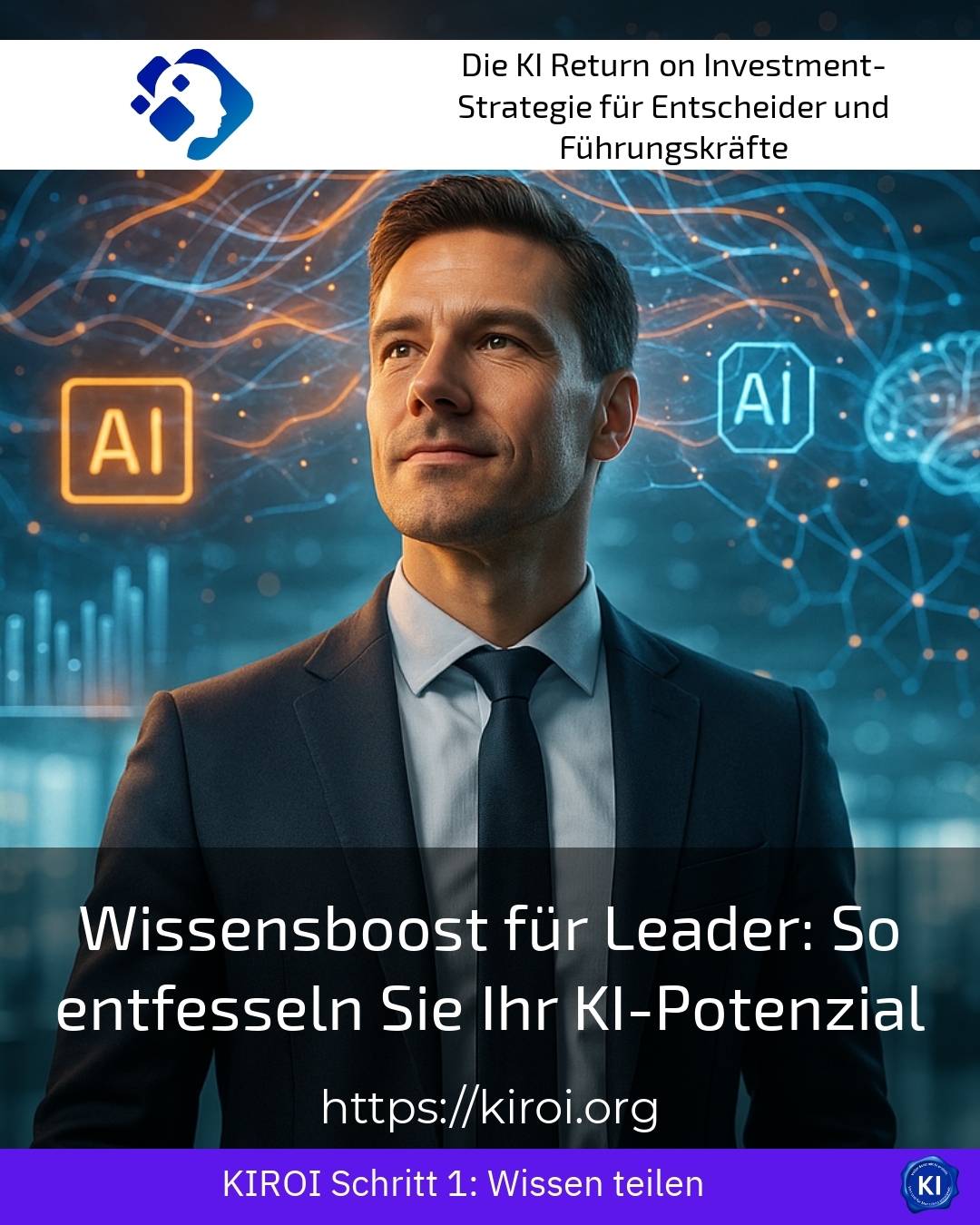
Imagine being able to make decisions every day based on a deep understanding of data, patterns, and relationships, without having to spend hours sifting through tables and reports. Knowledge boost for leaders: How to unleash your AI potential It is no longer a futuristic concept; it is a tangible reality that enables leaders worldwide to effectively lead their teams and transform their organizations sustainably. In a time where information grows exponentially and the complexity of business challenges increases, the ability to strategically employ intelligent technologies becomes the decisive competitive advantage. This article shows you practically how you can actively shape this change.
The new era of decision-making for leaders
Executives face a fundamental challenge today. They must make decisions faster than ever before. At the same time, stakeholders expect sound and understandable justifications. This tension between speed and quality dissolves when intelligent systems serve as support. For example, a medium-sized manufacturing company used predictive analytics to optimize its machine maintenance cycles. The result impressed all involved. The unplanned downtime was reduced by almost forty percent. Another example can be found in the healthcare sector. There, algorithmic assistants support doctors in diagnosing patients by comparing patient data with medical databases [1]. Clients in the financial sector also often report significant improvements. Portfolio managers use intelligent systems to identify market trends earlier and better assess risks.
The real value lies not in the technology itself. It is created by the combination of human intuition and machine precision. Executives who understand this symbiosis gain a significant advantage. They make decisions that are data-driven and context-sensitive. transruptions coaching closely accompanies leadership personalities in this transformation. It helps them redefine their own role and strategically utilize technological possibilities.
The knowledge boost for leaders begins with self-reflection
Before introducing new tools, you should question your own assumptions. What decisions do you make regularly? Which ones could benefit from additional data analyses? A manager from the logistics industry posed exactly these questions. He realized that his route planning was based predominantly on experience data. After the introduction of an intelligent optimization system, transport costs dropped significantly. In retail, executives use similar approaches. They analyze purchasing behavior in real time and adapt assortments dynamically [2]. In the education sector, remarkable developments are also evident. School principals are using adaptive learning systems to enable individual support.
Best practice with a AIROI customer
A medium-sized company from the manufacturing industry approached us with a specific challenge. The management wanted to understand how intelligent technologies could improve production planning. Initially, we conducted a comprehensive analysis of the existing processes. It turned out that many decisions were based on outdated data. The management received reports that were already two days old. In a dynamic market environment, this led to suboptimal decisions. Together, we developed a strategy for real-time data integration. The company gradually implemented a system that continuously analyzes production data. The management level now receives dashboards with current metrics. Decisions could be made faster and more informed. After six months, the CEO reported a significantly improved responsiveness. Delivery times became shorter and customer satisfaction increased measurably. This example illustrates how transruptive coaching accompanies projects and provides impetus for sustainable changes.
Strategic integration as the key to success
The introduction of intelligent systems often fails not because of the technology itself, but because of a lack of strategic integration. Leaders must understand that this is a holistic transformation process. An insurance company illustrates this impressively. It initially implemented isolated pilot projects. These showed promising results, but remained isolated solutions. It was only when the management developed a corporate strategy that the full potential was realized. In the customer support area, teams now use intelligent assistants for frequent inquiries. This allows employees to focus on more complex cases. In marketing, positive effects are also evident. Campaigns are personalized and reach more relevant target groups [3].
Another example comes from the pharmaceutical industry. There, intelligent analyses significantly accelerate drug development. Researchers can evaluate millions of molecular structures in the shortest time. What used to take years is now possible in months. The role of the leader is fundamentally changing. They become the orchestrator of various systems and teams. The Knowledge boost for leaders: How to unleash your AI potential it requires exactly this new competence. It is about optimally connecting people and technologies.
Cultural change as the foundation of sustainable transformation
Technology alone does not transform an organization. People do that. Therefore, the cultural aspect is crucial. Leaders must create an atmosphere that enables experimentation and understands mistakes as learning opportunities. A technology company established so-called innovation labs. There, employees test new applications in a protected environment. The best ideas are later scaled up. This approach reduces resistance and promotes acceptance. In the banking sector, clients often report initial skepticism from the workforce. Through transparent communication and early involvement, this was overcome. Cultural challenges are also evident in the public sector. Authorities must align citizen expectations with data protection requirements [4].
Transruptions coaching accompanies organizations through these cultural change processes. It helps leadership build trust and engage employees actively. Because only when all parties support the change can lasting impact be achieved. One automotive supplier demonstrated this impressively. They conducted regular workshops in which employees could practically test new technologies. The acceptance rate thus increased significantly. And the rate of innovation doubled within a year.
Practical steps for your personal knowledge boost for leaders
Where should you start in particular? This is a question many executives ask. The first step is to honestly analyze the status quo. What data does your organization already collect? How is it currently used? A trading company discovered untapped potential during this analysis. It had been collecting customer data for years, but only used it superficially. After introducing intelligent analytics tools, completely new insights emerged. The marketing department was able to target audiences more precisely. The sales team received valuable insights into cross-selling opportunities. And management gained a deeper understanding of market trends.
The second step involves prioritizing. Not all processes benefit equally from intelligent support. Focus on areas with high volumes and clear decision criteria. For example, an energy provider prioritized network load planning. Predictive models enabled significant efficiency gains here. In healthcare, many facilities are focusing on appointment management and patient flow optimization [5]. Both areas are particularly well suited because clear metrics exist. In the construction industry, promising applications are also emerging. Project managers use intelligent systems for resource planning and risk assessment.
Best practice with a AIROI customer
A service company from the consulting sector came to us with a specific request. The partners wanted to understand how they could use their knowledge database more intelligently. For years, consultants had documented project experience, but accessing it was cumbersome. Relevant information often went undetected. Together, we analyzed the existing structures and processes. It turned out that the search functions were outdated and lacked intuitive navigation. We developed a roadmap for the gradual improvement. The company initially implemented a semantic search system that understands the context of requests. Consultants can now naturally ask questions and receive relevant results. The time spent searching was reduced by an average of half. Additionally, the company introduced a recommendation system. It automatically suggests relevant documents based on the current project context. The partners report on a noticeably higher quality of their advisory services. This project illustrates how transruptive coaching develops and implements practice-oriented solutions.
Competence development as a continuous process
The Knowledge boost for leaders: How to unleash your AI potential It is not a one-time event. It requires continuous learning and adaptation. Technological development is advancing rapidly. What is state of the art today may already be outdated tomorrow. Therefore, leaders should establish regular learning routines. For example, a media company introduced monthly technology updates for the leadership team. External experts presented current developments and discussed their relevance. This significantly enhanced the strategic awareness. In retail, progressive companies rely on peer learning. Leaders from different departments exchange their experiences. This creates synergies and best practices spread organically.
Formal further education also plays an important role. Numerous institutions offer specialized programs for executives. These do not provide technical knowledge. They focus on strategic implications and leadership aspects [6]. A mechanical engineering company specifically invested in such programs. The executives gained a deeper understanding of possibilities and limitations. They were then able to formulate more realistic expectations and make better decisions. transruptions coaching supports in selecting suitable development measures and accompanies their integration into everyday work.
Ethical responsibility and societal implications
With the growing power of intelligent systems, so does the responsibility. Leaders must actively address ethical issues. How transparent are algorithmic decisions? What impact do they have on employees and customers? A human resources provider faced exactly these questions. They used intelligent systems to pre-select applicants. The efficiency gains were impressive, but concerns also arose. How could it be ensured that no discrimination occurred? The company introduced regular audits and transparent documentation of decision criteria. Similar requirements apply in the financial sector. Credit decisions must be understandable and fair [7]. Transparency is also essential in healthcare. Patients have the right to understand how diagnostic recommendations are made.
Executives should develop and communicate ethical guidelines. These provide guidance and create trust among all stakeholders. A telecommunications company established an ethics board for technological innovations. This reviews planned applications for their societal impact. Such committees support responsible decision-making. They provide impetus for sustainable and people-centered development.
My AIROI Analysis
The analysis of numerous transformation projects reveals a clear pattern. Successful executives do not view intelligent technologies as isolated tools. They understand them as an integral part of a holistic strategy. The true value only emerges through the combination of different elements. These include data quality, process integration, and above all human expertise. Organizations that consider all three aspects achieve more sustainable results. They avoid typical pitfalls such as exaggerated expectations or lack of acceptance.
What is particularly striking is the importance of the leadership role itself. Technology does not replace leadership; it expands its possibilities. Leaders who understand this use intelligent systems as amplifiers of their own strengths. They delegate routine tasks to algorithms and focus on strategic and interpersonal challenges. This realignment requires courage and a willingness to reflect. Not all leaders are immediately ready for this change. transruptions-Coaching accompanies this process of personal and organizational development.
The coming years will bring further developments. Executives who invest today create the foundation for future success. The Knowledge boost for leaders: How to unleash your AI potential It is not a goal, but a continuous journey. It requires curiosity, openness, and a willingness to change. Those who possess these qualities will be able to recognize and take advantage of the opportunities.
Further links from the text above:
[1] McKinsey Healthcare Insights – Digital Transformation in Healthcare
[2] Harvard Business Review – Technology and Analytics
[3] Gartner Marketing Insights – Intelligent Marketing Strategies
[4] Bitkom – Digital Transformation and Data Protection
[5] WHO Digital Health – Technology in Healthcare
[6] IMD Business School – Digital Business Transformation
[7] BaFin – FinTech and digital financial services
For more information and if you have any questions, please contact Contact us or read more blog posts on the topic Artificial intelligence here.






 Deutsch
 English (UK)