
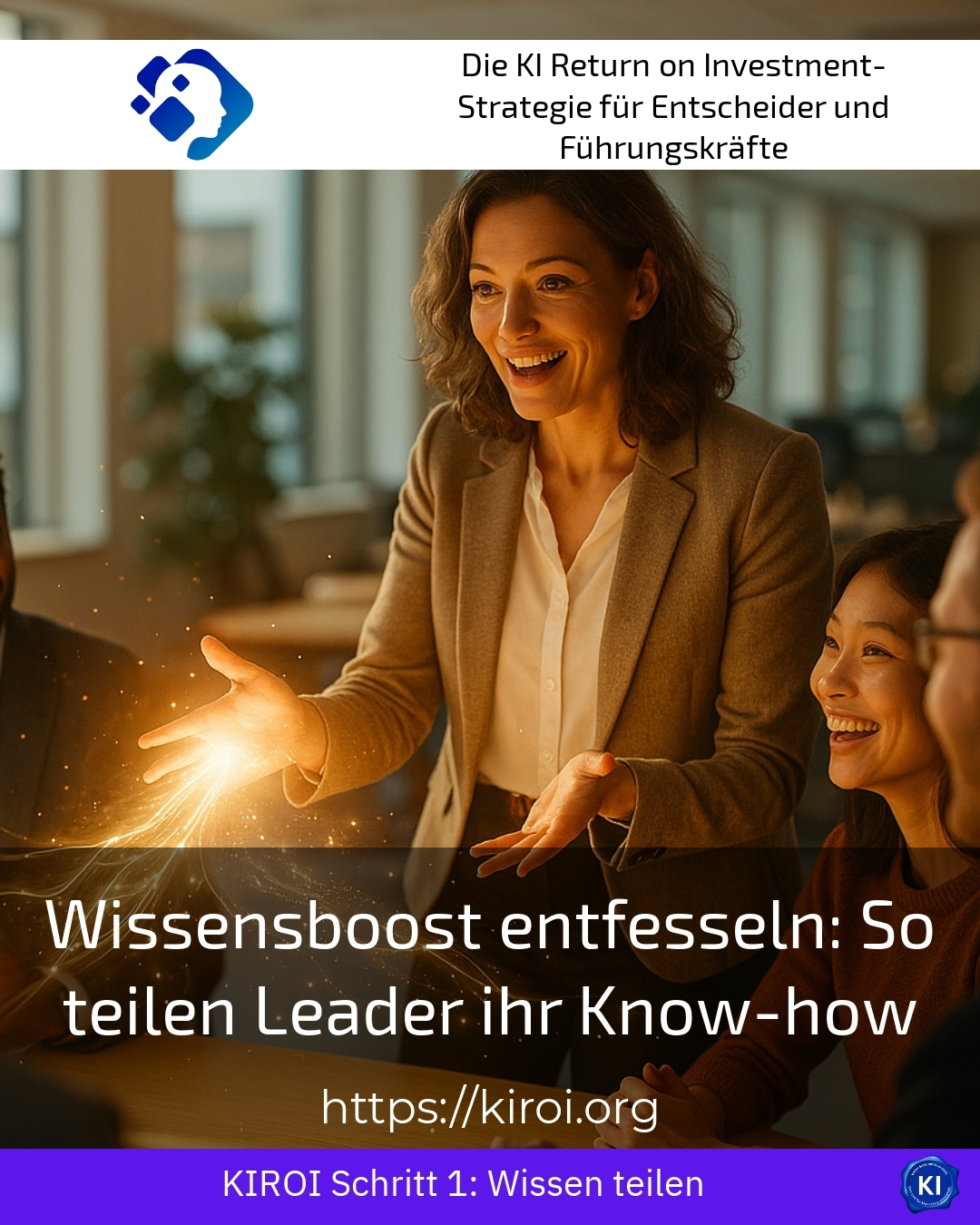
Imagine being able to process all the experiential knowledge of a leader in a company so that it reaches and transforms hundreds of employees at the same time. This is precisely where the modern knowledge boost unleash approach comes in, whereby leaders no longer just pass on their know-how in personal conversations, but multiply it systematically. At a time when information becomes outdated faster than ever before, the ability to share expertise effectively is becoming a decisive competitive advantage. Clients frequently report that traditional training formats are no longer sufficient. Digital transformation has changed the way we learn and teach. This article shows you concrete ways in which you, as a leader, can pass on your knowledge sustainably.
The new role of the leader as a knowledge architect
Today, leaders are taking on a completely new function in their organisations. They are no longer just decision-makers and strategists. They are becoming active creators of learning environments. For example, the managing director of a medium-sized mechanical engineering company started recording his monthly progress reports as a podcast. Employees could listen to these episodes during their commute. As a result, his knowledge suddenly reached three times as many colleagues.
The financial sector shows particularly impressively how expertise can be scaled. A board member of a regional bank developed short video sequences on complex regulatory topics. These micro-learning units replaced lengthy face-to-face training sessions. Learning time was reduced by sixty percent. At the same time, the retention rate increased significantly. In the healthcare sector, too, chief physicians are increasingly establishing digital case discussions. Young assistant doctors benefit from the documented experience of their superiors.
Transruptions-Coaching supports leaders with precisely such transformation projects. The transition from a traditional keeper of knowledge to a modern knowledge architect requires new competencies. It is about making implicit knowledge explicit. The art lies in presenting complex relationships in an understandable way.
Best practice with a AIROI customer
An international logistics group faced a huge challenge as experienced dispatchers were approaching retirement and their decades of accumulated experience threatened to be lost, which would have endangered the entire supply chain. As part of transruption coaching, we jointly developed a structured knowledge transfer programme in which the experts commented on their daily decision-making processes and these audio recordings were systematically documented, creating a comprehensive pool of experience. The older employees felt valued because their expertise was recognised as a strategic asset, and the younger colleagues gained access to knowledge that is not in any manual. Within six months, a knowledge database comprising over three hundred commented case studies was created, which now serves as a central training tool and has reduced the induction period for new dispatchers by forty percent. The project impressively demonstrates how the knowledge boost unleashed approach works concretely in practice and delivers measurable results.
Unleashing knowledge boosts through modern multiplier strategies
Successful leaders rely on multiplier effects to increase their reach. They identify talented employees as knowledge ambassadors. These individuals pass the expertise on to the teams. An example from software development illustrates this particularly well. The CTO of a technology company established so-called knowledge champions in every department. These received regular briefings and passed the content on in a context-specific manner.
In retail, branch managers use similar concepts. They train selected sales staff to become product experts. These experts in turn support their colleagues during complex advisory consultations. The insurance sector has also found innovative ways. Experienced field staff virtually accompany newcomers to client appointments. They provide live input via discreet communication channels.
Transruptions-Coaching supports organisations in building such multiplier networks. The process begins with an analysis of existing knowledge resources. We then jointly develop suitable transfer formats. Implementation takes place step by step and is continuously optimised.
Digital tools for systematic knowledge transfer
Modern technologies open up completely new possibilities for the exchange of knowledge. Collaboration platforms enable asynchronous learning across time zones [1]. For example, a pharmaceutical company uses an internal video platform for expert interviews. Managers regularly answer questions from the workforce there. The recordings are available permanently.
The automotive industry is increasingly relying on augmented reality solutions. Experienced technicians are thus able to guide younger colleagues remotely. Through the camera, they see precisely what is being worked on. Their expertise is integrated into the work process in real time. The construction industry is also experimenting with such technologies. Construction managers share their knowledge directly on site via video transmission [2].
Interactive knowledge bases have become established in the consulting industry. Partners document their project experience in a structured way. Junior consultants access this when taking on new mandates. In this way, they avoid typical beginner mistakes and deliver results more quickly.
Unleashing the emotional dimension of the knowledge boost
Knowledge transfer is more than a technical process. It touches upon profound emotional aspects. Some managers hesitate to share their knowledge completely. They fear becoming replaceable. Clients frequently report precisely these fears. Transruptions coaching guides them through this transformation.
A plant manager at a chemical company went through precisely this process. Initially, he held back critical process knowledge. During coaching, he realised that his value does not lie in information. His true strength was the ability to develop new solutions. After he generously shared his existing knowledge, he gained enormous respect. His position within the company even solidified.
The hotel industry offers further impressive examples. Experienced hotel directors systematically pass on their knowledge of guest care. They share stories about special service moments. These narratives shape the corporate culture more lastingly than any manual. In the culinary arts, head chefs assume a similar role. They document not only recipes, but also the story behind each dish.
Best practice with a AIROI customer
A mid-sized private bank realised that its older relationship managers possessed invaluable relationship knowledge that had never been recorded in a CRM system and threatened to be irretrievably lost with their upcoming retirements, which would have endangered long-term client relationships. The transruptions coaching helped to develop an innovative tandem programme in which experienced advisers visited their most important clients together with younger colleagues, sharing their observations and strategies so that a vibrant transfer of knowledge took place. In the process, the older employees also learned from the digital skills of the younger ones, leading to a genuine exchange on an equal footing and bringing the generations within the company together. After a year, the client retention rate for the transferred mandates had improved by fifteen percent because the new advisers not only knew the data, but also understood the personal stories and preferences of their clientele and were able to act with appropriate sensitivity.
Knowledge transfer as a strategic leadership tool
Smart leaders use knowledge transfer strategically for organisational development. They identify strategically relevant areas of knowledge. Then they develop systematic transfer programmes. An example from the energy sector demonstrates the effectiveness of this approach. The executive board of a municipal utility established monthly knowledge sessions on future topics.
These sessions followed a clear format. First, the executive board shared external insights and trends. Then, the participants discussed implications for their own company. Finally, concrete areas for action were identified. This created a continuous learning process at all levels. The employees felt involved and valued [3].
The media sector demonstrates how knowledge transfer also inspires creative processes. Editors-in-chief share their experiences of investigative research. They report on successes and failures. Young journalists learn more from these stories than from theoretical seminars.
Overcoming barriers and creating sustainable structures
The path to systematic knowledge transfer is rarely straightforward. Organisations encounter typical hurdles. Lack of time is frequently cited as the primary reason. Many managers feel trapped in day-to-day operations. Transruptive coaching helps to reset priorities.
A production manager at a textile company found a pragmatic way. He reserved every Friday afternoon for knowledge documentation. During this time, he recorded short videos. In them, he explained typical problem situations and his approaches to solutions. After a year, he had built up a comprehensive library. New shift managers use this resource intensively.
The legal industry is struggling with special challenges in knowledge transfer. Law firms have recognised that senior partners need to pass on their understanding of clients. They are developing structured handover processes during partner transitions. This is not just about facts, but about relationship qualities. Tax advisers are also increasingly relying on documented reports of experience. They systematically share their knowledge about typical client constellations.
In the telecommunications industry, community of practice models have proven successful. Experts from various locations interact virtually on a regular basis. They share best practices and discuss challenges. A facilitator structures these sessions and documents the insights.
My AIROI Analysis
The ability to systematically share knowledge is becoming the decisive differentiating factor for successful leaders. My experience from numerous support projects clearly shows that organisations with established knowledge transfer cultures operate more agilely and resiliently than their competitors, because they are not dependent on individual knowledge holders and can respond more quickly to changes.
The unleashing the knowledge boost approach works particularly well when it is embedded in the corporate culture rather than being viewed as an isolated project. Leaders who generously share their knowledge paradoxically gain influence and recognition because they are perceived as developers of talent rather than keepers of secrets.
Transruptions-Coaching supports organisations in shaping this cultural transformation. The process begins with an honest stocktake of existing knowledge resources and transfer barriers. Building on this, we develop bespoke concepts that fit the respective corporate reality. The technical tools are of secondary importance here. The crucial factor is the willingness to view knowledge as a shared resource.
The coming years will show which organisations master this challenge. Those that invest in systematic knowledge transfer now will gain a significant head start. They will learn faster, work more innovatively and be more attractive to talent. The path there requires courage, perseverance and professional guidance.
Further links from the text above:
[1] McKinsey: Knowledge Sharing in the Modern Workplace
[2] Harvard Business Review: Insights on Knowledge Management
[3] Gartner: Knowledge Management Research
For more information and if you have any questions, please contact Contact us or read more blog posts on the topic Artificial intelligence here.








 Deutsch
  English (UK)