
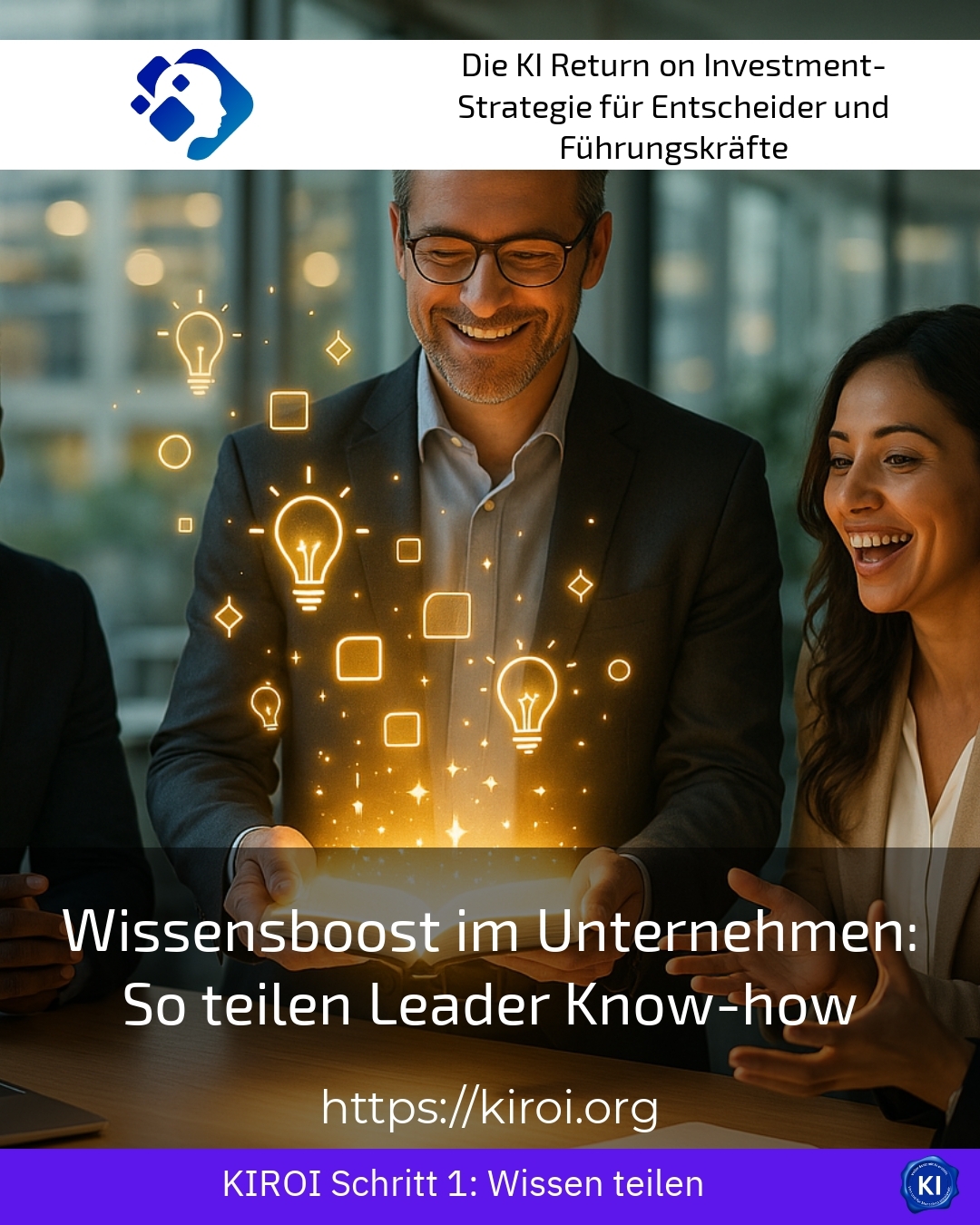
Imagine if the pooled expert knowledge of your most experienced leaders did not remain hidden in individual minds, but poured like a powerful stream through all departments of your company. The Knowledge boost in the company represents a decisive competitive advantage, as it exponentially increases an organisation's collective intelligence whilst simultaneously establishing a sustainable learning culture. In an era where information ages at a lightning-fast pace and continuous learning has become a fundamental prerequisite for business success, leaders must find new ways to systematically pass on their precious know-how. This article presents you with tried-and-tested strategies and concrete methods with which leaders can effectively multiply their expertise, whilst also highlighting how transruptions coaching can support companies in such transformation projects [1].
Why the knowledge boost has become indispensable in business
The half-life of specialist knowledge has shortened dramatically in recent years. What was still considered state-of-the-art yesterday can already be obsolete tomorrow. Modern organisations therefore require dynamic structures for continuous knowledge transfer. For example, a mechanical engineering company found that experienced engineers did not systematically pass on their specialist knowledge of complex manufacturing processes. The consequence was costly errors during the onboarding of new employees. A pharmaceutical company recognised similar challenges when passing on regulatory expertise. A medium-sized logistics service provider also struggled to document and make accessible the implicit knowledge of its route planners.
Demographic change is exacerbating this problem further. Many experienced specialists are approaching retirement. They take valuable empirical knowledge with them if no systematic handover processes exist. An energy supplier reported that thirty per cent of its subject matter experts would retire within five years. An insurance group faced the challenge of preserving the specialist knowledge of its claims adjusters. Similarly, an automotive supplier had to act urgently because its most experienced toolmakers would soon be leaving working life [2].
Developing leaders as knowledge multipliers
Leaders bear a special responsibility for the transfer of knowledge. They possess both a strategic overview and detailed operational knowledge. Yet many managers underestimate the value of their own expertise. Clients frequently report that they take their knowledge for granted. They fail to recognise the added value that a structured handover would provide. For instance, a production manager came to transruptions coaching because he wanted to make his department more efficient. In the course of the mentoring, he realised that his decades of experience needed to be systematically documented.
Developing managers into conscious knowledge multipliers requires a change in perspective. To achieve this, a chemical company established special reflection workshops for its management level. A telecommunications provider introduced peer-coaching formats where leaders learned from one another. A retail company also relied on structured knowledge interviews with its most experienced managers. These measures provided important impetus for a new knowledge culture. They supported the transformation from a hierarchical to a learning organisation [3].
Best practice with a AIROI customer
A medium-sized manufacturing company with around eight hundred employees approached us because it feared a dramatic loss of knowledge. The three most experienced production managers were going to retire within the next three years. Their specialist knowledge of complex production processes was not documented anywhere. transruptions coaching accompanied the company in establishing a systematic knowledge transfer process. First, together with the management, we identified the critical fields of knowledge. Subsequently, we developed a mentoring programme that enabled structured handovers. The experienced managers were supported in articulating and documenting their tacit knowledge. We conducted regular reflection sessions in which the knowledge holders translated their experiences into comprehensible instructions for action. Parallel to this, we established a digital knowledge archive that was easily searchable. The younger successors were thus able to access a rich treasure trove of experience. After eighteen months, the company reported that the onboarding time for new production managers had fallen by forty per cent. The error rate in production had also been significantly reduced.
Methods for a sustainable knowledge boost in the company
The selection of the right methods depends on various factors. Corporate culture, available resources and learning preferences play an important role. A software company successfully relied on so-called knowledge-sharing sessions. At these regular meetings, experts presented their specialist knowledge in a compact format. A construction company, on the other hand, preferred the master-apprentice principle with intensive personal guidance. A financial services provider combined both approaches and supplemented them with digital learning platforms [4].
Storytelling has proven to be a particularly effective method. People remember stories much better than abstract facts. A medical technology company therefore systematically collected reports of experience from its service technicians. These stories contained valuable lessons about problem-solving strategies. A food manufacturer documented the success and failure stories of its product development. This allowed new teams to benefit from past experiences. A consultancy firm also relied on systematic storytelling to preserve project experiences.
Use digital tools for knowledge transfer
Modern technologies open up a wide range of possibilities for knowledge exchange. However, technology alone does not guarantee success. The human component remains decisive. An electronics manufacturer introduced a complex knowledge management platform. However, it was barely used because the employees had not been sufficiently involved. A textile company did better and involved its teams right from the start. An insurance group cleverly combined technical solutions with personal exchange formats [5].
Video tutorials and webinars have established themselves as effective tools. A mechanical engineering company produced short explainer videos in which experienced technicians demonstrated complex maintenance processes. A pharmaceutical corporation used virtual classrooms for global training sessions for its sales representatives. An automotive manufacturer also relied on video documentation to share manufacturing knowledge across different locations. These formats made it possible to scale expert knowledge and make it available independently of time.
Creating the cultural prerequisites for successful knowledge transfer
An open learning culture forms the foundation for every sustainable Knowledge boost in the company. Without psychological safety, employees will not willingly share their knowledge. They might fear rendering themselves dispensable. A chemical company realised that its competitive culture hindered knowledge sharing. Employees hoarded knowledge as a personal advantage. A logistics service provider identified similar patterns and worked purposefully on its corporate culture. An IT service provider also had to build trust first before knowledge transfer worked.
The management level must actively model knowledge sharing. When managers themselves generously share their knowledge, teams follow this example. An energy company therefore established regular management dialogues where executive board members shared their experiential knowledge. A retail company introduced open question-and-answer sessions with the executive board. A technology company relied on transparent communication about strategic decisions and their backgrounds. These measures signalled that knowledge sharing was valued and desired.
Best practice with a AIROI customer
An international consumer goods corporation contacted us about a specific problem. The collaboration between the various national subsidiaries was not working optimally. Valuable market knowledge remained isolated within individual countries. Successful strategies were not shared systematically. transruptions coaching accompanied the company over twelve months in developing a global knowledge culture. We started with a comprehensive analysis of existing knowledge flows and identified barriers. Cultural differences and language barriers played an important role. Together, we developed a multilingual exchange format that enabled regular virtual meetings. Executives from various countries presented their local success stories. The stories were documented and made available in a central knowledge database. In addition, we established an international mentoring programme that networked executives across borders. The results significantly exceeded expectations. Within one year, several successful strategies were transferred from one country to others. Turnover in the participating markets increased measurably. Employee satisfaction also improved because people felt more strongly connected.
Overcoming resistance and promoting acceptance
Change processes frequently encounter resistance. Some employees perceive knowledge transfer as an additional burden. Others fear for their status as indispensable experts. An engineering company experienced that experienced skilled workers resisted the documentation of their knowledge. A consulting firm found that partners were reluctant to share their client knowledge with colleagues. A pharmaceutical company also struggled with resistance during the introduction of new knowledge management systems [6].
Overcoming such resistance requires tact and clever communication. An automotive supplier relied on intensive persuasion and highlighted the personal benefit for each individual. A chemical corporation linked knowledge sharing with recognition and career opportunities. An IT company introduced incentives for active knowledge sharing. These approaches supported acceptance and gradually reduced resistance. Patience and continuous guidance were essential in this process.
making the boost in knowledge within the company measurable
The effectiveness of knowledge transfer initiatives should be reviewed regularly. Without measurement, it remains unclear whether the invested resources are achieving the desired effect. An insurance group developed specific key performance indicators for its knowledge transfer. For example, it measured the onboarding time of new employees and the number of documented best practices. A manufacturing company recorded the reduction in recurring errors. A retail company analysed the improvement in its training results [7].
Qualitative indicators usefully complement quantitative measurements. A technology company conducted regular surveys on the knowledge culture. A logistics service provider collected feedback from employees on the usefulness of shared knowledge resources. A financial institution analysed the quality of decisions following the introduction of improved knowledge transfer processes. These combined approaches provided a comprehensive picture of effectiveness.
My AIROI Analysis
Systematic knowledge transfer in organisations is no longer an optional extra task, but a strategic necessity for long-term business success. My analysis shows that successful companies understand knowledge sharing as an integral part of their leadership culture. They invest not only in technical infrastructure, but above all in the development of an open learning culture. Managers play a key role in this as role models and active knowledge multipliers.
Particularly noteworthy is the realisation that knowledge transfer works best when it is designed in an emotionally engaging way. Storytelling and personal encounters create a deeper embedding than abstract documentation alone. At the same time, digital tools enable a scalability that was previously unthinkable. The combination of both approaches promises the greatest success. Companies should exercise patience in this regard, as cultural changes take time.
Transruptions coaching can provide valuable support during such transformation projects. It helps leaders consciously shape their role as knowledge disseminators. It assists organisations in overcoming resistance and building sustainable structures. Experience from numerous projects shows that external support often makes the decisive difference. It provides impulses that are difficult to generate internally and ensures the necessary consistency in implementation.
Further links from the text above:
[1] McKinsey – Knowledge Management Insights
[2] Harvard Business Review – Knowledge Management
[3] Forbes – Leadership Knowledge Transfer
[4] Gartner – Knowledge Management Best Practices
[5] MIT Sloan Management Review – Knowledge Management
[6] Deloitte Insights – Knowledge Management Transformation
[7] PwC – Measuring Knowledge Management Success
For more information and if you have any questions, please contact Contact us or read more blog posts on the topic Artificial intelligence here.











 Deutsch
 English (UK)