
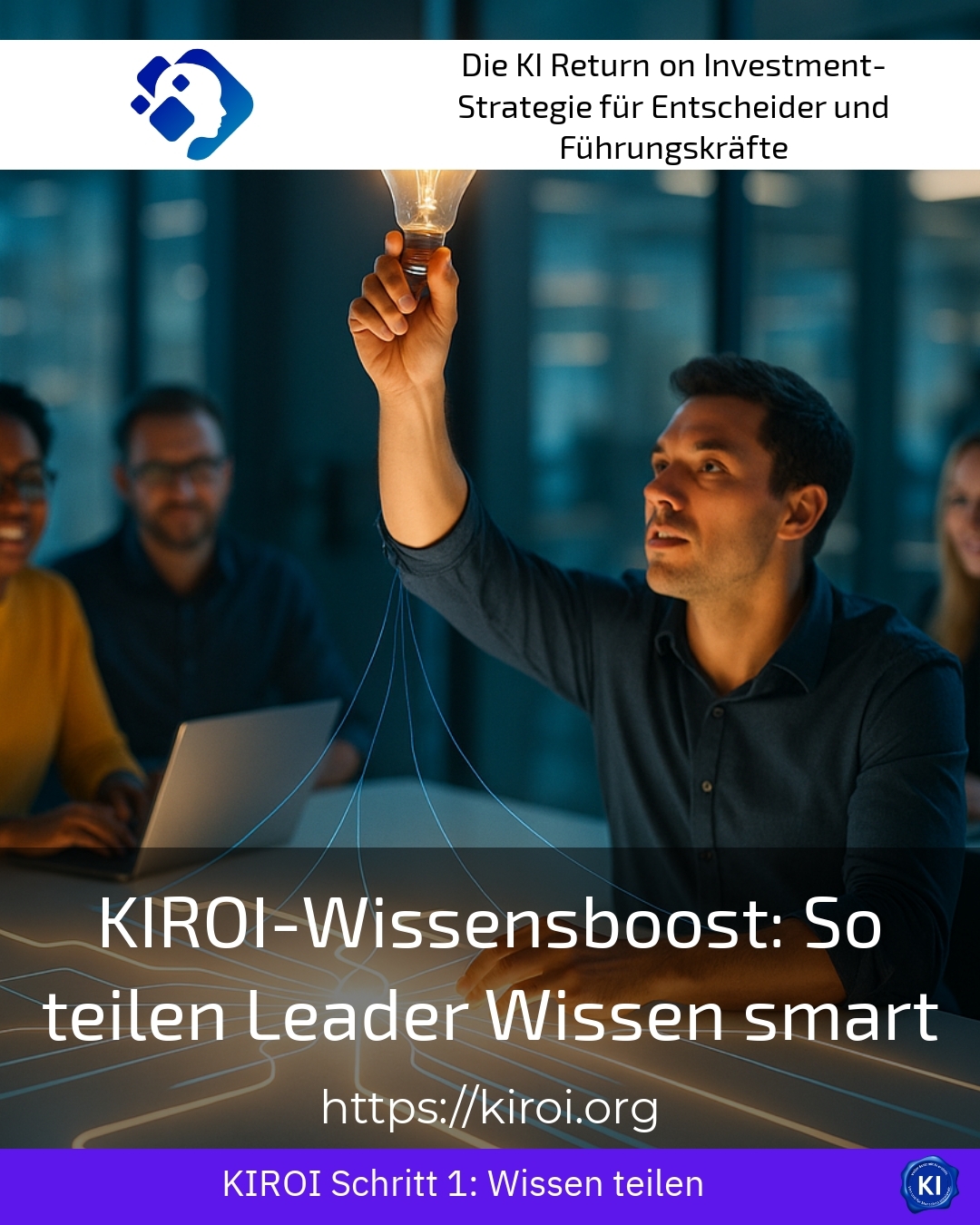
Imagine that the accumulated expert knowledge of your organisation no longer slumbered in individual heads, but flowed systematically while continuously multiplying. This is precisely where the AIROI Knowledge Boost a methodological approach that supports leaders in sharing their knowledge intelligently while simultaneously multiplying the collective intelligence of their teams. In an era when information becomes outdated faster than ever before, the ability to transfer knowledge in a structured way is becoming a crucial competency for sustainable success.
Why traditional knowledge transfer reaches its limits
The traditional methods of knowledge transfer in organisations are increasingly showing weaknesses. Meetings drag on endlessly. Emails disappear in overflowing inboxes. Documentation gathers digital dust in forgotten folder structures. Managers frequently report having to explain the same information over and over again because no lasting retention takes place.
For example, a team leader in a medium-sized company realised that he spent at least two hours a day on repetitive explanations. A head of department in another organisation found that critical project knowledge was lost every time personnel changed. A managing director noticed that her best ideas fizzled out in one-to-one meetings rather than enriching the entire organisation.
These observations highlight a fundamental problem. Knowledge does not flow automatically to where it is needed. It takes intelligent structures and conscious decisions for expertise to actually arrive and have an impact.
The AIROI knowledge boost as a systematic approach for leaders
The methodological framework of AIROI Knowledge Boost offers leaders concrete tools for more effective knowledge transfer. The focus is not on the quantity of information shared, but on its quality and sustainability. In this context, smart means that knowledge is made available at the right time, in the right place and in the right format.
In practice, this approach manifests in various ways. One head of department began recording his insights in short video sequences instead of writing long minutes. A project manager established weekly knowledge bites of a maximum of ten minutes' length for her team. A managing director developed a mentoring system in which experienced employees pass on their implicit knowledge in a structured way to junior staff.
These examples illustrate how varied the concrete implementation can be. However, the guiding principle remains the same: knowledge is actively curated, processed and distributed to suit the target audience, rather than leaving it to chance.
Best practice with a AIROI customer
A medium-sized enterprise with multiple locations faced a unique challenge in the area of internal knowledge transfer. The experienced managers possessed enormous specialist knowledge, which, however, was neither systematically documented nor passed on. As part of a transruptions coaching programme, the company developed a modular knowledge management system that was specifically tailored to the needs of the various departments. The managers learned to prepare their expertise in digestible units and distribute it via various channels. Within six months, a new culture of knowledge sharing was established, supported by all levels of hierarchy. It was particularly noteworthy that younger team members began to pass on their digital know-how to their more experienced colleagues in return. A fruitful exchange emerged that revitalised the entire organisation and noticeably increased its innovative capacity. Staff turnover fell noticeably because employees developed the feeling of being part of a learning community.
Practical tools for the AIROI knowledge boost in everyday leadership
Leaders need concrete tools to share knowledge smartly. Both analogue and digital formats play an important role here. The art lies in the right combination of different methods.
Microlearning modules have proven to be particularly effective. For example, a sales manager sends a three-minute audio snippet to his team every Monday. A head of HR shares an infographic weekly with the key insights from her professional reading. A production manager uses short demonstration videos to clearly explain complex processes [1].
Structured reflection sessions usefully complement these formats. Teams meet regularly to learn together from experience. Both successes and failures are analysed during this process. This practice prevents valuable insights from being lost.
The role of artificial intelligence in knowledge transfer
Modern technologies open up entirely new possibilities for knowledge sharing in organisations. Artificial intelligence can assist in automatically identifying and allocating relevant information. It helps to uncover gaps in knowledge and generate suitable learning recommendations [2].
For example, a head of department uses an AI-powered system that automatically identifies which team members can help with specific questions. A manager uses a tool that summarises meeting content and filters out the key points. A managing director relies on a platform that identifies knowledge silos within the organisation and builds bridges between them.
At the same time, the human element remains indispensable. Technology can facilitate knowledge transfer, but not replace it. The emotional connection between the provider and recipient of knowledge plays a decisive role in the sustainability of learning.
Cultural prerequisites for successful knowledge exchange
The AIROI Knowledge Boost only unfolds its full potential within a corresponding company culture. Leaders must actively model that the sharing of knowledge is valued and rewarded. Psychological safety forms the indispensable foundation for this.
For example, a head of division established the principle of a transparent error culture. Employees are encouraged to report even failed attempts. A head of department introduced so-called "learning gifts," where team members formally present their most valuable insights to colleagues. A managing director launched an internal podcast in which he talks openly about his own learning processes [3].
These cultural measures create the breeding ground in which systematic knowledge transfer can thrive. Without them, even the best tools and methods remain ineffective.
Best practice with a AIROI customer
A service sector company approached transruptions coaching because its existing expert knowledge was not being used effectively. The managers had the impression that every department kept reinventing the wheel, even though solutions already existed elsewhere. As part of the coaching, we jointly developed a concept for internal knowledge islands, which were linked by regular networking meetings. The managers learned methods to make their implicit knowledge explicit and transform it into shareable formats. Particularly successful was the introduction of knowledge tandems, where experts from different areas regularly exchanged ideas and learned from one another. The organisation reported significantly shorter onboarding times for new employees and an increased rate of innovation, as ideas now made their way through the company faster. The managers themselves felt relieved because they were no longer the sole bearers of knowledge, but had become part of a vibrant network.
Measurability and continuous improvement of knowledge transfer
Leaders frequently ask how the success of knowledge management initiatives can be measured. In fact, various indicators exist that can provide insight into their effectiveness.
For example, a team leader measures how quickly new employees become productive. A head of department records how often the same questions are asked and observes a significant decrease. A managing director analyses how frequently cross-departmental collaboration takes place and how this impacts project results.
Regular retrospectives help to continuously improve knowledge transfer. Teams reflect together on which formats work well and where there is a need for adjustment. This creates a learning system that optimises itself.
The AIROI knowledge boost as a leadership skill of the future
The ability to share knowledge smartly is increasingly becoming a core competence for leaders. In a working world characterised by complexity and rapid change, individuals can no longer keep track of all relevant information on their own.
A divisional head realised that his most important task was no longer knowledge itself, but orchestrating flows of knowledge. A leader evolved into a curator, filtering and preparing relevant information. A managing director now sees himself as a bridge-builder between various islands of knowledge within his organisation.
This role development requires new competencies. Leaders must learn to let go and share knowledge instead of hoarding it as a power base. They must create structures that enable and encourage the free flow of information [4].
My AIROI Analysis
The systematic transfer of knowledge represents one of the greatest challenges for modern leaders. The AIROI Knowledge Boost provides a methodical framework for this that takes into account both practical tools and cultural aspects. In my work with various organisations, it time and again becomes apparent that the success of knowledge management initiatives depends decisively on the attitude of the management.
Whoever regards knowledge as a common good and actively creates structures for its distribution will be more successful in the long term than those who rely on information supremacy. Technological capabilities are developing rapidly and constantly opening up new opportunities for effective knowledge transfer. At the same time, the human component remains crucial.
From my experience, I recommend that leaders start with small experiments and systematically expand them. Knowledge sharing cannot be mandated; it must grow organically. Coaching support from transruptions can provide valuable impetus and support the process. Clients frequently report that they have gained completely new perspectives through the structured reflection of their knowledge practices. Investment in systematic knowledge management pays off in the long term because it strengthens the resilience and innovative capability of the entire organisation.
Further links from the text above:
[1] McKinsey: The elusive art of knowledge management
[2] Harvard Business Review: Knowledge Management
[3] Gartner: Knowledge Management Research
[4] Forbes: Knowledge Sharing in the Workplace
For more information and if you have any questions, please contact Contact us or read more blog posts on the topic Artificial intelligence here.











 Deutsch
 English (UK)