
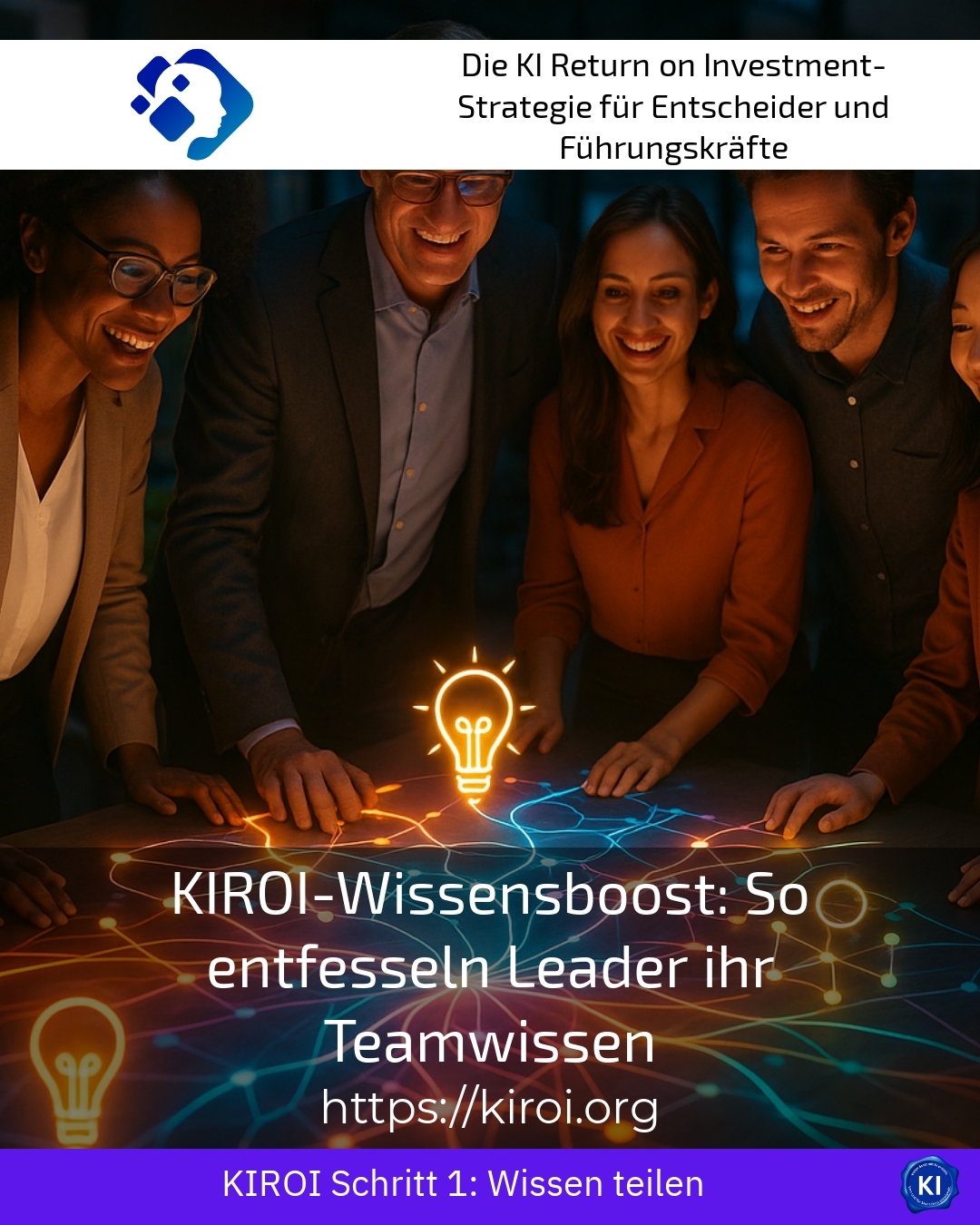
Imagine being able to activate all of your team's knowledge at the press of a button and make it usable for strategic decisions. This is precisely where the KIROI Knowledge Boost because he transforms hidden expertise into tangible competitive advantages. Today, leaders face the challenge of systematically tapping into collective intelligence. The following strategies will show you how, as a leader, you can unlock the full potential of your team.
Why traditional knowledge management is reaching its limits
In many organisations, valuable expert knowledge lies dormant in the minds of individual employees. This knowledge often remains unused because effective methods for sharing it are lacking. Traditional documentation captures only a fraction of actual competence. Knowledge gained through experience often evades written fixation. This is where transformation through intelligent approaches begins.
For example, a medium-sized company in the manufacturing industry struggled with knowledge transfer between experienced specialists and new team members. The onboarding period averaged eight months. Consulting firms face similar challenges with project knowledge. Valuable experience is also lost in the healthcare sector during staff changes. These examples highlight the urgent need for action.
The KIROI Knowledge Boost as a Catalyst for Team Excellence
The KIROI Knowledge Boost provides a structured framework for knowledge activation. It combines technological possibilities with human expertise. The focus is on practical applicability. Leaders learn to identify and overcome knowledge barriers. The methodology adapts flexibly to different organisational sizes.
In the banking sector, an executive applied the principles to make compliance knowledge available across teams. A logistics company used the approach for optimising process knowledge. Positive effects were also seen in software development for code documentation. These diverse fields of application underscore its universal usability.
Best practice with a KIROI customer
An international engineering group faced the challenge of systematising the specialist knowledge of its service technicians and making it accessible to all branches. The initial situation was characterised by isolated pockets of knowledge and long response times for complex fault scenarios. As part of the transruptions coaching, we supported the leadership team in developing a structured knowledge strategy. First, we jointly identified the critical knowledge carriers and their unique experiential knowledge. We then developed a format for regular exchanges between locations. The managers learned to moderate knowledge dialogues and document findings. Within six months, the average problem-solving time was reduced by forty percent. Employee satisfaction increased measurably because frustration due to a lack of information decreased. Particularly noteworthy was the emergence of a new knowledge culture with voluntary knowledge sharing. The project now serves as a blueprint for further transformation initiatives within the group.
Practical tools for the KIROI knowledge boost in everyday leadership
Effective leaders use various tools for knowledge activation [1]. Structured reflection sessions after projects are among the most effective methods. They allow for the capture of lessons learned in real time. Peer case consultations also contribute to knowledge networking. These formats can be easily integrated into existing meeting structures.
A pharmaceutical company introduced weekly knowledge sprints where teams shared their findings. An advertising agency established creative knowledge formats such as storytelling sessions. In the public sector, structured handover protocols proved useful during job changes. These examples demonstrate the variety of possible implementations.
The role of the leader as a knowledge architect
Leaders significantly shape the knowledge culture through their behaviour. They create spaces for exchange and acknowledge knowledge sharing. The role model function means actively sharing one's own knowledge. At the same time, it is important to promote psychological safety within the team [2]. Only then does a willingness for open communication arise.
In retail, a leader motivated their team by introducing knowledge bonuses. An architectural firm created a physical knowledge-sharing space for spontaneous exchange. Digital formats, such as internal podcasts, also proved effective for distributed teams. These measures support establishing a learning organisation.
Overcoming obstacles with the KIROI knowledge boost
Clients often report resistance to knowledge sharing. Some employees fear becoming replaceable through the dissemination of knowledge. Others experience a lack of time as the main obstacle to exchanging information. KIROI Knowledge Boost systematically addresses these barriers. It provides impetus for overcoming fear of knowledge.
An insurance company solved the problem with transparent career prospects for knowledge carriers. In crafts, a combination of time budgets and recognition helped. An IT service provider developed gamified elements for knowledge sharing. These approaches show ways to overcome knowledge hoarding.
Best practice with a KIROI customer
An energy provider approached us with an urgent knowledge gap in their technical department. Several experienced engineers were nearing retirement, and critical plant knowledge was at risk of being lost. Management felt overwhelmed and sought a structured approach. As part of the transruption coaching, we first developed a knowledge map of the entire department. This visualised the distribution of expertise for the first time and identified critical knowledge monopolies. Subsequently, we supported the establishment of tandem structures between experienced and junior employees. The tandems were given dedicated time for knowledge transfer and joint problem-solving. Training for management in moderating knowledge transfer was particularly important. They learned to ask the right questions and make implicit knowledge explicit. After one year, the teams reported significantly increased confidence in taking action, even without the departed colleagues. Management developed a new awareness of their role as knowledge architects.
Technology as an enabler for knowledge networking
Modern digital tools significantly support knowledge activation [3]. They enable asynchronous exchange across locations and time zones. At the same time, they do not replace personal dialogue. The right balance between digital and analogue is crucial. Leaders choose suitable tools for their specific requirements.
An automotive supplier used video recordings for the documentation of complex manual tasks. A law firm relied on collaborative knowledge databases for precedents. In the education sector, community platforms proved effective for sharing experiences. These technical solutions sensibly complement the human component.
Measurability and continuous improvement
Successful knowledge strategies are based on measurable objectives and regular review. Key figures such as onboarding times or error rates provide orientation. Qualitative indicators like employee satisfaction are also relevant. The KIROI Knowledge Boost integrates evaluation as a fixed component. This creates a cycle of continuous optimisation.
A chemical company tracked the reduction of repeat errors as a success indicator. In tourism, customer satisfaction was used as a proxy for knowledge quality. The speed of innovation cycles can also provide insights. These metrics help in managing knowledge initiatives.
My KIROI Analysis
The systematic activation of team knowledge is evolving into a crucial competitive factor for organisations of all sizes and sectors. My experience from numerous support projects shows that success largely depends on the attitude and commitment of leaders. Technical solutions alone rarely lead to lasting changes in knowledge culture. Instead, a combination of clear strategic alignment, suitable methods, and above all, an atmosphere of psychological safety is needed.
I find the development particularly noteworthy in organisations that establish knowledge sharing as a natural part of their working culture. These teams demonstrate higher resilience to staff turnover and react more quickly to market changes. KIROI Knowledge Boost offers a proven framework that can be adapted to individual contexts. Investing in knowledge strategies pays off in the long term through increased efficiency and innovation. I recommend that all leaders start with small experiments and observe the impact. Positive feedback from the team will quickly spur further initiatives. Ultimately, sharing knowledge is a deeply human ability that just needs the right framework.
Further links from the text above:
[1] Harvard Business Review – Knowledge Management
[2] McKinsey – Insights on People and Organisational Performance
[3] Gartner - Definition of Knowledge Management
For more information and if you have any questions, please contact Contact us or read more blog posts on the topic Artificial intelligence here.











 Deutsch
  English (UK)