
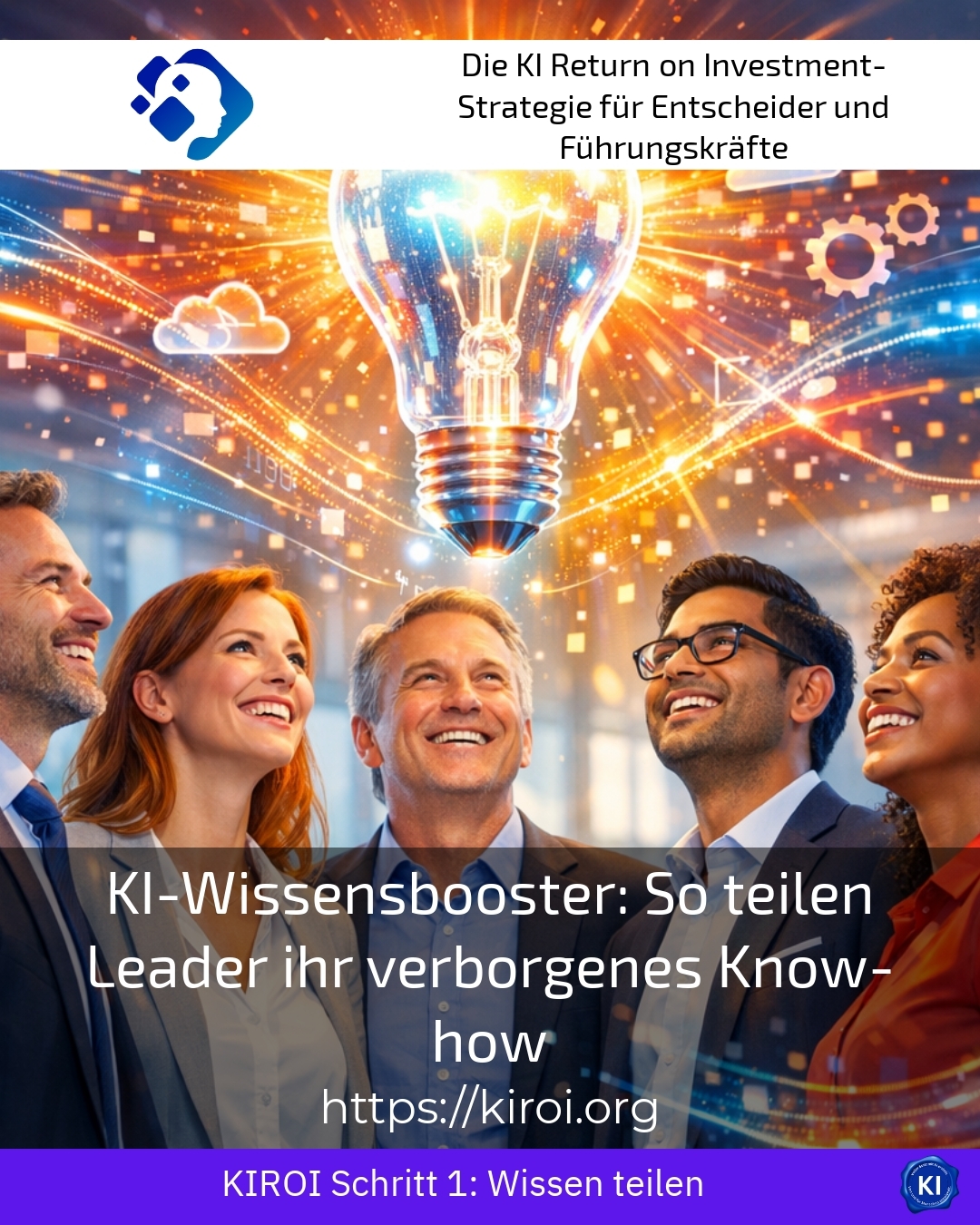
Have you ever wondered why some leaders seem to effortlessly spread their knowledge throughout the entire company, while others, despite years of expertise, remain isolated knowledge islands?
This question concerns organizations worldwide, and the answer is often hidden in a fascinating phenomenon. The so-called AI Knowledge Booster Currently, the way experienced leaders share their tacit knowledge with teams is revolutionizing. This is not just about documentation; it is about intelligently extracting and sharing knowledge. In many industries, leaders are reporting amazing results. They are using modern technologies to make hidden insights visible. transruptions coaching accompanies companies precisely during such transformation projects and supports them in building sustainable knowledge structures.
The hidden potential of implicit leadership knowledge
Executives accumulate countless experiences, insights, and patterns of intuition over the years that are difficult to capture in manuals. This implicit knowledge arises from thousands of decisions, crises, and successes. It manifests itself in gut feelings during negotiations, in the ability to read team dynamics, and in intuition about the right time to act. Clients often report that they cannot articulate this very knowledge. They know that they know something, but they cannot put it into words.
In the technology sector, this phenomenon is particularly evident among experienced project managers. One example: Senior developers instinctively recognize which code structures will cause problems later on. They can almost sense when a sprint is in trouble. Product managers often already recognize in early stages which features will delight users. Agile coaches identify team conflicts before they erupt openly. Such knowledge of experience is invaluable to organizations. At the same time, it often disappears without a trace when executives leave the company.
The AI Knowledge Booster It starts right here and creates new opportunities. Intelligent systems analyze decision patterns and make hidden expertise visible. They identify recurring success patterns in the communication of executives. Furthermore, they extract core principles from years of experience. These insights are then prepared for junior employees.
Best practice with a AIROI customer
A medium-sized software company faced a formidable challenge because several experienced team leaders were retiring at the same time. The management feared a massive loss of knowledge that could threaten product development. As part of a transruptive coaching project, a systematic approach was developed to capture the tacit knowledge of these leaders. First, we conducted structured in-depth interviews that focused specifically on decision-making situations. The leaders described concrete scenarios from their daily work and explained their thought processes. Subsequently, these insights were translated using intelligent analysis tools into decision trees and action recommendations. The younger team leaders were given access to an interactive knowledge system that provided them with guidance in difficult situations. After six months, the successors reported significantly more confidence in complex decision-making situations. The company was able to maintain its quality standard despite the lack of experienced personnel.
How the AI Knowledge Booster Democratizes Leadership Experience
The democratization of leadership knowledge initially sounds like an abstract concept. In practice, however, it means very concrete changes in everyday work. Junior developers can suddenly benefit from decades of architectural experience. Young leadership recruits gain access to proven conflict resolution strategies. New team members understand more quickly why certain processes exist.
In the field of software development, this change manifests itself particularly impressively. Code reviews are enriched by context-specific empirical data. Stand-up meetings benefit from systematically prepared best practices. Retrospectives draw on successful improvement strategies from the past. Sprint planning takes into account historical experience when estimating effort requirements. All of these applications are based on the systematic transfer of management knowledge.
The goal is not to replace or automate human leadership. Rather, modern approaches create a bridge between generations of leaders. They enable continuity despite personnel changes. They support emerging talent in making difficult decisions. They preserve organizational knowledge for future challenges.
Practical application areas for the AI knowledge booster in companies
The concrete applications are diverse and relevant across industries. In technical fields, intelligent systems support the documentation of architectural decisions. They capture the reasons behind certain design decisions. They connect technical knowledge with business contexts. They make it understandable why certain solutions were chosen.
Project management also shows remarkable applications. Risk assessments benefit from systematically captured experience data. Stakeholder communication is supported by proven strategies. Escalation processes are based on successful historical practices. Resource planning takes into account implicit knowledge about team capabilities.
In particular in the area of software quality assurance, knowledge transfer has a major impact. Test strategies are optimized through years of experience with typical error sources. Performance optimizations draw on proven patterns. Security reviews benefit from systematically documented vulnerabilities. Release processes are refined through historical insights.
Best practice with a AIROI customer
An international technology company struggled with a recurring problem when onboarding new developers. Despite extensive documentation, it took an average of eight months for new team members to start working productively. The experienced developers complained about constant interruptions caused by the newcomers’ questions. As part of the transruptions coaching process, we developed a multi-step approach to knowledge extraction. First, we systematically identified the most common questions and stumbling blocks in onboarding. Then we analyzed which implicit assumptions experienced developers made in their work. These hidden assumptions were explicitly documented and integrated into an interactive onboarding system. New team members received contextual guidance when they worked on specific code areas. The average onboarding time decreased to four months, and the experienced developers reported significantly fewer interruptions. The team was able to increase its overall productivity while improving the satisfaction of new employees.
Challenges in implementing knowledge transfer systems
The introduction of systematic knowledge transfer solutions brings specific challenges. Leaders must first be willing to share their knowledge. This readiness is by no means self-evident. Sometimes experienced professionals fear being replaced. Others shy away from the effort of documenting their knowledge. Others again doubt the possibility of even verbally expressing their implicit knowledge.
In the technical environment, we often encounter the phenomenon of „expert knowledge without words.“ Senior architects make decisions in fractions of a second for which they have no rational explanation. Experienced DevOps engineers instinctively sense when systems become unstable. Long-time product owners anticipate which features will appeal to users. Systematizing this intuitive knowledge requires specialized methods and a lot of patience.
Technical hurdles also play an important role in implementation. Existing documentation systems must be integrated. Data protection requirements require careful consideration. The quality of the extracted insights must be continuously reviewed. User friendliness determines the actual acceptance of the systems.
Cultural prerequisites for successful knowledge transfer
The success of knowledge transfer initiatives depends largely on the corporate culture. Organizations need an open learning culture that values knowledge sharing. They need psychological safety so that leaders can share mistakes and failures. They require recognition for their contribution to the collective knowledge base.
In agile software development environments, there are often already favorable foundations in place. Pair programming creates natural opportunities for knowledge transfer. Retrospectives encourage reflection on experiences. Communities of Practice bring together experts from different teams. Mentoring programs systematically connect experienced and new employees.
Nevertheless, these established practices often fall short. They capture only a fraction of the available knowledge. They do not reach all employees equally. They depend on the availability of individual individuals. They do not scale with growing organizational size.
Best practice with a AIROI customer
A rapidly growing start-up in the field of enterprise software faced a classic scaling problem. The founders and early employees possessed deep domain knowledge that could not be quickly transferred to new team members. With a doubling of the workforce within a year, this critical knowledge could be diluted. The transruptive coaching accompanied the company in developing a systematic knowledge strategy. First, we conducted a knowledge map that identified critical competence areas. Then we developed specific capture methods for each area that suited the respective knowledge type. For technical architecture knowledge, we relied on structured decision protocols with justifications. For customer understanding, we used narrative case studies with contextual details. For process knowledge, we implemented interactive checklists with embedded explanations. The result was a vibrant knowledge base that is continuously growing and being maintained. New employees report a significantly shorter time to full productivity, and the founders feel relieved from constant requests for explanations.
The role of leaders in modern knowledge transfer
Leaders must actively shape and redefine their role in knowledge transfer. They become curators of organizational knowledge. They must plan time for reflection and documentation. They should actively seek opportunities to share their knowledge. They can serve as role models for an open knowledge culture.
In the software development field, this means concrete behavioral changes. Tech leads should systematically document and justify their architectural decisions. Engineering managers can pass on their conflict resolution strategies in coaching sessions. Principal engineers should schedule time for mentoring and knowledge transfer. Agile coaches can demonstrate their facilitation techniques in observable sessions.
At the same time, the AI Knowledge Booster a relief from repetitive explanation tasks. Managers no longer have to explain the same basics over and over again. They can focus on more complex coaching situations. They regain time for strategic tasks. They experience greater satisfaction through more challenging mentoring relationships.
My AIROI Analysis
The systematic collection and dissemination of leadership knowledge is at a turning point that can fundamentally change organizations. Based on my experience in guiding numerous transformation projects, I see three key developments that companies should consider.
First, the ability to extract knowledge will become a strategic core competency. Organizations that can systematically capture and share the tacit knowledge of their experienced leaders will enjoy a significant competitive advantage. They can scale faster, cope better with turnover, and develop talent more effectively. This ability cannot be built overnight; it requires long-term investments in culture, processes, and technology.
Second, the role of experienced leaders is fundamentally changing. They are increasingly becoming knowledge multipliers whose value is measured not only by their direct performance but also by their contribution to the collective knowledge base. This development requires new incentive systems and career paths that explicitly recognize and reward knowledge transfer.
Thirdly, I observe that successful knowledge transfer initiatives always require a human-centered approach. Technology alone cannot solve the problem. It requires experienced coaches who support executives in reflecting on and articulating their knowledge. It requires cultural interventions that promote trust and openness. It requires organizational frameworks that create time and space for knowledge transfer. transruptions coaching can accompany and support companies in all these aspects.
The future belongs to organizations that succeed in unlocking the hidden knowledge of their leaders and making it accessible to everyone. This process is challenging, but the results far justify the effort.
Further links from the text above:
[1] AIROI-Methodology for knowledge management
[2] Transruptions coaching for transformation projects
For more information and if you have any questions, please contact Contact us or read more blog posts on the topic Artificial intelligence here.









 Deutsch
 English (UK)