
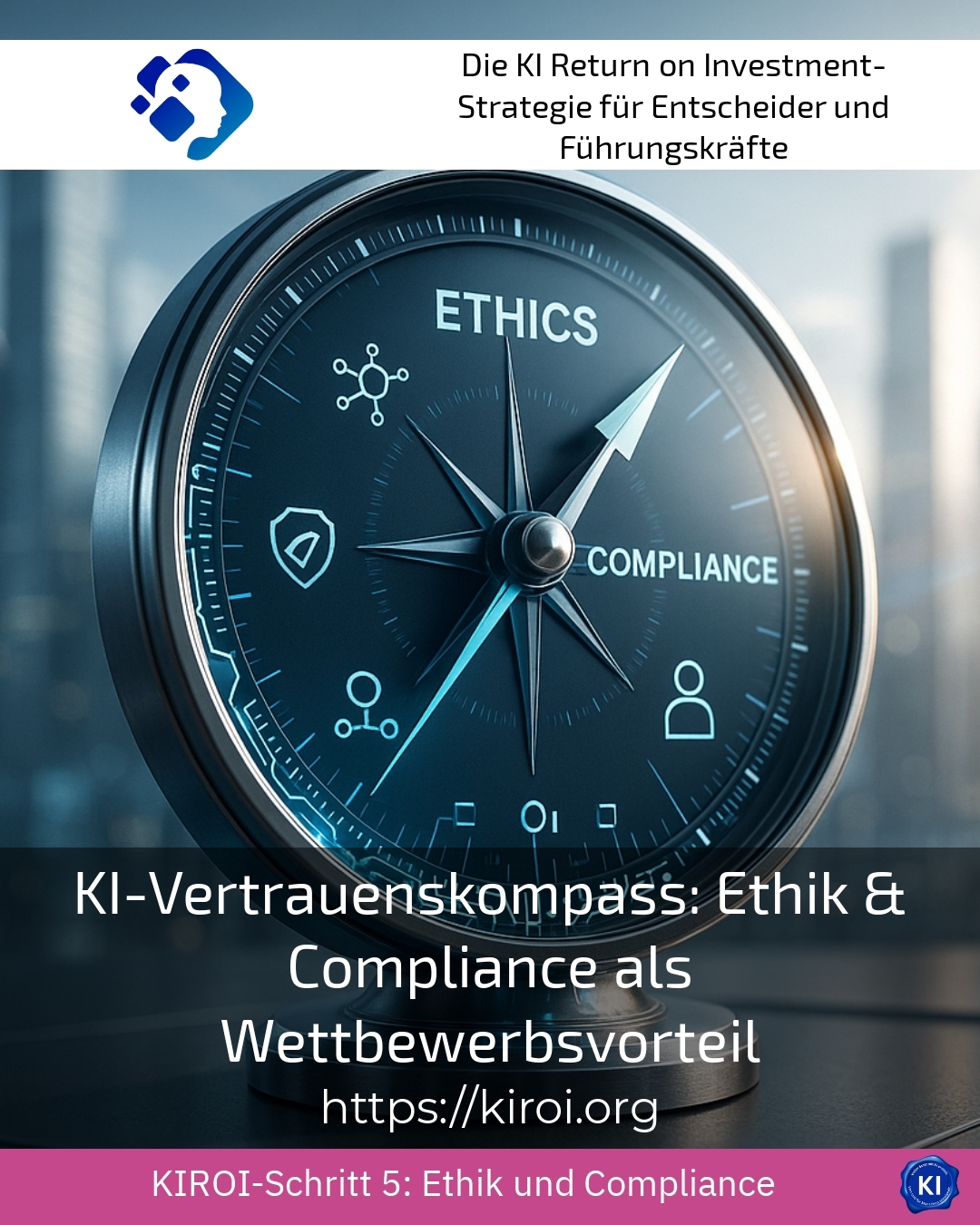
Imagine your company has an invisible compass that guides every step of its digital transformation, building trust with customers, employees, and business partners along the way. This is precisely the function performed by the AI Trust Compass: Ethics & Compliance as a Competitive Advantage In a time when algorithmic decisions are increasingly being critically scrutinised. The demand for transparent and comprehensible automated processes is growing rapidly. Companies that actively shape this change are positioning themselves sustainably in the market. This is no longer just about technical implementation. Rather, the question arises as to how organisations can take responsibility. Ethical guardrails and regulatory requirements are merging into a strategic instrument. Clients often report uncertainties in the implementation of such projects. Transruption Coaching supports precisely these demanding transformation projects with practical impulses and structured support.
Why ethical principles are becoming the decisive differentiating factor
The digital landscape is changing at breathtaking speed. Algorithms are making decisions about credit applications, personnel selection and customer service. This development brings enormous opportunities with it. At the same time, concerns about fairness and explainability are growing. Consumers today expect more than technical perfection; they demand transparency and ethical conduct from the companies whose services they use. A financial services provider that clearly explains how automated credit decisions are made gains trust. An insurance company that discloses its risk assessment models strengthens customer loyalty in the long term. Likewise, an e-commerce provider that makes its recommendation algorithms transparent benefits from increased customer loyalty.
The AI Trust Compass: Ethics & Compliance as a Competitive Advantage acts as a strategic navigation tool. It helps organisations find the balance between innovation and responsibility. Companies that invest early in ethical frameworks create robust foundations for long-term success. For example, a major telecommunications provider has completely switched its customer service automation to transparency principles. A logistics group implemented traceable route optimisations that convince drivers and customers alike. Furthermore, a pharmaceutical company developed ethical guidelines for its research algorithms, which are now considered an industry standard.
Understanding regulatory requirements as a driver of innovation
Many executives initially view compliance as a necessary evil. However, this perspective is significantly short-sighted. Regulatory requirements can act as a catalyst for innovation. The European legal framework for automated decision-making systems is setting global standards. Companies that proactively implement these requirements gain a competitive advantage over international rivals. An automotive supplier used compliance requirements as an opportunity to rethink its entire product development. A medical technology company developed new quality standards for its diagnostic systems through regulatory requirements. An energy provider also transformed its network control, taking ethical principles into account, and achieved significant efficiency gains in the process.
Best practice with a KIROI customer
A medium-sized company in the manufacturing sector faced the challenge of making its automated quality control systems transparent and comprehensible. While the existing algorithms delivered precise results, the decision-making processes remained largely opaque to employees and customers. As part of an intensive support process, the project team first developed a comprehensive catalogue of criteria for ethical algorithm design. This catalogue included aspects such as comprehensibility, fairness, and human control options. Subsequently, the company implemented a dashboard that visualises the decision pathways of the systems and presents them for different stakeholder groups. Employee training formed another central component of the project. Today, production employees can understand the automated decisions and correct them if necessary. Customer satisfaction increased measurably, and the company won several tenders due to its transparent quality assurance. The entire transformation process spanned eighteen months and was supported by continuous coaching.
The AI Trust Compass: Ethics & Compliance as a Competitive Advantage in Practice
The theoretical foundations of ethical algorithm design are now well-documented. The real challenge lies in practical implementation. How can companies proceed concretely to build trust systematically? The first step involves an honest assessment of existing automated processes. For instance, a retail company analysed its pricing algorithms and identified unintentional discrimination patterns. A bank reviewed its credit scoring models and discovered that certain demographic groups were systematically disadvantaged. A recruitment agency realised through this analysis that its pre-selection systems were reproducing unconscious biases.
Following the analysis, concrete action strategies are developed. These strategies must consider both technical and organisational dimensions. A software company established an interdisciplinary ethics committee that evaluates all new developments. An insurance group introduced regular audits of its automated decision-making systems. Likewise, a retailer implemented a complaint management system specifically for algorithmically generated decisions. These measures require investment but pay off in the long term.
Employees as the key to trustworthy transformation
Technology alone does not build trust. People make the difference. Therefore, the involvement of employees in ethical transformation processes is indispensable. A manufacturing company trained its entire workforce in the fundamentals of algorithmic decision-making. A logistics company established feedback loops between drivers and development teams. A healthcare provider also actively involved medical professionals in the further development of its diagnostic systems. These approaches not only strengthen the quality of the systems but also the commitment of the employees.
Transruptions-Coaching supports companies in structuring these complex change processes. The guidance encompasses both strategic and operational dimensions. Clients often approach with questions about the concrete implementation of ethical guidelines. Others seek support in communicating changes to stakeholders. Yet others require impetus for developing suitable governance structures. The diversity of topics reflects the complexity of the challenges.
Best practice with a KIROI customer
A recruitment services company wished to fundamentally realign its automated pre-selection systems while implementing the highest ethical standards. Management had recognised that trust in algorithmic decisions is a key competitive factor and acted proactively accordingly. The project team began with a comprehensive stakeholder analysis to understand and incorporate the expectations of applicants, client companies, and its own employees into the planning. On this basis, the team developed a multi-stage transparency concept that considers and addresses different information needs. Applicants henceforth received understandable explanations of the criteria influencing their assessment and could comprehend why certain decisions were made. Client companies gained insight into the methodological foundations of pre-selection and could formulate specific requirements that were incorporated into the algorithms. The company's own recruiters received intensive training and can now critically handle system recommendations and, if necessary, question them based on sound reasoning. The company documented the entire process and now shares its experiences within industry associations to contribute to the development of standards and inspire other organisations.
Communication as a bridge of trust between algorithms and humans
Even ethically impeccable systems fail if they are not communicated appropriately. The way companies talk about their automated processes significantly shapes trust. A financial services provider developed a multilingual information platform about its algorithms. A technology group regularly publishes reports on the further development of its ethical standards. In addition, a mobility provider established direct dialogue with users about the functioning of its matching algorithms.
These communication strategies follow the principle of appropriate transparency. Not every technical detail needs to be disclosed. The crucial point is that stakeholders can understand the essential principles and control mechanisms. For example, one retailer explained to its customers in simple terms how personalised recommendations are generated and what influence they have. An energy supplier visualised the functioning of its smart grids in an understandable and appealing way for different target groups. A healthcare company developed an interactive explainer video on its diagnostic support systems, which clearly illustrates complex interrelationships.
The AI Trust Compass: Ethics & Compliance as a Competitive Advantage for Sustainable Growth
Long-term business success is increasingly based on trust. Companies that integrate ethical principles into their business models build resilient customer relationships. An insurance company saw a significant increase in customer loyalty after introducing transparent claims processing algorithms. A retail company gained new business partners through its exemplary ethical standards in automated pricing. An industrial company also opened up new markets because its ethically grounded quality assurance systems gained international recognition and served as a benchmark.
Building trust requires continuous commitment and ongoing development. Ethical standards are not static guidelines, but evolve with societal expectations. A pharmaceutical company regularly reviews its research algorithms against current scientific findings and adapts them accordingly. A financial services provider continuously adjusts its fairness criteria to new insights and communicates these changes transparently. Likewise, a technology group updates its ethical guidelines through dialogue with external experts and the interested public.
My KIROI Analysis
The systematic examination of ethical principles and regulatory requirements is becoming a crucial success factor for organisations of all sizes and industries. My analysis of numerous transformation projects shows that companies with a clear ethical positioning achieve and maintain significant competitive advantages in the long term. The key here lies not in perfect systems, but in the willingness for continuous improvement and open dialogue with all stakeholders. Organisations that understand ethics as a strategic tool unlock new opportunities for differentiation and create sustainable competitive advantages that are difficult to replicate. Technological development will continue to advance and bring new challenges that are not yet foreseeable today. Ethical principles offer a stable framework for orientation that enables flexibility and innovation, while at the same time setting boundaries. Investing in transparent and understandable automated processes pays off measurably, as numerous practical examples impressively demonstrate [1]. Transruption Coaching supports companies in systematically overcoming these complex challenges and developing individual solutions. The combination of strategic orientation and practical implementation support enables sustainable transformation success that goes beyond short-term optimisation. Companies that invest in ethical foundations today create the prerequisites for long-term success in an increasingly networked and algorithmically shaped economic world, where trust becomes a scarce resource.
Further links from the text above:
[1] European Commission – European approach to artificial intelligence
For more information and if you have any questions, please contact Contact us or read more blog posts on the topic Artificial intelligence here.









 Deutsch
  English (UK)