
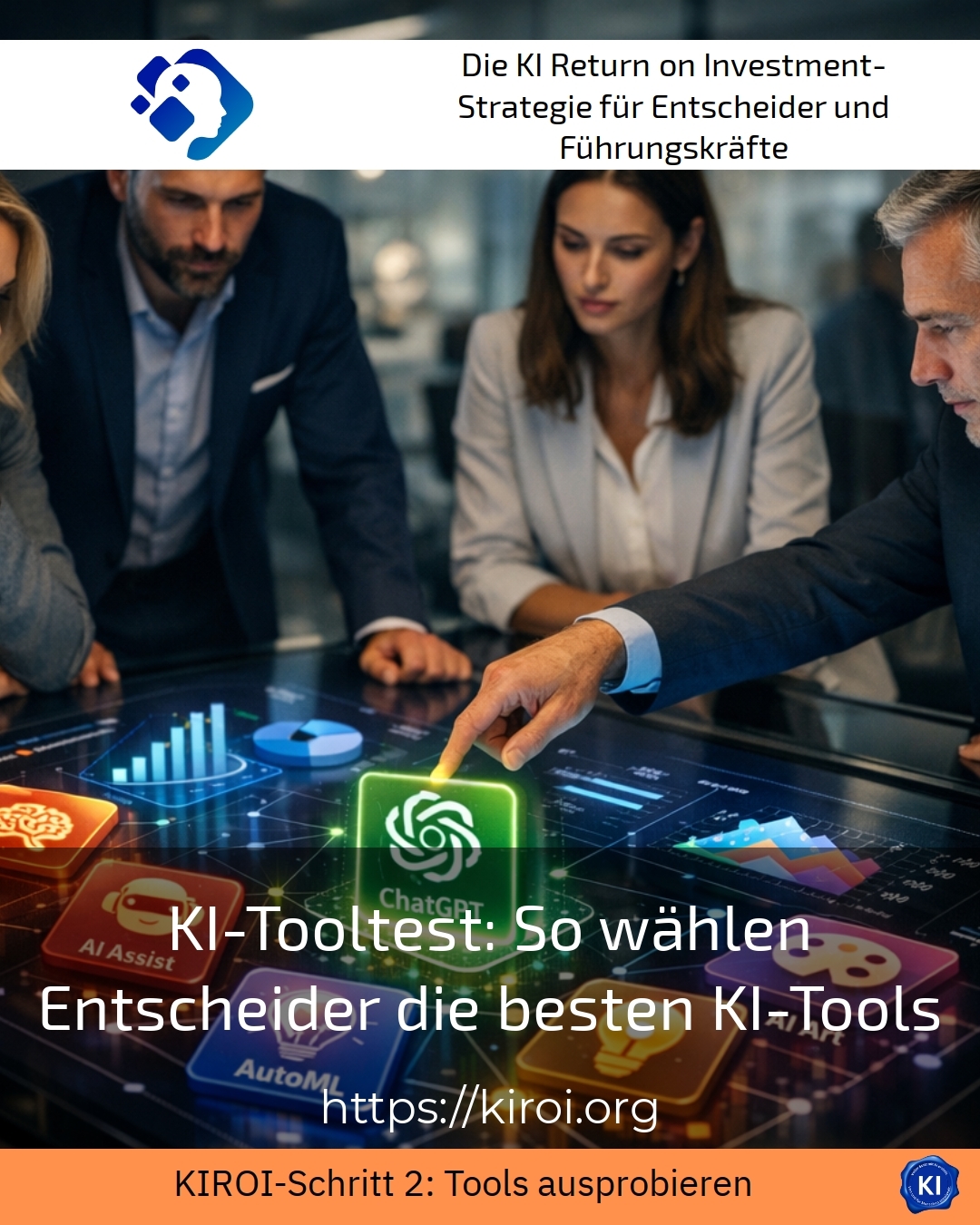
Have you ever wondered why some organizations achieve impressive success with intelligent solutions while others fail despite significant investments? The answer often lies not in the technology itself, but in the way leaders make their decisions. A systematic AI Tool Test This forms the indispensable foundation for sustainable implementations. Many decision-makers report that they feel overwhelmed by the sheer variety of available applications and therefore tend to make hasty, ill-considered decisions. This is where a well-thought-out evaluation strategy comes into play; it goes far beyond superficial functional comparisons and instead takes individual requirements, cultural aspects, and long-term development potential into account.
Why a structured AI tool test is indispensable
The landscape of intelligent applications continues to evolve at breathtaking speed. Executives face the challenge of identifying precisely those among the thousands of available solutions that can create real value for their specific situation. A methodically-based approach is essential to this task. AI Tool Test It helps to avoid costly misjudgments while simultaneously uncovering hidden potential. Clients often report that they only realized what requirements they actually need to meet in a solution through systematic evaluation. This clarity does not come naturally; it requires a conscious engagement with one’s own processes, goals, and resources.
Especially in complex organizational structures, the value of a careful approach becomes evident. For example, a financial service provider must set entirely different criteria than a manufacturing company or an educational institution. Data protection requirements vary just as much as the integration possibilities within existing system landscapes. Furthermore, cultural factors play a crucial role, because the best technology is of little use if it is not accepted by the employees. transruptions-Coaching supports organizations precisely in these multifaceted projects and provides impulses for a holistic approach.
Best practice with a AIROI customer
A medium-sized logistics company with over three hundred employees faced the challenge of optimizing its route planning. The management had already contacted three different providers and was confused by the different promises they made. As part of the AIROI onboarding process, we first developed a detailed requirements catalog that took into account both technical aspects and organizational requirements. Through structured test scenarios using real company data, we were able to objectively compare the actual performance of the different solutions. The result surprised all involved, as it wasn’t the most expensive provider that delivered the best results; rather, it was a mid-priced solution that was particularly easy to integrate into the existing IT infrastructure. The implemented solution now helps the company shorten delivery times while reducing fuel costs. What was particularly valuable was the realization that a thorough evaluation process ultimately saves time and resources rather than tying up those resources.
Key criteria for the AI tool test for decision-makers
The selection of suitable evaluation criteria is crucial to the success of the entire selection process. It is no longer just about technical specifications or pricing models; it involves a comprehensive understanding of what a solution should and can do for the organization. Experienced decision-makers consider at least six different dimensions, each requiring its own evaluation criteria and together providing a complete picture.
Define functional requirements precisely
The first step is to formulate one’s own requirements as precisely as possible. It helps to distinguish between functions that are absolutely necessary and additional services that are desirable. For example, a retail company needs different functions for inventory optimization than for customer analysis [1]. At the same time, future developments must be taken into account, because a solution should be able to keep up with the growing demands. Creating a weighted criteria catalog helps to objectively evaluate subjective impressions and compare different alternatives.
The analysis of specific application scenarios from practice is particularly insightful. A hospital that wants to optimize administrative processes faces completely different challenges than a marketing agency focused on content creation. A automotive supplier, in turn, has specific requirements for quality control and process management. This diversity illustrates why standardized rankings and general recommendations are only conditionally helpful [2]. Instead, an individual approach that honors the specific context is needed.
Evaluate integration and scalability
The best solution is useless if it does not fit into the existing system landscape. Interfaces to existing ERP systems, databases, and communication platforms must be carefully examined. Technical standards as well as practical aspects such as implementation effort and training requirements play an important role in this. A pharmaceutical company recently reported that the integration of a new solution took three times longer than originally planned because interface problems were underestimated.
Scalability often only becomes an issue when it is already too late. What works smoothly with ten users can look completely different with one hundred or a thousand users. The same applies to data volumes and processing speeds. An insurance company found that its chosen solution became significantly slower in processing large volumes of documents. An energy provider had to switch after only six months because the original solution could not keep up with the rapid growth in requirements. These experiences underscore the importance of proactive planning.
Compliance and data protection are taken into account
Regulatory requirements vary significantly depending on the industry and region. A bank is subject to different regulations than a craft business. Especially strict requirements apply in healthcare, where patient data enjoy special protection [3]. The AI Tool Test These aspects must be taken into account from the very beginning to avoid any surprises later on. This also includes the question of where data is processed and stored, as well as what access rights different user groups have.
The GDPR sets binding minimum standards across Europe. However, many organizations go beyond these requirements voluntarily. For example, a telecommunications provider developed its own internal guidelines for the use of intelligent systems. A university placed particular emphasis on transparency and explainable decision-making processes. A media company, in turn, focused on the comprehensibility of content recommendations. These different focuses show that compliance goes far beyond merely fulfilling legal minimum requirements.
Best practice with a AIROI customer
An international business advisory firm wanted to equip its internal knowledge database with intelligent search functions. The challenge was to protect sensitive client information while simultaneously providing advisors with quick access to relevant knowledge. As part of the AIROI implementation process, we developed a multi-stage authorization concept that defined different access levels while taking into account both data protection requirements and practical needs. We tested four different solution providers under realistic conditions and evaluated not only their technical capabilities but also their data protection concepts and server locations. The solution ultimately chosen now allows advisors to find relevant documents in seconds without compromising confidential information. What was particularly valuable was the realization that, upon closer examination, seemingly more affordable providers carried significant compliance risks that would have far outweighed the initial price advantage.
Practical implementation of a systematic tool testing process
A structured evaluation process follows proven phases that build upon each other and lead to informed decisions together. It is important to involve the right stakeholders from the outset and to define clear responsibilities. Organizations often report that only by involving different perspectives has a complete picture been achieved. The IT department views other aspects differently than the functional department, and management, in turn, has strategic perspectives in mind.
Phase One: Requirements analysis and market research
The process begins with a thorough analysis of one’s own needs and constraints. Workshops with various stakeholders help bring together different perspectives. One construction company used this phase to determine that the actual requirements of the project manager differed significantly from the assumptions of the management. A tax advisory firm recognized that, in addition to the actual functionality, user friendliness would be crucial. A travel agency, in turn, identified usability as the most important criterion.
The subsequent market research is intended to provide a comprehensive overview of available solutions. Specialized comparison portals as well as industry associations and specialist publications [4] help with this. It is important not only to consider the well-known major providers, but also to take into account specialized niche solutions. Often, these offer better results for specific use cases than general-purpose platforms.
Phase Two: Shortlist creation and testing phase
Market research results in a manageable list of promising candidates. Three to five solutions are usually sufficient for a thorough evaluation. These are then tested under realistic conditions, using real company data and typical application scenarios. A mechanical engineering company tested various predictive maintenance solutions with historical sensor data from its own production. A hotel chain used booking data from previous seasons to compare predictive capabilities. A publisher evaluated content analyses based on its own publications.
The testing phase should be long enough to identify even less obvious strengths and weaknesses. Experienced decision-makers recommend at least four to six weeks. During this time, as many of the employees who will actually be affected later on should be included as possible. Their feedback is often more insightful than any technical specification.
Phase Three: Evaluation and Decision-Making
The collected findings are systematically evaluated and converted into a comprehensive assessment. Combining quantitative measurements with qualitative assessments helps here. A weighted evaluation matrix makes various aspects comparable and supports decision-making. A food manufacturer developed a scoring system that took into account both technical and economic and organizational criteria. A law firm placed particular emphasis on evaluation by actual users. A software developer, on the other hand, prioritized API quality and developer documentation.
Best practice with a AIROI customer
A German family-owned company in the specialty chemicals sector faced the strategic decision to support its research and development processes with intelligent systems. The starting point was complex, as different departments already used different tools that did not communicate with each other. As part of the AIROI onboarding process, we first conducted a comprehensive inventory that took into account both technical and cultural aspects. The subsequent evaluation phase involved five different providers, which we intensively tested over a period of two months. We worked closely with researchers, IT specialists, and management to include all relevant perspectives. The result was not a single solution, but a well-thought-out concept consisting of two complementary systems that together cover all requirements. The implementation was carried out in phases and was accompanied by extensive training measures, ensuring that acceptance within the workforce was high from the very beginning.
Typical pitfalls and how to avoid them
Even experienced decision-makers sometimes stumble into traps that can jeopardize success. Awareness of typical sources of error helps to avoid them in advance. Clients often report afterwards that they had overlooked or underestimated certain warning signs. The following points deserve special attention.
Focusing solely on technical aspects is one of the most common mistakes. A solution may be technically sound, but if it does not fit the corporate culture, it will fail. A traditional trading company invested heavily in a state-of-the-art solution that was never truly embraced by the employees. A tech startup, on the other hand, failed with a too conservative solution that slowed down the usual work pace. A tradesman found that the chosen solution was too complex for the actual needs [5].
Overly ambitious expectations also regularly lead to disappointment. Intelligent systems can support many things, but they are not miracle weapons. Realistic goals and gradual implementations have proven to lead to better results than hasty large-scale projects. transruptions coaching helps organizations develop appropriate expectations while at the same time not losing sight of ambitious goals.
My AIROI Analysis
Selecting suitable intelligent systems is one of the most important strategic tasks facing decision-makers today. My experience from numerous accompanying projects shows that the difference between success and failure rarely lies in the technology itself, but rather in the way organizations structure the selection process. A systematic approach that takes into account technical, economic, organizational, and cultural aspects equally leads to significantly more sustainable results than intuitive quick decisions.
It seems particularly important to me to involve all relevant stakeholders from the very beginning. The best solutions do not emerge at the desk of the IT department or in the strategy circle of the management, but in the dialogue between different perspectives. It is not just about bringing together professional expertise, but also about creating acceptance and commitment for the subsequent implementation. Those who are involved from the very beginning also contribute to the decision later on.
The future will be shaped by organizations that have understood that intelligent systems are not self-sufficient. They require continuous attention, regular adjustments, and a willingness to learn. AI Tool Test This is not a one-time event, but the starting point for an ongoing optimization process. Those who adopt this perspective will be more successful in the long run than those who seek a quick solution and then move on to the next topic. The complexity of the task may seem intimidating at first, but with the right guidance and a structured approach, it can be mastered.
Further links from the text above:
[1] McKinsey: The State of AI
[2] Gartner: Artificial Intelligence Insights
[3] European Commission: Data protection
[4] Bitkom: Artificial Intelligence
[5] Harvard Business Review: Artificial Intelligence
For more information and if you have any questions, please contact Contact us or read more blog posts on the topic Artificial intelligence here.









 Deutsch
 English (UK)