
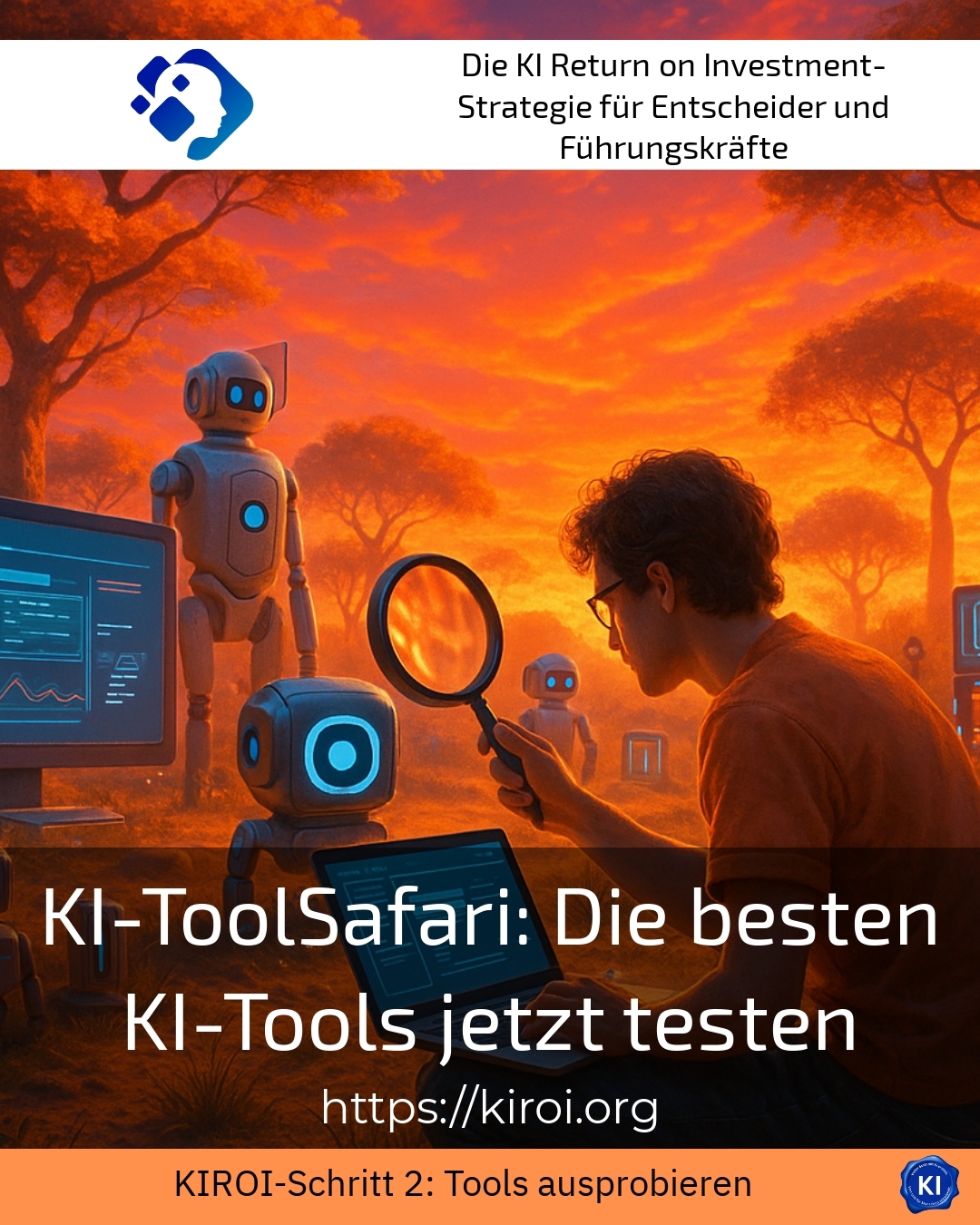
Imagine you're entering a digital jungle brimming with innovative applications that could revolutionise your work processes. This is precisely what awaits you when systematically exploring the current landscape of intelligent assistance systems. The AI ToolSafari will open up completely new perspectives on automated problem-solving. Clients often report feeling overwhelmed by the possibilities yet simultaneously disoriented. This article will guide you through the jungle of opportunities, offering concrete impulses for your own journey of discovery.
Why a structured discovery journey is worthwhile
The sheer number of available applications can quickly overwhelm even seasoned technology enthusiasts. This is why a methodical approach is recommended when evaluating new systems. For example, companies in the manufacturing sector use predictive maintenance systems to forecast machine failures and minimise costly downtime [1]. Banks and insurance companies employ intelligent analysis tools to detect fraud patterns in real time. Marketing departments, in turn, are experimenting with text generation systems that can create personalised content at scale. These three examples illustrate the vast range of application areas.
A carefully considered approach saves time and resources. It prevents frustrating failed attempts with unsuitable applications. Instead, you can focus on solutions that genuinely fit your specific needs. Transruption coaching supports companies in systematically designing these evaluation processes. This results in sustainable implementation strategies rather than short-term experiments without long-term benefits.
The AI ToolSafari as a systematic evaluation process
Consider exploring new technologies like a safari through unknown territory. You need an experienced guide, the right equipment, and a clear plan. In a digital context, this first means conducting a precise needs analysis. For example, a logistics company could evaluate route optimisation systems that intelligently adapt delivery routes. Retailers, on the other hand, are testing demand forecasting applications that anticipate seasonal fluctuations. Law firms, in turn, are trialling document analysis tools that identify relevant passages in extensive contract collections.
The key lies in the systematic documentation of your findings during this exploration phase. Note not only functionalities but also ease of use and integration possibilities. Take data protection aspects and compliance requirements of your industry into consideration. This structured approach distinguishes a professional evaluation from random trial and error.
Best practice with a AIROI customer
A medium-sized manufacturing company from southern Germany approached our transruption coaching team with a specific challenge. The management had heard of numerous intelligent applications but didn't know where to start. Together, we developed a structured evaluation plan for a systematic AI tool safari through relevant application areas. First, we identified three core areas with the greatest optimisation potential: quality control, warehouse management, and customer service. Subsequently, the responsible departments each tested three different applications in a controlled pilot project. The employees documented their experiences on standardised evaluation forms, which we had developed together. After six weeks of intensive testing, clear favourites emerged for each area. The company subsequently implemented a system for automated visual quality inspection with remarkable results. The error detection rate improved by approximately thirty percent compared to manual inspection. At the same time, inspection times decreased significantly, thereby accelerating the entire production process. This success motivated the team to gradually introduce the other identified solutions as well.
An overview of intelligent application categories
The landscape of available systems can be broadly divided into several main categories. Text processing and content generation form a particularly dynamic category. For example, journalistic editorial teams use research assistants that identify and summarise relevant sources [2]. Advertising agencies are experimenting with systems that create ad copy in various tonalities. E-commerce platforms employ product description generators that automatically caption thousands of items.
Image processing and visual analysis represent another significant category. Medical facilities are testing systems for the analysis of X-rays and MRI scans. Real estate companies are utilising virtual staging applications that digitally furnish empty rooms. Car manufacturers are relying on visual inspection systems that detect paint defects during the production process.
Data analysis and forecasting form the third central pillar of intelligent applications. Energy providers use load forecasting systems that predict electricity consumption. Pharmaceutical companies employ molecular analysis applications that identify promising drug candidates. Human resources consultancies are experimenting with matching algorithms that align applicant profiles with job requirements.
Discovering AI tool-based voice assistants
Conversational applications have made enormous progress in recent months. They understand complex queries and deliver context-sensitive answers. Customer service departments are implementing chatbots that independently answer standard queries. This frees up human employees for more complex concerns. Educational institutions are using tutoring systems that address individual learning difficulties. Consulting firms are employing research assistants that summarise industry trends.
However, the integration of such systems requires careful planning and realistic expectations. No system is perfect or can completely replace human expertise. Instead, hybrid working models emerge in which humans and machines work together. Transruption coaching supports companies in designing these new forms of cooperation. Together, we develop implementation strategies that take into account both technical and human factors.
Practical evaluation criteria for your decision-making
When evaluating different applications, you should consider several dimensions. User-friendliness is a key factor in team adoption. For example, an architecture firm tested various rendering applications and ultimately chose the most intuitive solution [3]. A mechanical engineering company, on the other hand, prioritised interface compatibility with existing CAD systems. A media company, meanwhile, placed particular importance on the quality of text generation.
Scalability is another important criterion. Can the application grow with your company? What costs will arise with increasing usage volumes? These questions should be clarified early on. Data security and compliance conformity are equally important. Check where your data is processed and stored. Pay attention to provider certifications and data protection declarations.
Support and documentation quality also influence your long-term success. Is there German-language support for technical issues? Do extensive tutorials and training materials exist? These aspects are often overlooked during initial enthusiasm.
Best practice with a AIROI customer
A regional insurance agency was looking for ways to speed up its claims processing. Claims handlers were spending a lot of time manually analysing claim notifications and photographic documentation. As part of our transruption coaching, we developed a catalogue of criteria together for evaluating various document analysis systems. Of particular importance were the accuracy of handwriting recognition and integration into the existing administration system. The team tested a total of five different applications under realistic conditions using anonymised historical cases. It became apparent that the most technically advanced solution was not the most suitable. Instead, a mid-priced application impressed with its excellent usability and responsive customer support. Consequently, the implementation went much more smoothly than in comparable projects at other companies. The entire claims team now uses the application daily and reports significant time savings. The average processing time per claim has been reduced by approximately forty percent. At the same time, customer satisfaction has noticeably improved due to faster responses. This success demonstrates how important a thorough evaluation is before making the final decision.
Typical challenges and how to overcome them
The introduction of intelligent systems regularly brings with it certain hurdles. Resistance within the team is among the most common challenges. Employees may fear becoming redundant through automation. Transparent communication and involvement in the evaluation process help here. Demonstrate how the new tools make work easier rather than replacing it.
Unrealistic expectations also frequently lead to disappointment. The marketing representation of many providers promises more than the systems can actually deliver. Therefore, start with manageable pilot projects and defined success criteria. For example, a tax consultancy began with the automation of a single document type. A craft business initially limited itself to appointment scheduling using intelligent assistance. A recruitment consultancy initially focused only on the pre-selection of application documents.
Technical integration issues represent another common challenge. Not every application can be seamlessly integrated into existing IT infrastructures. Therefore, clarify interface questions before the final purchasing decision. Request test environments and involve your IT department early on.
Sustainable integration into everyday work
After a successful evaluation, the real work begins. Lasting integration demands continuous attention and adaptation. Create training programmes that bring all users up to the same level of knowledge. For example, a logistics company introduced short, weekly training sessions for new features. A design agency set up an internal help channel for user queries. An engineering firm documented best practices in a shared wiki.
Regular reviews of usage intensity and satisfaction help with optimisation. Are all functions being used, or only a fraction of the potential being realised? Are there recurring problems or ambiguities? This feedback is incorporated into continuous improvement processes. Transruptions coaching also supports companies in this long-term optimisation phase.
Furthermore, stay informed about further developments of the systems you use. Most providers regularly release updates with new functionalities. Actively utilise these improvements to continuously increase your benefits. At the same time, you should keep an eye on the market and evaluate new alternatives if necessary.
My AIROI Analysis
The systematic exploration of intelligent applications offers significant potential for businesses of all sizes. However, successful implementation requires much more than just technical understanding. The human dimension, from team acceptance to leadership culture, is crucial to success or failure. Our experience from numerous support projects clearly shows that careful preparation makes the decisive difference. Companies that conduct a structured AI tool safari achieve more sustainable results than those that implement individual solutions too hastily.
The realistic assessment of the current state of development seems particularly important to me. The available systems can do a lot, but not everything, and they by no means completely replace human judgment. Instead, new forms of collaboration between humans and machines are emerging. This hybrid intelligence clearly surpasses purely human as well as purely machine performance in many areas. The art lies in making targeted use of these synergies and optimally combining the strengths of both sides.
In the coming months, I expect further progress in multimodal applications that process text, image, and speech in an integrated manner. Companies should closely monitor these developments and adapt their strategies accordingly. A continuous willingness to learn and a desire to experiment will become crucial competitive factors. Transruption Coaching will be your reliable partner to help you navigate this exciting journey successfully.
Further links from the text above:
[1] McKinsey Digital: The Top Trends in Tech
[2] Gartner Newsroom: Emerging Technology Insights
[3] Forbes Technology Council: Industry Perspectives
For more information and if you have any questions, please contact Contact us or read more blog posts on the topic Artificial intelligence here.











 Deutsch
  English (UK)