
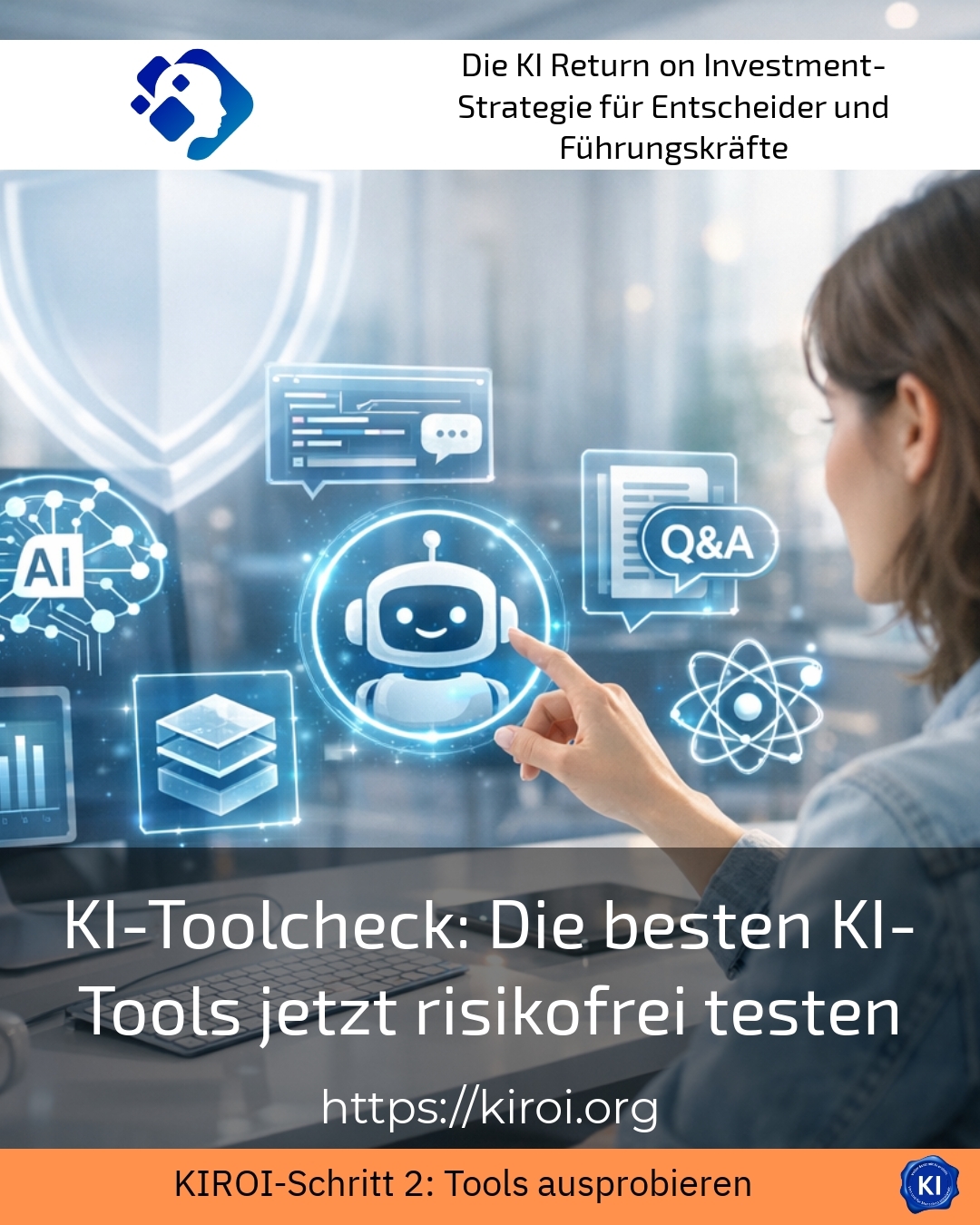
Have you ever wondered why so many companies hesitate when it comes to integrating modern software solutions into their business processes, even though the benefits are already clear? The answer often lies in the fear of making the wrong investment, the uncertainty regarding implementation, and the concern that the chosen solution may not fit the individual requirements. This is where the approach of a comprehensive AI tool check comes into play; it provides decision-makers with the opportunity to thoroughly test innovative applications first before committing long-term. This approach revolutionizes the way organizations make technological decisions and opens entirely new perspectives for secure digital transformation [1].
Why risk-free testing has become indispensable today
The landscape of intelligent applications has dramatically changed in recent years, making even experienced professionals struggle to keep track. Companies in the manufacturing sector often report that they want to evaluate various automation solutions, but they don’t know where to start. In healthcare, on the other hand, clinics face the challenge of evaluating diagnostic systems without compromising ongoing operations. In the financial sector, banks are also looking for ways to optimize fraud detection while simultaneously meeting regulatory requirements.
A structured testing approach allows for systematically overcoming these hurdles and making informed decisions. This involves not only testing individual functions but rather a holistic assessment that takes into account both technical and organizational aspects. Logistics companies can, for example, test route optimization systems under real-world conditions before adapting their entire fleet management. Retail companies first test personalized recommendation systems in selected stores to measure their effectiveness. Educational institutions evaluate adaptive learning systems in pilot classes before implementing them schoolwide [2].
The AI tool check as a strategic instrument for corporate management
Executives increasingly recognize that selecting suitable technologies must not be left to chance but requires a methodical approach. A well-thought-out evaluation process takes into account multiple dimensions, ranging from technical compatibility to user-friendliness and long-term scalability. Insurance companies use such structured evaluation methods to compare damage control systems and quantify their potential efficiency. Telecommunications providers rely on comprehensive testing phases when they want to introduce customer service automations. Energy providers, in turn, thoroughly examine predictive maintenance solutions before deploying them in critical infrastructures.
Accompanying by experienced specialists can offer significant added value in this context, as it helps companies avoid typical pitfalls and streamline the evaluation process. Transruptions coaching positions itself as a valuable resource that supports organizations in the strategic evaluation and implementation of intelligent solutions [3]. Pharmaceutical companies often report that external expertise has helped them objectively evaluate molecular analysis systems. Media companies appreciate the neutral perspective when selecting content creation tools. Construction companies benefit from expert support in evaluating project management automations.
Best practice with a AIROI customer
A medium-sized mechanical engineering company faced the challenge of modernizing its quality control through intelligent image recognition systems, with various vendors presenting promising solutions. The management team deliberately chose a structured evaluation approach that tested several systems in parallel under controlled conditions. Over a twelve-week period, three different solutions were operated in a specially equipped test environment that processed real production data. The results showed significant differences in recognition accuracy, with one solution significantly better at segmenting complex geometries than its competitors. Particularly valuable was the ability to test the systems under varying lighting conditions and with different material surfaces. The quality assurance staff were actively involved in the evaluation process and were able to contribute their practical experience. At the end of the testing process, the company had a well-founded basis for decision-making that took into account not only technical parameters but also the acceptance of the workforce. The investment decision was significantly easier to make because concrete performance data were available and the risk of a misinvestment was minimized.
Systematic evaluation: The best AI tools are methodically evaluated
The methodological evaluation of intelligent applications requires a well-thought-out criteria system that encompasses both quantitative and qualitative aspects. Agricultural enterprises, for example, evaluate harvest forecasting systems based on their predictive accuracy, but also with regard to their integration into existing management systems. Hotel chains test revenue management solutions under various occupancy scenarios to assess their adaptability. Logistics service providers evaluate warehouse management systems both in terms of their efficiency and their scalability in the face of growing volumes.
A comprehensive AI tool check takes into account various evaluation dimensions that can be weighted differently depending on the industry and use case. For example, law firms place particular emphasis on the confidentiality of data processing when evaluating research tools. Advertising agencies, on the other hand, prioritize the creative quality when evaluating design assistants. Personnel consulting firms, in turn, focus on the fairness of matching algorithms and their transparency in candidate selection [4].
Overcoming practical challenges in implementation
The biggest obstacles to the introduction of intelligent systems often lie not in the technology itself, but in organizational and cultural factors that deserve careful consideration. For example, hospitals report that integrating diagnostic support systems requires significant training for medical staff. Manufacturing companies face the challenge of seamlessly integrating quality control systems into existing production lines. Retail companies must ensure that price optimization systems are compatible with existing ERP solutions.
Transruptions coaching accompanies organizations precisely during these complex transformation projects and provides valuable insights for successful implementation. This involves not only technical aspects, but also change management and the development of new working methods. Municipal utilities often report that the support in introducing network control systems has significantly contributed to project success. Airports appreciate the external perspective in implementing passenger flow analyses. Sports stadiums benefit from expert assistance in setting up visitor management systems.
Best practice with a AIROI customer
A regional banking group wanted to support its credit decision-making processes through intelligent analytical tools, but faced significant regulatory requirements. The first step was to identify different providers that could meet the strict requirements of the financial regulator. In a controlled sandbox environment, four different solutions were tested in parallel and compared. The evaluation spanned six months and included both historical data analysis and real-time assessments. Particularly important was the traceability of the decision criteria, which had to be documented in regulatory audits. The credit department was involved in the evaluation process from the outset and was able to contribute important practical requirements. An external coaching team accompanied the entire process and helped develop objective evaluation criteria. The result was a well-informed decision for a solution that was both technically convincing and regulatory compliant. The bank was able to reduce its decision-making times while simultaneously improving the quality of its risk assessments.
The importance of test environments for a successful AI tool check
A realistic testing environment forms the foundation of any serious evaluation and enables systems to be tested under realistic conditions. Automotive suppliers set up dedicated testing cells to extensively test welding robot controls before implementing them in mass production. Food manufacturers use pilot production lines to test sorting machines with different product variants. Printing companies evaluate color management systems using representative sample jobs that cover the entire spectrum of their orders [5].
Investing in suitable testing infrastructure pays off in the long run because it enables informed decisions and prevents costly misjudgments. Chemical companies report that testing facilities for process control systems may initially appear expensive, but they quickly pay off. Textile manufacturers appreciate the possibility of testing pattern recognition systems with different fabric qualities. Furniture manufacturers initially evaluate trim optimization using test materials before they allow valuable raw materials to be processed.
Future prospects and strategic development
The ability to systematically evaluate new technologies and test them without risk becomes a crucial competitive advantage in an increasingly technology-driven economy. Publishers are experimenting with automated translation systems to more quickly access international markets. Architecture firms are testing generative design tools that open up new creative possibilities. Engineering firms are evaluating simulation systems that more accurately model complex physical processes than conventional methods.
The continuous development of one’s own evaluation capabilities should be considered a strategic investment. Research institutions report that structured testing procedures have significantly accelerated their technology transfer processes. Municipal governments use pilot projects to carefully introduce citizen service automation. Cultural institutions test visitor guidance systems in selected areas before implementing them on a wider scale.
My AIROI Analysis
The systematic evaluation of intelligent applications has established itself as an indispensable instrument for responsible technology decisions. The added value of a structured approach cannot be overstated. Organizations that rely on risk-free testing make better decisions and avoid costly misjudgments that can have not only financial but also organizational consequences. The guidance provided by experienced specialists, such as Transruptions Coaching, can significantly accelerate and enhance the evaluation process. Particularly valuable in this context is the external perspective, which overcomes operational blind spots and provides new impulses. The presented practical examples vividly demonstrate that structured testing methods are applicable in almost all industries and offer measurable benefits. It is crucial not to view evaluation as a one-time project, but as a continuous process of technological development. Investing in suitable testing environments and evaluation capabilities pays off in the long run and strengthens competitiveness sustainably. Companies should therefore not hesitate to seek professional support and establish the AI Toolcheck as a strategic instrument for corporate management. The future belongs to organizations that consciously and thoroughly select technology, rather than being guided by marketing promises.
Further links from the text above:
[1] McKinsey: AI Insights and Research
[2] Gartner: Artificial Intelligence Research
[3] AIROI-Blog: Strategies for digital transformation
[4] Forbes: Coverage of AI and Machine Learning
[5] Harvard Business Review: AI and Machine Learning
For more information and if you have any questions, please contact Contact us or read more blog posts on the topic Artificial intelligence here.








 Deutsch
 English (UK)