
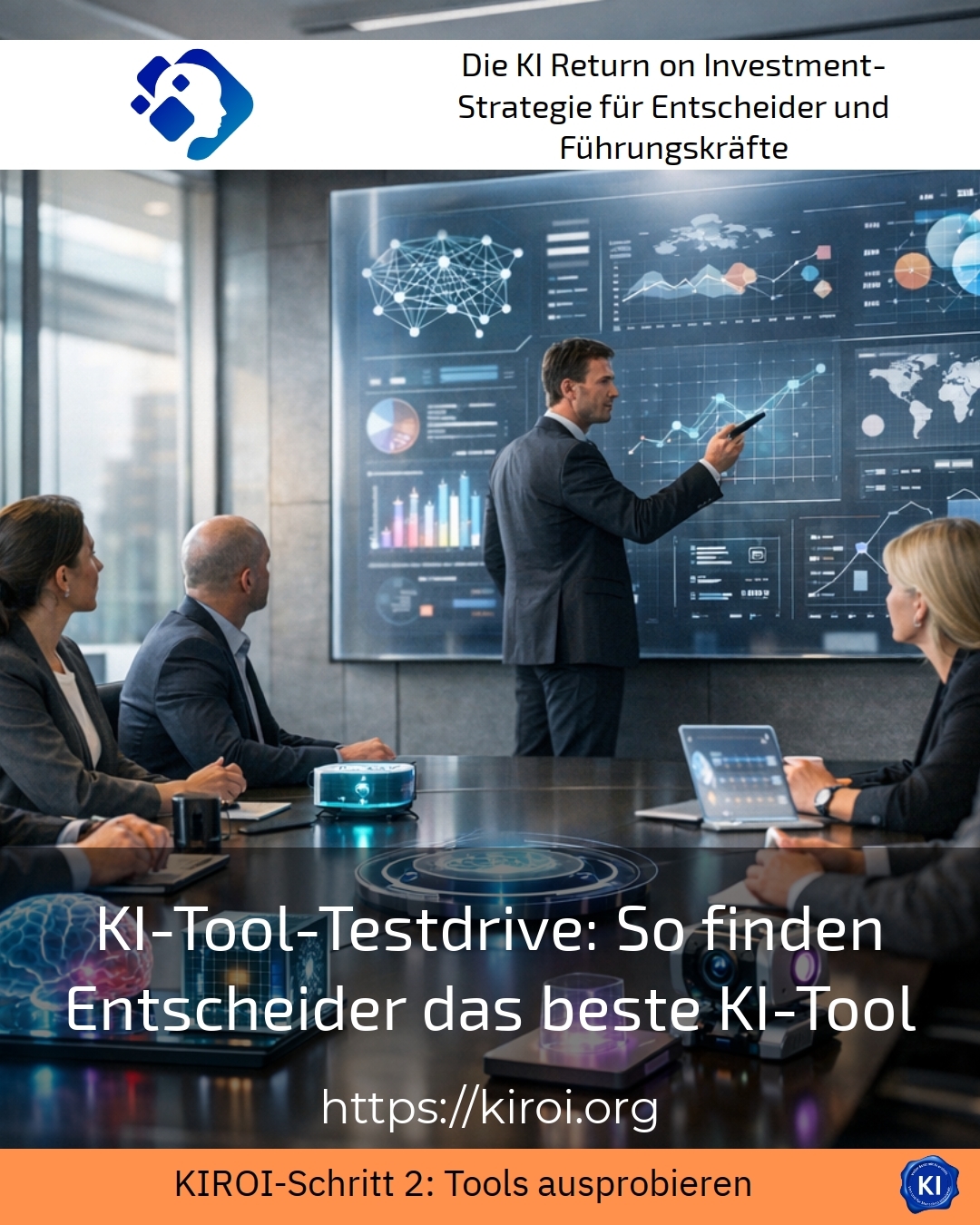
How do you actually recognize which intelligent software solution really suits your company before investing six-figure sums? This question currently concerns numerous executives who have to navigate the jungle of automated decision systems. The systematic AI tool test drive It is establishing itself as an indispensable method for responsible business leaders. Because while providers boast impressive promises, it is only through practical testing in the context of their own company that a solution can actually create added value. In the world of automated assistance systems, the distinction between the good and the bad quickly becomes clear, and that is exactly why this topic deserves your full attention.
Why a structured AI tool test drive has become indispensable
The landscape of intelligent enterprise solutions has changed dramatically in recent months. Nearly daily, new applications appear on the market. These promise significant efficiency gains. However, companies often report disappointing experiences following hasty purchasing decisions. A systematic evaluation process helps avoid such costly mistakes.
In the field of logistics and supply chain management, the difference that well-informed selection makes is particularly evident. Automated route planning systems, for example, must harmonize with the specific characteristics of a company. Integrating them into existing ERP systems often presents an underestimated challenge. Predictive maintenance solutions for the fleet, in turn, require access to historical vehicle data. Without practical testing in one’s own operation, such compatibility issues remain unanswered.
Inventory optimization tools are another area of application that requires extensive testing. These systems analyze sales patterns and predict future demand. However, the quality of such predictions depends heavily on the industry and the specific product categories. A test run using real company data therefore provides significantly more meaningful results than manufacturer data.
The role of transruptive coaching in evaluation
transruptions coaching accompanies decision-makers in this complex task using proven methods. The approach combines strategic corporate consulting with practical technology assessment. The focus is not on the technology itself, but on the concrete benefits for the respective business model. This perspective helps executives look beyond the short-term efficiency promises.
Best practice with a AIROI customer
A medium-sized wholesaler of industrial supplies faced the decision between three different demand forecasting systems. The company serves over two thousand business customers with a product range of more than fifty thousand items. The initial enthusiasm following the providers’ product demonstrations quickly gave way to disappointment when the first integration tests began. Within the framework of a structured testdrive process, all three solutions were evaluated simultaneously over a period of six weeks. It was revealed that the solution that initially seemed expensive provided the most accurate predictions for the company’s specific product categories. The seemingly cheaper alternative would have led to significant overstocking due to inaccurate forecasts. The transruptive coaching accompanied this process with clear evaluation criteria and neutral moderation. Ultimately, the company saved a six-digit amount in subsequent costs through this systematic approach because the right decision was made.
The five phases of a successful AI tool test drive
A well-thought-out evaluation process follows proven structures. These can be divided into five consecutive phases. Each phase serves a specific purpose within the overall process. Skipping individual steps has been found to lead to suboptimal results in practice.
Phase 1: Requirements analysis and goal definition
Before solutions can even be considered, one must clearly define one’s own needs. This sounds obvious, but is often neglected. What specific business processes should be improved? What measurable goals are being pursued? These questions deserve detailed answers.
In the area of customer communication, for example, it is not enough simply to want to introduce a chatbot. Should it primarily answer standard inquiries or also conduct complex consultations? Should multiple languages be supported? How should the transfer to human employees take place? Only after such detailed questions have been clarified can a meaningful selection begin.
Document processing systems require similarly detailed considerations. The range extends from simple text recognition to automated contract analysis. Invoice processing solutions, in turn, must accommodate the specific format variations of their own suppliers. This diversity makes precise requirements definition indispensable.
Phase 2: Market research and pre-selection
The abundance of available solutions makes systematic pre-selection necessary. Structured comparison criteria support orientation in this process. Industry-specific experiences of the providers play an important role. Reference projects in comparable companies provide valuable insights into the practical suitability [1].
Personnel planning systems illustrate the importance of industry-specific expertise particularly well. A system developed for retail rarely fits seamlessly into the requirements of a manufacturing operation. Shift models, qualification requirements, and regulatory frameworks differ significantly. Therefore, the preselection should focus on relevant industry experience.
Quality control systems with image recognition pose similar challenges. A surface inspection system in metal processing differs fundamentally from solutions for the food industry. The number of meaningfully testable alternatives must therefore be limited early on.
Phase 3: Developing structured test scenarios
The real one AI tool test drive It requires well-thought-out test scenarios. These should represent realistic use cases from the company's daily operations. Standard demonstrations by the providers are not sufficient for a thorough evaluation. Instead, their own data and processes must be incorporated into the test setup.
For example, a text analysis tool for customer feedback should be tested with real customer reviews of the company itself. Only then can it be determined whether the sentiment analysis is appropriate for the industry-specific jargon. Irony and regional language variants pose additional challenges. The test scenarios must deliberately include such borderline cases.
Forecast systems for energy consumption require historical consumption data from the company itself. Only when predictions are matched with actual consumption can reliable accuracy values be obtained. Seasonal fluctuations and unusual events should be included during the test period.
Best practice with a AIROI customer
A service company in the facility management sector was looking for a solution to automate the deployment planning of its service technicians. The challenge was coordinating over three hundred employees with different qualifications in a catchment area spanning several federal states. The developed test catalogue included thirty-six specific scenarios that covered typical and unusual planning situations. These included morning sickness, short-term emergency interventions, and the consideration of customer priorities. Two of the three tested systems already failed to properly account for travel times between deployment locations. The third system mastered the standard scenarios with ease, but showed weaknesses in integrating new employees into the planning process. These findings led to renegotiations with the provider, which resulted in a customized training agreement. Without the systematic test drive, these vulnerabilities would have only become apparent during production operation.
Phase 4: Evaluation and documentation
The systematic evaluation of the test results forms the core of decision-making. Quantitative and qualitative criteria should be taken into account equally. A purely focus on accuracy metrics is too short-sighted. Aspects such as user friendliness and integration effort also deserve attention [2].
Documentation of all test results enables clear decision-making. This transparency also supports subsequent reviews of the chosen course of action. Additionally, it facilitates internal communication of the decision to stakeholders. Often, executives report on the importance of this documentation in subsequent budget discussions.
Customer service speech assistance systems highlight the multifaceted nature of evaluation. In addition to pure recognition accuracy, response times, dialogue management, and escalation logic play important roles. The system’s response to unexpected customer inquiries demonstrates its robustness. All of these aspects must be integrated into a balanced evaluation scheme.
Phase 5: Pilotage and gradual introduction
Even after a successful AI tool test drive A cautious introduction is recommended. A pilot project in a limited business area provides further insights. Interactions with existing processes and systems are revealed. The acceptance among the affected employees can be evaluated.
Automated accounting systems, for example, should initially run in parallel with the existing process. The direct comparison of the results creates confidence in the new solution. Deviations can be analyzed and the system configuration can be adjusted if necessary. Only after a successful parallel phase does the complete transition take place.
Sales recommendation systems also benefit from a gradual introduction. Initially, product recommendations can only be displayed as suggestions for sales representatives. The actual success rate of these recommendations is measured. Only when there are convincing results does the process undergo greater automation.
Avoid common stumbling blocks when testing an AI tool
Experience shows that certain errors in evaluation processes recur again and again. Awareness of these pitfalls helps us avoid them. The pressure of ambitious project schedules often leads to hasty decisions. A realistic time plan for the evaluation process is therefore essential.
Over-evaluating demonstration results is another common mistake. Providers naturally present their solutions in the best possible light. Optimized demo data and idealized scenarios distort the picture. Only testing with real, realistic data provides reliable findings [3].
Neglecting integration aspects often leads to unpleasant surprises after the purchase decision. A powerful standalone solution is of little use if it cannot communicate with existing systems. Interfaces to ERP systems, CRM platforms, and document management systems deserve special attention. The effort involved in data migrations is regularly underestimated.
Best practice with a AIROI customer
A manufacturing company in the automotive supply industry had decided, after a superficial evaluation, to adopt a quality inspection system with visual inspection. The purchasing decision was primarily based on an impressive manufacturer presentation and attractive licensing conditions. It was only during implementation that it became apparent that the system did not reliably detect the specific surface properties of the materials used. The false alarm rate was significantly above the acceptable level and led to massive production disruptions. After six frustrating months, the project was canceled and a structured evaluation process was resumed. The accompanying transruptive coaching process helped the company learn from the mistakes and develop a systematic catalog of criteria. The ultimately chosen alternative has been functioning reliably for over one year with an identification accuracy of over ninety-nine percent. The financial damage caused by the wrong decision could have been avoided through an initial test drive.
My AIROI Analysis
The systematic evaluation of intelligent business solutions is becoming a core competency of forward-thinking executives. The described test drive approach offers a proven framework that can be adapted to a wide range of industry contexts. The investment in a thorough evaluation process is often repaid by avoided misjudgments and an optimized solution selection. What is particularly noteworthy is the often underestimated importance of the requirements analysis as the foundation of the entire process, because without a clear definition of the objectives, even the most sophisticated testing methodology cannot lead to optimal results.
The accompanying support provided by experienced advisors, such as the transruptions coaching offered by the company, can make the difference between a good and an outstanding decision. External perspectives help overcome operational blind spots and identify hidden requirements. The documented case studies vividly demonstrate which financial and operational risks can be mitigated through a structured process. At the same time, it must be emphasized that even the best evaluation process does not guarantee the later success of the project, as unforeseen developments can never be completely ruled out.
The increasing maturity of the market for intelligent enterprise solutions makes well-informed decision-making both more demanding and more important. Decision-makers who invest in their evaluation skills today gain a sustainable competitive advantage. AI tool test drive Therefore, as an established method, it deserves a firm place in the toolkit of modern corporate management.
Further links from the text above:
[1] Gartner Research on Technology Trends
[2] Bitkom guides on digital transformation
[3] Fraunhofer Institute on practical applications
For more information and if you have any questions, please contact Contact us or read more blog posts on the topic Artificial intelligence here.










 Deutsch
 English (UK)