
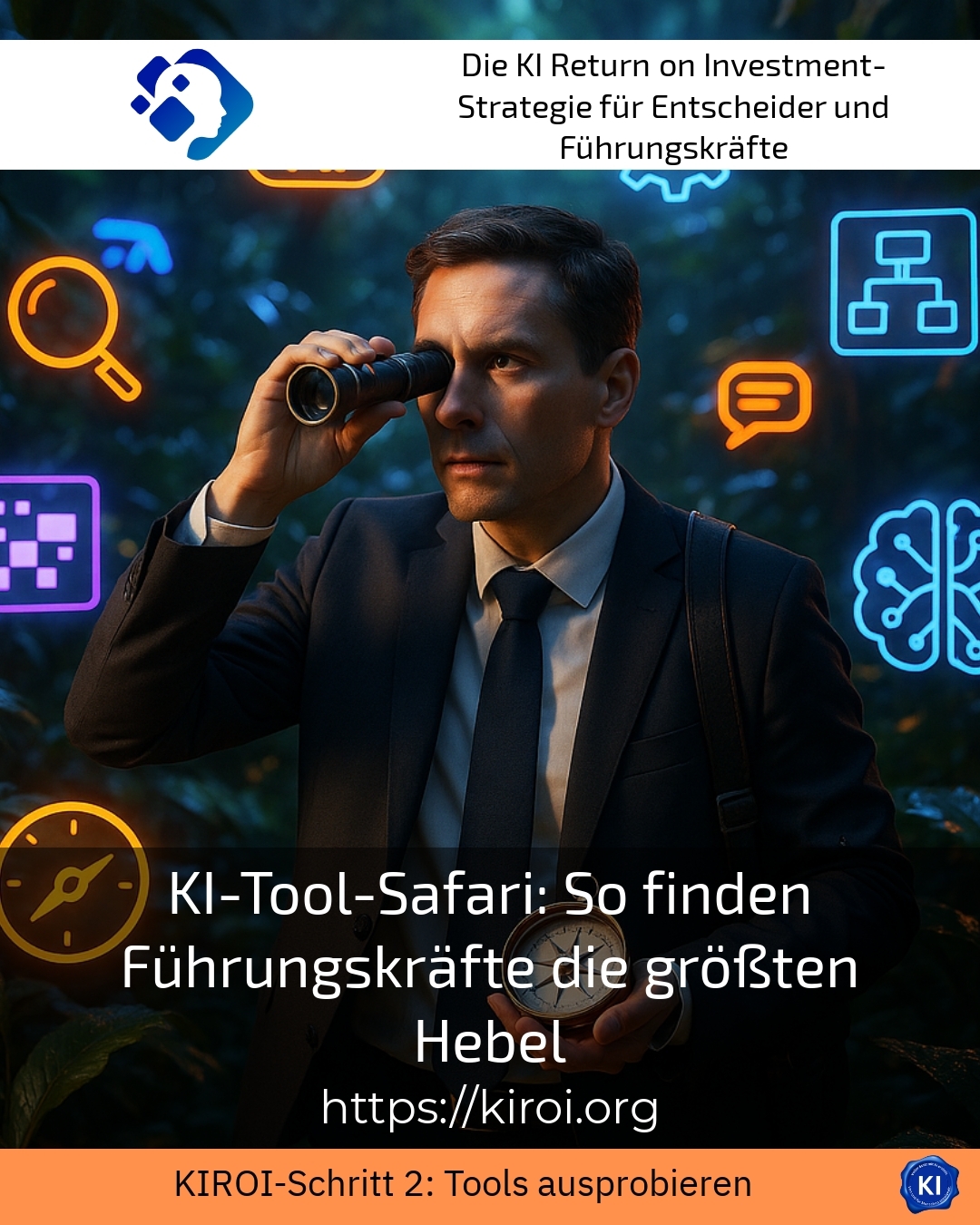
Imagine stepping into a lush jungle brimming with hidden treasures, yet without a compass or map, you quickly lose your way in the impenetrable thicket of possibilities. This is precisely how many decision-makers feel about the current situation when searching for the right digital tools. AI Tool Safari: How Leaders Can Find the Biggest Leverage becomes the decisive adventure that determines competitiveness and future viability. New applications appear on the market daily. Each promises groundbreaking results. But which ones truly deliver on their promises? And above all: Which ones are suitable for your company and your specific challenges? This article takes you on a strategic expedition through the technology jungle and shows you how to discover the true gems.
Understanding the starting situation: Why a systematic approach is essential
The market for intelligent applications is growing exponentially and unstoppably. Thousands of solutions are vying for the attention of decision-makers in companies of all sizes. This abundance can seem overwhelming. Executives often report a veritable paralysis in the face of the sheer number of options. They spend valuable time testing unsuitable tools. Frustration grows. Productivity suffers. And in the end, all too often, there's just the feeling of being left behind.
A structured approach offers a solution here. First, it's important to clearly define your own needs. Which processes are currently causing the most friction? Where are employees spending time on repetitive tasks? Which bottlenecks are hindering growth? These questions form the foundation of any successful technology evaluation. In the financial services sector, for example, many institutions struggle with the manual processing of loan applications. Lead times are long. Customers wait impatiently. Competitors with faster processes are gaining market share. Intelligent analysis tools can make a significant difference here.
In the healthcare sector, on the other hand, different challenges take centre stage. Clinics are looking for ways to reduce administrative tasks. Doctors often spend more time on documentation than with patients. Intelligent speech recognition systems can provide support here. They capture spoken findings and automatically convert them into structured documentation. Transruption coaching supports such transformation projects from the initial analysis to successful implementation.
The AI tool safari begins with the right preparation
Before you embark on your search, you will need a clear roadmap. This comprises several essential components. Firstly: An honest inventory of your current technological infrastructure. Secondly: The definition of measurable goals you wish to achieve. Thirdly: A realistic budget that also accounts for training costs and implementation effort. Fourthly: The identification of pilot areas where you can initially test new tools.
In retail, for example, there are various entry points. Customer service teams can benefit from intelligent chatbots. These answer frequently asked questions automatically and around the clock. Warehouse management uses forecasting tools for optimised order quantities. Marketing departments rely on personalised product recommendations. Each of these areas requires different solutions. The art lies in setting the right priorities.
Best practice with a KIROI customer
A medium-sized trading company with several hundred employees faced the challenge of modernising its customer service without losing the personal touch that had distinguished the company for decades. The management approached us with the request to improve service quality while significantly reducing response times. Together, we first analysed the existing volume of inquiries and categorised the various customer concerns by complexity and frequency. It became clear that around sixty percent of all incoming inquiries concerned relatively standardised topics. Delivery times, returns processing and product availability dominated the daily business of the service employees. Based on these findings, we gradually implemented an intelligent assistance system that initially only handled simple inquiries. Employees were involved from the outset and received comprehensive training on working with the new system. After six months, the average response time had been reduced by more than half. Customer satisfaction increased measurably. And the service employees reported higher job satisfaction as they could now dedicate themselves to more complex and interesting concerns.
Landmarks in the Technology Jungle: How Leaders Identify Real Levers
the most successful companies follow their AI Tool Safari a proven pattern. They initially focus on quick wins with manageable risk. These so-called quick wins build trust in new technologies. They provide valuable learning experiences for the entire team. And they generate momentum for more challenging projects.
In the manufacturing industry, the benefits are particularly evident. Predictive maintenance systems analyse machine data in real-time. They recognise wear patterns before failures occur. Unplanned production stoppages can thus be significantly reduced. Savings often exceed investment costs within a few months. Quality control systems with image recognition identify errors faster and more reliably than the human eye. They work around the clock without showing signs of fatigue. The error rate decreases. Customer satisfaction increases.
In the realm of professional services, the greatest potential often lies in the automation of research and documentation tasks [1]. Law firms are using intelligent systems to analyse large volumes of documents. Due diligence processes, which previously took weeks, are now being shortened to days. Management consultancies are relying on automated market analyses, gaining deeper insights into industry trends more quickly. Transruption coaching supports companies in sustainably embedding such transformations.
The evaluation criteria for sustainable decisions
When evaluating potential solutions, you should consider several dimensions. Technical performance is important, but not solely decisive. Aspects such as data protection compliance and security standards are equally relevant. GDPR requirements play a central role, especially for European companies. Providers should transparently explain how they handle sensitive data. Where is it stored? Who has access? What certifications are available?
The ability to integrate with existing systems deserves special attention. Standalone solutions create new data silos. They increase complexity rather than reduce it. Open interfaces and standard formats make connection considerably easier. In the banking sector, for example, new tools must be able to communicate seamlessly with core banking systems. In the healthcare sector, strict requirements apply to interoperability with hospital information systems [2].
The scalability of a solution determines its long-term value. What works for a team of ten today must also be viable for a hundred or a thousand users tomorrow. High-growth companies in the technology sector know this challenge particularly well. They choose solutions from the outset that can grow with them. E-commerce startups, for example, need systems that can handle sudden peaks in load. Black Friday and the Christmas business present particular challenges.
Best practice with a KIROI customer
A logistics company with an international network was looking for ways to optimise its route planning while simultaneously reducing its ecological footprint. The existing planning processes were still largely based on the dispatchers' experience and simple spreadsheets. The complexity, with several thousand daily shipments, far exceeded human processing capacity. Together, we developed a multi-stage evaluation procedure for various optimisation solutions on the market. First, we defined clear success criteria: a reduction in total kilometres by at least fifteen percent, improved vehicle utilisation, fewer empty runs, and more punctual deliveries. Three providers were shortlisted and each received historical data for a pilot test. The results showed significant differences in practical applicability. The ultimately selected provider impressed not only with the best optimisation performance but also with an intuitive user interface and excellent support. After widespread implementation, fuel costs decreased by eighteen percent. CO2 emissions were reduced accordingly. And the dispatchers could henceforth concentrate on exceptional cases and customer service instead of route calculations.
The Human Dimension: Taking Employees Along on the AI Tool Safari
Technology alone does not create transformation. The most successful implementations are characterised by the intensive involvement of the employees concerned. Fears and reservations must be taken seriously. They do not disappear by being ignored. Open communication about the goals, benefits, and also the limitations of new tools builds trust. Training and support during the introduction phase are indispensable.
This dynamic is particularly apparent in the insurance sector. Claims handlers often fear becoming redundant due to automated claims processing. In practice, however, the focus of their work usually just shifts. Standard cases are processed more quickly. Complex situations receive more attention. The customer relationship quality increases. Employees who actively shape this change often report increased job satisfaction [3].
Transruption coaching places particular emphasis on this change management dimension. We support teams through all phases of the change. From initial scepticism and the learning curve to routine use. For instance, in the media industry, we regularly see how initial resistance to automated content analyses dissipates. Editors recognise that their creative work is enriched by data support. Journalists use research assistants for deeper background investigations. Editorial quality improves. The reach of content grows.
The leaders as expedition leaders on the safari
The role of the leadership level can hardly be overstated. Transformation is only successful with visible commitment from the top. Leaders must become users themselves. They should understand the new tools and know their possibilities. Only then can they formulate realistic expectations. Only then can they motivate their teams authentically.
In the pharmaceutical industry, for example, forward-thinking leaders use intelligent analytics systems for strategic decisions. They gain condensed insights into market developments and competitor activities. They can react more quickly to regulatory changes. The time from idea to market readiness for new products is shortened. In the construction industry, innovative management teams are relying on digital twins of large projects. These enable virtual walkthroughs and early detection of planning errors. Cost overruns are reduced. Project adherence to schedule improves.
Best practice with a KIROI customer
A family company with a long tradition in mechanical engineering faced the challenge of preserving its extensive knowledge and making it accessible to younger generations. Many long-serving experts were approaching retirement. Their implicit knowledge of manufacturing processes, customer preferences, and problem-solving strategies was at risk of being lost. Management recognised that traditional documentation methods had their limitations here. Together, we developed an innovative approach to knowledge extraction and storage. Experienced employees were interviewed in a structured manner about their working methods. Their answers were analysed and transferred into an intelligent knowledge management system. Younger colleagues can now use this system as an interactive advisor. They ask questions about specific manufacturing problems and receive context-specific solution suggestions based on the collected wealth of experience. The onboarding times for new employees have significantly decreased. The error rate in production has fallen. And the valuable knowledge of the pioneering generation remains with the company even after their departure.
My KIROI Analysis
The strategic search for the right technological tools is indeed like a safari through unknown terrain. Success requires preparation, patience, and a willingness to learn. Leaders who embark on this expedition give their organisations crucial competitive advantages. AI Tool Safari: How Leaders Can Find the Biggest Leverage is not a one-off project but a continuous process. The technological landscape is evolving rapidly. What is considered state-of-the-art today can be standard tomorrow.
From my experience with numerous transformation projects, some success factors emerge. Firstly, the importance of clear objectives: companies that know exactly what they want to achieve find suitable solutions more quickly. Then, the role of corporate culture: openness to new ideas and a constructive approach to errors significantly accelerate progress. Furthermore, the necessity of sufficient resources: transformations must be adequately equipped in terms of finance, time, and personnel.
The biggest levers are often not where one initially suspects. Sometimes it is seemingly small process improvements that collectively have an enormous impact. Sometimes it is bold realignments of entire business models. Transruptions coaching supports companies in identifying and consistently utilizing their individual levers. We provide impetus, ask critical questions, and assist with implementation. Ultimately, it is not technology that determines success, but the way people use it.
Further links from the text above:
[1] McKinsey: The Economic Potential of Generative AI
[2] Bitkom: Artificial Intelligence in Business Use
[3] Harvard Business Review: Artificial Intelligence Research and Insights
For more information and if you have any questions, please contact Contact us or read more blog posts on the topic Artificial intelligence here.











 Deutsch
  English (UK)