
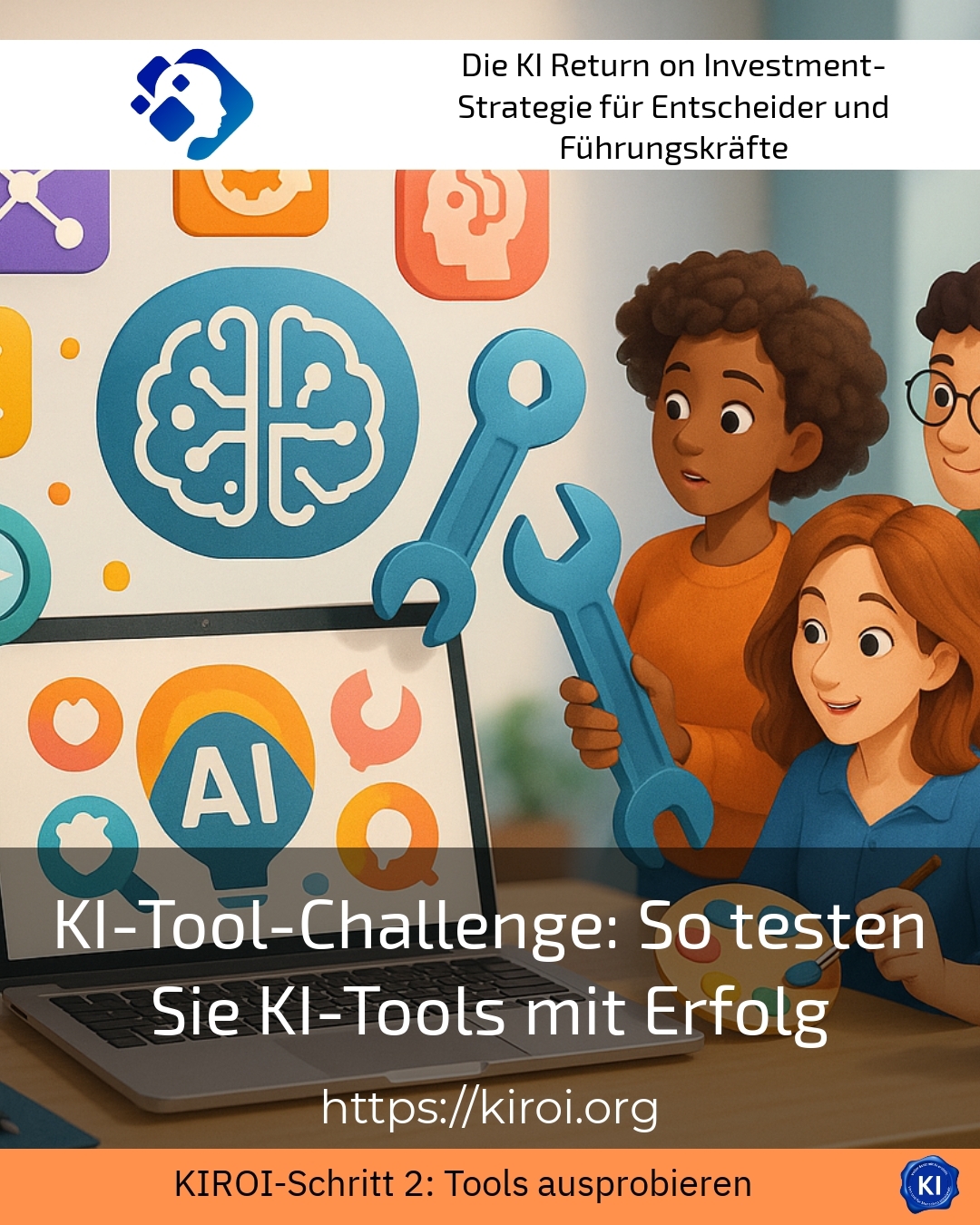
Imagine you're standing in front of a giant toolbox filled with gleaming instruments, yet none are labelled, and no one explains to you which tool is suitable for which purpose. This is how many companies feel when they approach the world of algorithmic assistance systems, and one AI Tool Challenge want to get started. The selection is overwhelming, the promises sound enticing, but the path to successful implementation of these technologies often remains vague and full of unexpected obstacles. In this post, you will learn how to proceed in a structured and methodical way to identify, test and sustainably implement the right solutions for your company.
Why a structured AI tool challenge is indispensable
Digital transformation has made its way into almost all sectors. Companies are under increasing pressure to optimise their processes. At the same time, the supply of intelligent software solutions is growing exponentially. Without a well-thought-out testing strategy, organisations lose valuable resources. They invest time and money in tools that do not meet their requirements. Therefore, experts recommend a systematic approach to evaluation.
In the financial sector, for instance, institutions employ algorithms for fraud detection. Insurers use automated systems for claims assessment. Banks implement chatbots for customer service. Each of these applications requires different evaluation criteria. Because the requirements are so diverse, blanket approaches often fail. Instead, companies need customised test scenarios that take their specific business processes into account and deliver realistic results.
A medium-sized logistics company recently reported on its experiences. The team had tested several route optimisation solutions in parallel. It turned out that the most expensive option was not necessarily the best. Instead, a lesser-known alternative impressed with better integration into existing systems. Companies only gain such insights through a systematic approach.
Best practice with a AIROI customer
A leading retail company with over three hundred branches in Germany approached us seeking support in selecting a forecasting system for inventory planning. The project team had already contacted several providers and received presentations, but decision-making proved difficult because all solutions appeared promising and internal stakeholders pursued different priorities. As part of our transruption coaching, we jointly developed a structured evaluation framework that took into account both technical and organisational criteria. We defined concrete test scenarios based on historical sales data and established measurable success criteria against which the various solutions could be objectively compared. Following an eight-week pilot phase with three selected providers, a clear favourite emerged, which not only delivered the best forecasting accuracy but could also be seamlessly integrated into the existing merchandise management system. Six months after implementation, the company reported a significant reduction in overstock and improved product availability in its branches.
The five phases of a successful AI tool challenge
Successful test projects follow a clear structure. This structure provides orientation for all involved parties. It prevents important aspects from being overlooked. Furthermore, it creates transparency for management. The following five phases have proven their worth in practice.
Phase one: Needs analysis and objective definition
Before companies even begin searching for suitable solutions, they should precisely define their requirements. What specific problems are to be solved? Which processes can be improved through automation? These questions sound trivial, but projects often fail precisely at this stage. For example, a pharmaceutical company was looking for a document analysis solution. It only became clear during the course of the project that a complete knowledge management system was actually needed. Such late realisations lead to delays and significantly increase costs.
Transruption coaching can provide valuable impetus at this stage. An external perspective helps to identify blind spots. Professional support also aids in prioritising requirements. Many clients report that this collaboration has enabled them to formulate their goals more clearly.
Phase two: Market research and pre-selection
The market for intelligent software solutions is complex. New providers and products emerge daily. At the same time, others disappear from the market. Thorough research is therefore essential. Companies should not only consider features. The stability of the provider, their references, and the support offered also play an important role.
In the healthcare industry, for example, there are special requirements for data protection and compliance [1]. Hospitals and doctor's practices must ensure that all systems used comply with regulatory specifications. A diagnostics provider reported that they had initially identified twenty potential solutions. After checking the compliance requirements, only five remained. This drastic reduction shows how important it is to consider industry-specific criteria early on.
Phase three: Pilot projects and controlled tests
Following the pre-selection, the actual testing phase begins. A structured approach with clearly defined criteria is recommended here. Companies should develop realistic test scenarios that reflect later production operations. Furthermore, it is important to allow sufficient time for evaluation.
An energy provider tested three different load forecasting systems in parallel. The team conducted comparative tests over several weeks. They assessed not only forecast accuracy but also factors such as usability and integration capability. The results surprised management because the supposedly most advanced solution showed weaknesses in practical application.
Best practice with a AIROI customer
An international manufacturing company in the mechanical engineering sector approached us with a desire to optimise its quality control through image recognition systems, significantly reducing the scrap rate. The company had already had negative experiences with a previous implementation attempt, where the selected solution had not achieved the promised detection accuracy and ultimately had to be shut down. As part of our support, we developed a comprehensive test protocol that took into account various types of defects, lighting conditions, and material variations. We organised a structured competition between four suppliers, with all systems tested under identical conditions and the results evaluated by an independent team. Particularly valuable was the involvement of the production employees, who provided valuable insights into the practical requirements of everyday work and identified potential problems at an early stage. After the test phase was completed, the company opted for a solution that, while it did not achieve the highest detection rate in the laboratory, delivered the most consistent results under real production conditions and was rated as the most user-friendly by the employees.
Phase four: Evaluation and Decision-Making
The collected data must be evaluated systematically. Both quantitative and qualitative criteria should be considered equally. Numbers alone do not tell the whole story. The experiences of the test users will also be included in the evaluation. A structured scoring model can help with decision-making [2].
In the media industry, for example, a publishing house tested various systems for automated content creation. The quantitative results showed similar performance metrics across all tested solutions. Only the qualitative evaluation by experienced editors revealed significant differences. Text quality and style varied considerably between the providers. This insight would not have become apparent with a purely data-based analysis.
Phase five: Implementation and continuous optimisation
After the decision is made, the real work begins. Implementation requires careful planning and communication. Employees must be trained. Processes will be adjusted. Furthermore, continuous monitoring of performance is necessary. Many companies underestimate this effort.
A telecommunications provider reported on its experiences implementing a new customer support system. The technical implementation went smoothly. However, acceptance problems among employees emerged later. Change management had not been given sufficient attention. Transruption coaching can also provide support in this phase because it focuses on the human factor.
Avoiding typical pitfalls in the AI tool challenge
Despite careful planning, obstacles can arise. Knowing common sources of error helps to avoid them. Many companies have similar experiences. One can learn from these.
A common error is overestimating data quality. Intelligent systems require high-quality input data. If this is not available, even the best algorithms will deliver unsatisfactory results. A retail company had to pause its demand forecasting project because the historical sales data had too many gaps. Cleaning the data foundation took several months.
A further stumbling block is the lack of involvement from specialist departments. IT teams alone cannot identify all relevant requirements. The domain knowledge of subject matter experts is indispensable. In the automotive industry, for example, a project for production optimisation failed because the engineers were involved too late [3]. Their concerns regarding specific process parameters were not initially taken into account. This led to costly rework.
Best practice with a AIROI customer
A regional bank with over fifty branches sought support in evaluating automated credit decisioning systems, turning to us after initial in-house attempts failed to yield the desired results. The challenge was to find a solution that was both efficient, met the stringent regulatory requirements of financial supervision, and provided comprehensible decisions for the caseworkers. Together with the project team, we developed a multi-stage testing process that first examined compliance requirements, then evaluated technical performance, and finally investigated user acceptance. Particularly important was the close collaboration with the legal department and the data protection officer to ensure that all selected solutions complied with applicable regulations. Following an intensive three-month testing phase, the bank was able to make an informed decision and began the phased introduction of the selected system, with our support continuing through the implementation phase to quickly address any emerging challenges.
The role of transruption coaching in transformation projects
Complex technology projects require more than technical know-how. They also demand a willingness to change and organisational adaptability. This is where transruption coaching comes in. It supports companies in navigating through unknown territory, with people at the centre, not just the technology.
Many clients come with issues such as feeling overwhelmed by technological possibilities. They report resistance within the team or unclear responsibilities. Others seek support in communicating with various stakeholders. Transruption coaching offers a safe space for reflection and strategy development in these situations.
In the construction industry, for example, we supported a company in introducing planning software with intelligent features. The technical implementation was well prepared. However, conflicts arose between experienced project managers and younger, tech-savvy employees. These tensions were resolved through targeted coaching. The project was ultimately completed successfully.
My AIROI Analysis
The systematic evaluation of intelligent software solutions is developing into a core competency for future-proof companies. Based on my experience with numerous projects across various industries, I draw several important conclusions that I would like to share with you here. Firstly, it becomes apparent that the success of a AI Tool Challenge crucially depends on the quality of the preparation, with the definition of clear goals and measurable success criteria laying the foundation for all further steps. Secondly, many organisations underestimate the human factor, as even the technically superior solution will fail if it is not accepted by the users.
I find the importance of industry-specific expertise in designing test scenarios particularly noteworthy. A financial services provider has different requirements from a manufacturing company or a media house. These differences must be taken into account in the evaluation methodology. Furthermore, I observe that companies that seek external support often reach better decisions more quickly. The external perspective helps to overcome tunnel vision and adopt new perspectives.
In the future, I expect structured evaluation processes to become even more important. The number of available solutions will continue to rise. At the same time, the differences between the offerings will become more subtle. This makes it all the more important to ask the right questions and apply suitable testing methods. Transruption coaching can offer valuable support in this regard by helping companies understand their specific challenges and develop tailor-made solution approaches.
Further links from the text above:
[1] Federal Data Protection Commissioner on AI in Healthcare
[2] Bitkom Guide to AI Implementation
[3] Platform Industry 4.0 – Best Practices
For more information and if you have any questions, please contact Contact us or read more blog posts on the topic Artificial intelligence here.









 Deutsch
  English (UK)