
Have you ever wondered why your company has become barely more productive despite massive investments in automated solutions? This question is currently on the minds of numerous executives who need to realize that the AI approach Their organization may be fundamentally misaligned. Many decision-makers invest significant resources in technologies that merely accelerate existing processes, without questioning whether these processes are even still relevant or necessary. The truth is uncomfortable: Working faster does not automatically mean working better, and this is exactly where the fundamental misunderstanding lies that condemns numerous digitalization projects to failure. In the following sections, you will learn why a radical rethink is necessary and how you can create real added value.
The traditional AI approach and its hidden pitfalls
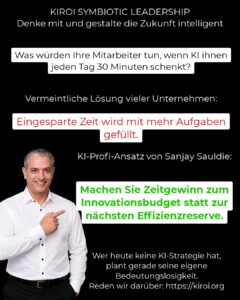
Most organizations follow an approach that seems completely logical at first glance: With intelligent technologies, we can do the same work faster. This mindset has firmly established itself in boardrooms and management meetings because it is easy to communicate and seemingly easy to measure. For example, a manufacturing company automates its quality control and reduces the testing time per unit from five minutes to thirty seconds. A logistics provider implements intelligent route planning, thereby saving twenty percent in travel time. A financial services provider speeds up the credit approval process from three days to a few hours. All these examples sound impressive and are proudly presented in business reports.
However, behind this facade of progress lies a serious problem. Accelerated processes are rarely fundamentally questioned, but merely optimized in their existing form. An insurance company speeds up the processing of claims without checking whether certain verification steps are still meaningful at all. A retail company automates its reporting process, even though no one actually reads the reports or draws conclusions from them. An energy provider digitalizes its customer correspondence without analyzing which communication is actually necessary. These examples illustrate that speed alone does not create value.
Transruptional coaching closely accompanies executives in this realization and helps them ask the right questions before making technology decisions. Often, clients report that it was only through this reflection that they understood why their previous digitalization projects had not delivered the expected results.
The revolutionary AIROI AI approach: Elimination before acceleration
The AIROI-methodology follows a fundamentally different approach. AI approach, which overturns established thinking. Instead of accelerating existing work, the principle is: First eliminate unnecessary work. This seemingly simple insight has far-reaching consequences for a company’s entire digital strategy. A mechanical engineering company discovered during an AIROI analysis that forty percent of its internal approval processes had grown historically and offered no real added value anymore. A pharmaceutical company recognized that certain documentation requirements stemmed from long-outdated compliance regulations. A telecommunications provider found that its customer service tickets were largely caused by confusing product descriptions.
The AIROI-approach consistently distinguishes between value-adding work, necessary but not value-adding work, and pure waste. This categorization enables companies to allocate their limited resources where they can make the greatest difference. A automotive supplier reduced its project documentation by sixty percent without compromising on quality. A chemical company eliminated duplicate approval loops that no one had questioned for years. A medical technology manufacturer radically simplified its production planning, thereby gaining capacity for real innovation work.
Best practice with a AIROI customer A medium-sized manufacturing company originally came to us with the desire to accelerate its order processing through intelligent automation. However, the initial analysis conducted as part of the transruptions coaching revealed a completely different picture of the situation. It turned out that almost thirty percent of all orders went through internal corrections because information between sales and production was not transmitted correctly. Instead of accelerating these faulty processes, we worked together to identify the causes of these information gaps and systematically eliminate them. The result exceeded all expectations: the throughput time was reduced by forty-five percent, not through faster processing, but by eliminating rework loops. The resources saved could be used for developing new products, which led to significant sales growth in the long term. This example impressively shows that the right approach is not always the obvious one.
Why this AI approach challenges leaders
Implementing the AIROI-principle requires courage and the willingness to question established structures. Leaders must admit that processes they may have introduced themselves are no longer relevant. A manager of a construction company had to accept that his elaborate project controlling caused more work than it saved. A sales manager of a software company realized that her weekly reporting requirements hindered the team more than they supported. A production manager of a consumer goods manufacturer found that certain quality controls had arisen out of fear of problems that had long since been resolved.
These findings are uncomfortable, but they form the foundation for real transformation. Transruptive coaching supports leaders in constructively shaping this self-reflection and deriving concrete action steps from it. Insights from external perspectives help overcome operational blind spots and identify new opportunities.
Practical steps for implementing the right AI approach
The implementation begins with a systematic inventory of all activities and processes. A food manufacturer mapped out all the steps of the process from ordering to delivery, identifying numerous redundant activities [1]. A mechanical engineering company analyzed its communication flows and discovered that certain information was forwarded five times before reaching the actual recipient. A textile company examined its product development and found that design variants were created that never made it to production.
In the second step, each activity is critically evaluated using clear criteria. What value does this activity create for the customer? What regulatory requirements does it fulfill? What would happen if we simply removed it? These questions often lead to surprising findings. An electronics manufacturer found that certain test protocols had not been evaluated for years [2]. A packaging company realized that its elaborate supplier audits yielded little insight that was not already known from other sources. A furniture manufacturer discovered that customer complaints were often caused by unnecessary product complexity.
Only in the third step does intelligent technology come into play, and that is where it can create real value. A steel manufacturer did not automate its entire planning, but specifically focused on bottleneck analysis. A plastic processor only deployed intelligent systems where they could actually improve decisions. A glassmaker focused its digital investments on areas with demonstrable improvement potential.
Best practice with a AIROI customer An internationally operating company in the field of industrial manufacturing had already invested significant sums in various automation solutions without achieving the hoped-for productivity increases. In the course of intensive collaboration, we jointly analyzed the entire value chain and found that many automated processes were based on historically based assumptions that were no longer relevant. For example, inventory levels were automatically reordered even though the underlying demand forecasts were systematically too high. Similarly, quality reports were automatically generated that no one needed or evaluated anymore. Through the consistent application of the AIROI-principle, we were able to identify which automations actually created value and which merely accelerated waste. The company was thus able to reduce its technology costs by more than thirty percent while significantly increasing operational efficiency. This transformation required time and the willingness to question cherished systems, but the results speak for themselves.
The strategic dimension of job elimination
Eliminating unnecessary work has far-reaching strategic implications that go beyond pure efficiency gains. A machine tool manufacturer gained the capacity to expand its service business through process simplification. A precision parts manufacturer was able to respond more quickly to customer requests by eliminating bureaucratic hurdles. An equipment manufacturer used the freed up resources to develop sustainable product alternatives.
These strategic advantages do not arise by chance; they are the result of a conscious prioritization. Transruptive coaching helps companies recognize these connections and utilize them purposefully. Leaders learn to distinguish between short-term efficiency gains and long-term competitiveness [3].
My AIROI Analysis
The intensive discussion on the topic clearly shows that the prevailing approach in many organizations needs to be fundamentally overhauled. The reflex-like acceleration of existing processes often leads to the opposite of the desired results in most cases; it often exacerbates existing problems. My experience from numerous consulting projects and coaching engagements confirms that companies that initially eliminate unnecessary work achieve significantly better results than those that automate every process without distinction. The AIROI-approach offers a structured framework for systematically addressing this transformation and achieving both short-term successes and long-term competitive advantages. Particularly important is the realization that technology is always only a tool and must never be an end in itself. True art lies in asking the right questions before seeking technological answers. Leaders who embrace this paradigm shift often report a fundamental change in their perspective on digitalization and innovation. They recognize that less is often actually more and that real productivity gains often arise from simplification rather than complexity growth. This insight requires courage and the willingness to question established paradigms, but it forms the foundation for sustainable business success in an increasingly dynamic business world.
Further links from the text above:
[1] McKinsey – Lean Management Insights
[2] Harvard Business Review – Process Improvement
[3] Gartner – Digital Transformation Insights
Are you a leader and would you like to learn how you can genuinely introduce AI into your company in a valuable and sustainable way, away from the hype? Take part Contact us or read more blog posts on the topic Artificial intelligence here.








 Deutsch
 English (UK)