
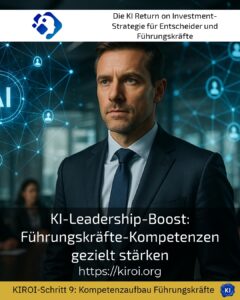
Imagine that your entire organization could undergo a fundamental change within a few months. The decision-makers in your company are facing an unprecedented transformation, because the AI Leadership Upgrade: Equipping Leaders for the Future It becomes the core competency of choice. While many organizations are still hesitant, others have already realized that technological progress remains ineffective without human leadership excellence. The ability to strategically deploy intelligent systems and navigate teams through change processes is what distinguishes successful companies from those that fall behind. In this article, you will learn how to actively shape this transformation.
Understanding the new reality for decision-makers
The working world is changing at a speed that many people are surprised by. Leaders often report uncertainties in dealing with new technologies [1]. This uncertainty is understandable and widespread. At the same time, enormous opportunities are opening up for those who are willing to learn. For example, a manufacturing company in mechanical engineering faced the challenge of optimizing processes. The management realized that traditional methods were no longer sufficient. Through targeted guidance, the team developed a new understanding of data-driven decision-making. A medium-sized automotive supplier, in turn, took the opportunity to fundamentally rethink its quality control. The management level invested in its own development and thereby accompanied the entire change. A logistics company also transformed its route planning through intelligent support. These examples show how diverse the application possibilities are.
AI leadership upgrade as a strategic necessity
Many clients come to transruptive coaching with specific questions. They want to understand how they can prepare their teams for change. Others are looking for ways to meaningfully integrate technological innovations into existing structures. Guiding such projects requires both technical understanding and human empathy [2]. For example, a pharmaceutical company wanted to accelerate its research processes. The management team needed guidance to engage its employees. Through continuous support, it was possible to overcome resistance and spark enthusiasm. A financial services provider, on the other hand, sought ways to improve customer consultations. The consultants were gradually introduced to new tools. A third example comes from an energy provider that wanted to modernize its network monitoring. Here, it became clear that the human factor remains crucial.
Best practice with a AIROI customer
An international manufacturing company turned to transruptions coaching with a clear challenge. The middle management felt overwhelmed by the speed of technological change. The management had already made extensive investments in intelligent systems. However, there was a lack of acceptance and understanding among the operational management. As part of the coaching, individual conversations were initially conducted with all involved parties. It became apparent that many fears were based on a lack of information. Through customized workshops, these fears could be addressed. The participants gradually developed a new understanding of their role. They understood that technology would support them and not replace them. After six months, eighty percent of the management reported increased self-confidence. The productivity of the entire department increased by fifteen percent. Particularly noteworthy was the improved communication between the hierarchical levels. This project demonstrates how important human accompaniment is in the context of technological transformations.
Developing competencies for leadership of tomorrow
The requirements for modern executives have become diverse and demanding. In addition to professional expertise, they need emotional intelligence and a basic understanding of technology. Clients often report a desire for concrete guidance. They want to know which skills they should prioritize. A retail company specifically invested in the training of its store managers. They learned how to use data-based insights for assortment decisions. A construction company, in turn, trained its project managers in using digital planning tools. The results exceeded the original expectations significantly. A media company also focused on continuously developing the competencies of its editorial teams. These examples illustrate the range of possible applications [3].
Developing leaders fit for the future
The concept of AI Leadership Upgrade: Equipping Leaders for the Future It encompasses several dimensions. First, it involves understanding the technological possibilities and limitations. Then comes the ability to translate these insights into strategic decisions. Finally, communication with various stakeholders is crucial. One telecommunications company developed an internal mentoring program for these purposes. Experienced executives mentored younger colleagues in their initial steps. An insurance company established regular exchange formats between IT and specialist departments. A retail company, in turn, created experimental spaces for innovative ideas. These diverse approaches illustrate the diversity of successful strategies.
Transruptions Coaching positions itself clearly as a companion in such transformation projects. The support is provided individually and adapted to the specific situation. It is not about prefabricated solutions, but about joint development. For example, a healthcare provider required special sensitivity due to patient data. The coaching took ethical aspects and regulatory requirements into account. A manufacturing company, on the other hand, focused on integrating different locations. A software developer, finally, wanted to further develop his agile methods. Each of these projects required a customized approach.
Cultural change as the foundation for sustainable transformation
Technological change can only be achieved on the foundation of an open corporate culture. Leaders must create an atmosphere that allows for experimentation and tolerates mistakes [4]. Often, clients report cultural barriers in their organizations. Overcoming these requires patience and consistent action. One chemical company launched an initiative to promote a culture of innovation. Employees were encouraged to submit their own improvement suggestions. A textile manufacturer established regular innovation days for all employees. A food producer, in turn, created cross-functional project teams. These measures contributed to a noticeable cultural change.
Best practice with a AIROI customer
A medium-sized family-run metalworking company faced a generational change. The younger generation wanted to introduce modern technologies and digitize processes. The older generation, on the other hand, relied on proven methods and personal experience. These different perspectives led to tensions within the management team. Transruptive coaching began with a careful analysis of the situation. In individual conversations, the needs and concerns of all parties were captured. It became clear that both sides could contribute valuable insights. The experience of the older generation was indispensable for understanding customer relationships. The younger generation’s technological understanding opened up new possibilities. Through moderated workshops, the team developed a shared vision. This vision integrated traditional values with innovative approaches. After a year of mentoring, all involved reported improved collaboration. The company was able to significantly increase its competitiveness while maintaining family harmony. This case illustrates impressively how important the human dimension remains in the context of technological transformations.
Embedding AI leadership upgrade in practice
The practical implementation of a AI Leadership Upgrade: Equipping Leaders for the Future requires a structured approach. First, the current competencies and development needs should be analyzed. Then, the definition of concrete learning objectives and milestones follows. Finally, continuous reflection and adaptation are crucial. One electronics company established quarterly reviews of its leadership development. One furniture manufacturer relied on individual development plans for each leader. A transport company, in turn, combined face-to-face workshops with digital learning formats. These different approaches can be adapted depending on the context [5].
The topics that people come to transruptive coaching with are diverse. Some seek support in the strategic realignment of their department. Others want to develop their personal leadership skills. Still others need guidance in designing change processes. One mechanical engineering company wanted to transform its service department. The coaching focused on integrating predictive maintenance systems. A consumer goods manufacturer, in turn, sought ways to personalize its products. A service company, finally, wanted to optimize its customer interactions. Each of these projects required individual guidance.
My AIROI Analysis
The discussion of leadership-related transformation clearly shows that technological change always requires human change as well. Organizations that invest exclusively in technology and neglect the development of their leadership will not achieve the expected results. The examples from various industries illustrate that successful transformation must take place simultaneously on multiple levels. The strategic level defines the direction and creates resources for change. The operational level implements the changes in everyday life and gathers valuable experiences. The cultural level forms the foundation for sustainable development and continuous learning.
The importance of individual coaching in such transformation processes is particularly noteworthy. Standardized programs can provide valuable foundations, but they rarely achieve the depth of customized approaches. Transruptions coaching offers just such individual support for projects involving leadership development. Experience shows that organizations that invest in their leaders are more successful in the long run. They can implement changes more quickly and engage their employees better. Therefore, investing in leadership competencies is not an optional expense, but a strategic necessity for sustainable organizations.
Further links from the text above:
[1] McKinsey – Future of Work Insights
[2] Harvard Business Review – Leadership Topics
[3] World Economic Forum – Future of Work
[4] MIT Sloan – Leadership Research
[5] Gartner – Leadership Development
For more information and if you have any questions, please contact Contact us or read more blog posts on the topic Artificial intelligence here.










 Deutsch
  English (UK)