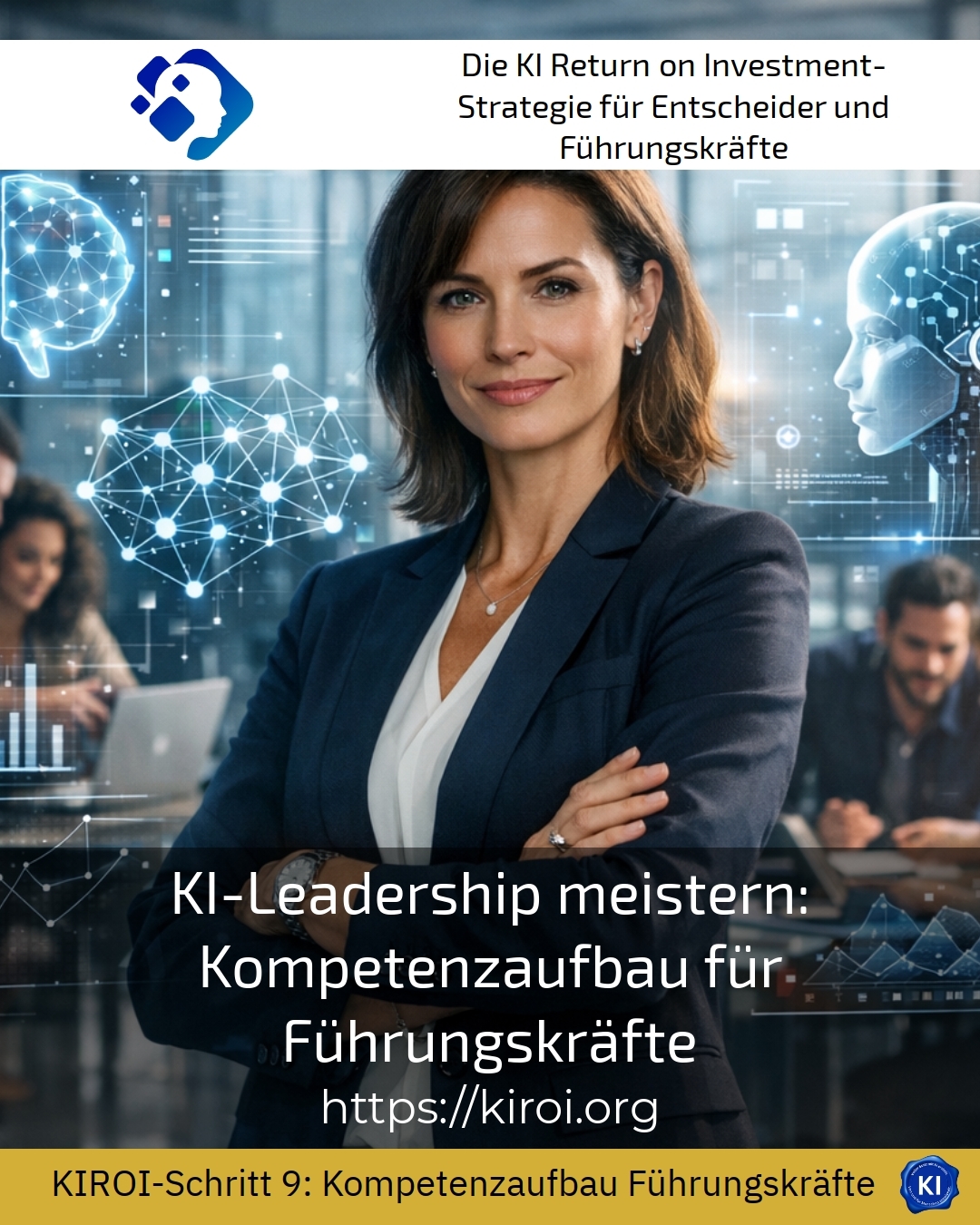
How can leaders ensure that they do not lose their grip in a world full of algorithmic decision-making processes while simultaneously successfully navigating their teams through digital transformation? This question currently concerns decision-makers in almost all sectors of the economy, because the ability to Mastering AI Leadership: Competence Building for Executives It is increasingly becoming the decisive competitive factor. Anyone who still hesitates today risks losing their place in the competition tomorrow. However, the good news is that the path to competent leadership in the age of intelligent systems is teachable. However, it requires courage, openness, and the willingness to question established patterns of thinking.
The changed role of the leader in the age of intelligent systems
The requirements for leadership have fundamentally changed in recent years. In the past, expertise in a specific field and the ability to drive change often sufficed. Today, leaders must also understand how algorithmic systems work. They must also understand the opportunities and risks associated with them. At the same time, they should be able to guide their employees through change processes.
In the banking sector, this change is particularly evident. Branch managers must now understand how credit decisions are supported by algorithms. They help advisors use new tools meaningfully. In addition, they explain to customers why certain decisions are made. In retail, on the other hand, management uses predictive analytics for inventory planning. This optimizes supply chains and personalizes customer interactions. The logistics industry relies on intelligent route planning and automated warehouse management. All of these developments require a new understanding of leadership.
Often, executives report that they feel overwhelmed by the speed of change. They turn to transruptive coaching with questions like these: How do I explain the added value of new technologies to my team? How do I deal with fears of job loss? How do I ensure that ethical principles are upheld? These questions show that modern Mastering AI Leadership goes far beyond technical understanding.
Mastering the technical fundamentals as a foundation for AI leadership
No one expects executives to be able to program themselves. However, a fundamental understanding of the functioning of intelligent systems is essential. Only those who understand how algorithms recognize patterns and make predictions can properly interpret their results. Only then can one ask meaningful questions and avoid making erroneous decisions.
In healthcare, for example, clinical management systems use diagnostic support systems. They need to understand when these systems work reliably. Equally important is knowing where their limits lie. In the manufacturing industry, production managers rely on predictive maintenance. They analyze machine data to avoid breakdowns. Insurance companies use algorithms for risk assessment and damage forecasting. Compliance departments at banks rely on automated fraud detection.
Best practice with a AIROI customer
A medium-sized manufacturing company in the mechanical engineering sector faced the challenge of preparing its production managers for the introduction of intelligent maintenance systems. The management team had decades of experience in traditional manufacturing. However, they had significant reservations about data-driven decision-making processes. As part of the transruptive coaching, we initially developed a customized training program. This program conveyed the fundamentals of machine learning in understandable language. The participants learned how to analyze sensor data and what conclusions can be drawn from it. Particularly important was the realization that human expertise and algorithmic analysis complement each other. After six months of mentoring, the management team reported a significantly increased level of confidence. They were now able to make informed decisions about the deployment of the new systems. Team acceptance increased significantly. Unplanned machine outages were reduced by over thirty percent. This success shows how important continuous support in competence development is.
Emotional intelligence and change management as key competencies
Technical knowledge alone is not enough to lead teams successfully through digital transformation. At least as important are emotional intelligence and strong skills in change management. Leaders must take fears seriously while simultaneously fostering enthusiasm for new opportunities. They must recognize resistance and be able to constructively handle it.
In customer service, team leaders often experience uncertainty among their employees. Chatbots are handling more and more standard requests. The remaining tasks are becoming more complex and demanding. In accounting, intelligent systems are increasingly automating routine tasks. Accounts staff are wondering what role they still have left. In journalism, algorithms are already generating simple text messages. Editors must redefine their core competencies.
Transruptive coaching helps leaders overcome these challenges. We provide guidance for difficult conversations and support the development of individual communication strategies. Clients often report that after undergoing the coaching, they have become more confident in dealing with resistance to change. They have learned to authentically discuss uncertainties while still providing guidance.
Ethical leadership and responsible technology use in building competence for executives
The question of ethical principles is gaining increasing importance in the context of intelligent systems. Leaders have a responsibility to ensure that technology is used in accordance with societal values. They must ensure that algorithmic decisions are understandable and fair. Discrimination caused by biased datasets must be actively prevented.
Human resources managers in larger companies are increasingly relying on algorithmic pre-selection of applicants. They need to understand the biases that can arise in this process. In law enforcement, predictive systems support deployment planning. Decision-makers must critically question the assumptions underlying these systems. Credit institutions use scoring models for credit decisions. Executives must ensure that these models do not disadvantage certain population groups.
Within the framework of Mastering AI Leadership: Competence Building for Executives Participants develop a sharpened awareness of these issues. They learn to develop ethical guidelines for their company. They establish processes for regularly reviewing algorithmic decisions. This makes responsible technology use part of the lived corporate culture.
Best practice with a AIROI customer
A large insurance company implemented a system for automated damage assessment in car accidents. The relevant department managers were prepared for the implementation through transruptive coaching. First, we jointly analyzed the functioning of the algorithm and its decision logic. It turned out that certain vehicle types were systematically evaluated differently than others. This insight led to a critical review of the training data. The management learned to ask targeted questions of the technical teams. They developed an escalation procedure for contentious cases. Furthermore, they established regular audits to verify the quality of decisions. The employees were actively involved in the process and received clear guidelines for special cases. After the implementation, the processing time was significantly reduced. At the same time, customer satisfaction remained at a high level. The executives reported a strengthened confidence in their own judgment. They now felt able to critically monitor and shape technological developments in a constructive way.
Strategic competence development and lifelong learning
Technological change is advancing at an astonishing pace. What is considered innovation today is already standard tomorrow. Therefore, leaders must foster a culture of lifelong learning and embed it in their organizations. Only then will companies remain adaptable and future-proof.
In the pharmaceutical industry, intelligent systems support drug development. Research leaders must continuously learn to understand new analytical methods. In the energy sector, algorithms optimize grid utilization and energy distribution. Executives must be able to monitor and develop these systems. The automotive industry is working on autonomous vehicles and connected mobility. Project managers need constantly updated knowledge of sensors and machine vision.
Transruptions coaching supports leaders in developing individual learning strategies. Together, we identify knowledge gaps and appropriate training formats. Some clients benefit from structured online courses. Others prefer peer learning within leadership networks. Still others learn best through practical project work. The appropriate strategy varies for each individual.
Networks and collaborative learning for sustainable competence building
No one has to go it alone on the path to competent handling of intelligent systems. Sharing experiences with like-minded people significantly accelerates the learning process. Leadership networks offer valuable opportunities for sharing experiences. Cross-industry perspectives often reveal surprising solutions.
In retail, store managers from different chains exchange their experiences with personalized customer interactions. In the construction industry, project managers discuss the use of Building Information Modeling. Media companies share insights about algorithmic content recommendations and their impact on editorial decisions. Telecommunications providers compare their experiences with automated customer service solutions.
The Mastering AI Leadership Such networks are made much easier by these networks. In transruptive coaching, we actively promote the establishment of such connections. We provide contacts with other leaders facing similar challenges. This creates long-term learning partnerships that extend far beyond the actual coaching support.
My AIROI Analysis
The analysis of numerous coaching projects clearly shows that successful leaders adopt a holistic approach. They combine technical knowledge with strong emotional intelligence and ethical awareness. Particularly successful clients are characterized by their willingness to openly address their own uncertainties. They understand that ignorance is not a weakness, but rather a starting point for growth.
The AIROI methodology has proven to be particularly effective because it systematically addresses all relevant competence areas. Leaders learn to make strategic decisions about the use of technology. They develop communication strategies for their teams and stakeholders. They establish governance structures for responsible technology use. And they embed a culture of continuous learning in their organizations.
It is striking that the greatest leverage often does not lie in the technology itself. Rather, the way leaders communicate with their teams makes the crucial difference. Those who manage to spark enthusiasm for new possibilities while taking fears seriously will be successful. Transruptive coaching can provide valuable impulses in this regard. However, it does not replace the leaders’ own reflection and continuous commitment. The path to mastering intelligent systems is a marathon, not a sprint. But every step along the way pays off, both for the leaders themselves and for their teams and organizations. The journey is a marathon, not a sprint. But every step along the way pays off, both for the leaders themselves and for their teams and organizations.
Further links from the text above:
[1] Transruptions coaching and digital transformation
[2] AIROI Master Plan for Managers
[3] Strategies for the deployment of intelligent systems
For more information and if you have any questions, please contact Contact us or read more blog posts on the topic Artificial intelligence here.






 Deutsch
 English (UK)