
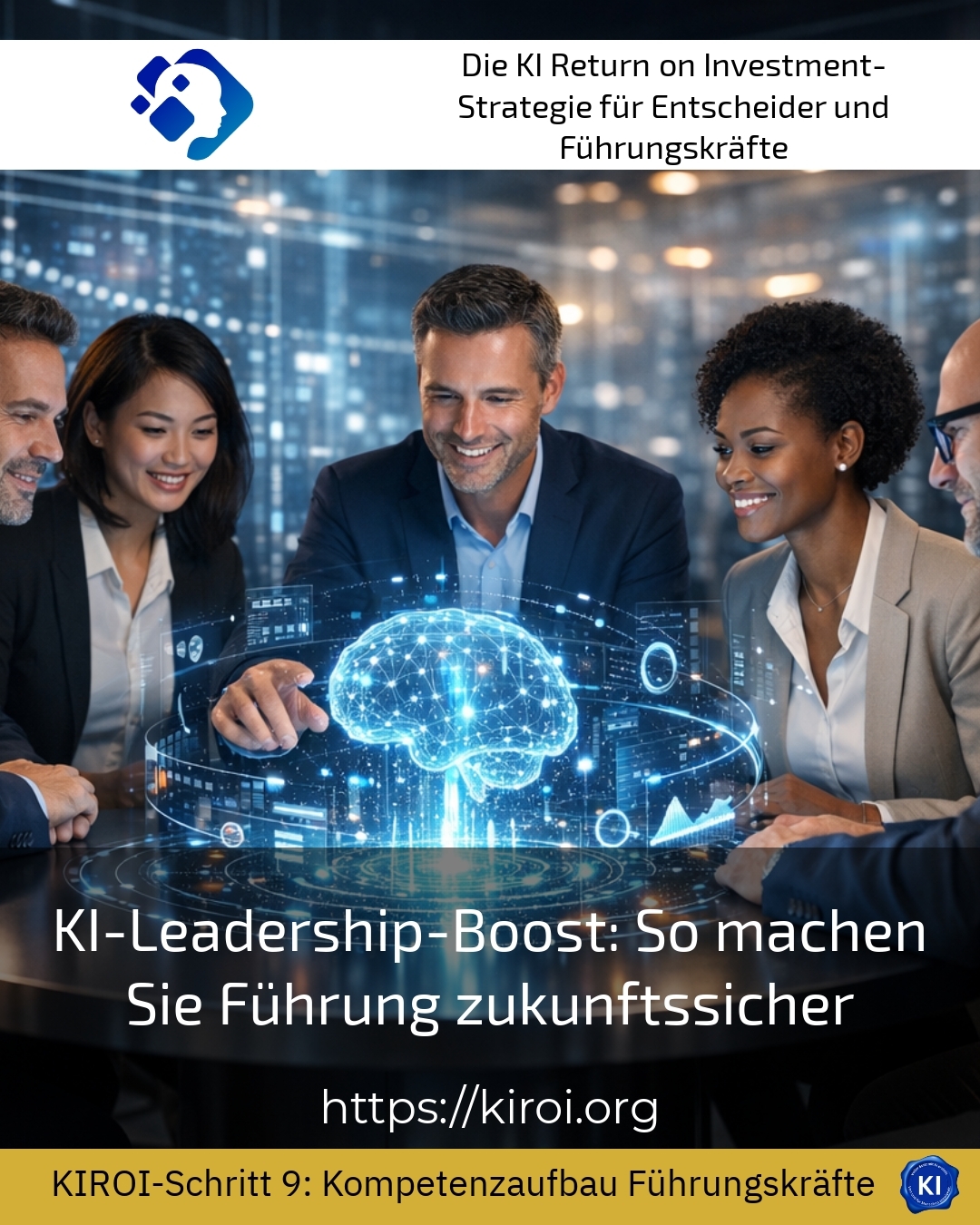
Will you still hold the same leadership role in three years’ time that you have today, or has everything fundamentally changed by then? This question currently concerns countless decision-makers in companies of all sizes, because the rapid technological development is increasingly calling traditional leadership concepts into question. The AI Leadership Boost It offers a promising approach to preparing leaders for the challenges of the coming years. Many leaders report feeling overwhelmed by the speed of change. At the same time, however, enormous opportunities open up for those who are willing to develop their skills and explore new paths.
Understanding the new reality of leadership
The workplace is undergoing a profound transformation that affects all levels of hierarchy and leaves no one untouched. Leaders face the task of leading teams that increasingly need to work together with intelligent systems. In the manufacturing industry, for example, production managers no longer only coordinate human employees; they also coordinate autonomous robotic systems and data-driven planning tools. A logistics company recently reported that their shift managers are now also required to evaluate and integrate the optimization suggestions of intelligent route planning systems. In healthcare, diagnostic assistance systems support medical decision-making, which poses new demands on medical leadership [1].
This development requires a fundamental rethinking of the way leadership is understood and practiced. Traditional command-and-control structures are increasingly giving way to collaborative models in which leaders act as facilitators and enablers. Transruptive coaching accompanies leadership in these very projects around the integration of new technologies into existing leadership structures. Clients often report that they initially feel uncertainty when it comes to redefining their own role. This uncertainty is, however, a natural part of the transformation process and can be constructively utilized with the right guidance.
Why the AI leadership boost has become indispensable today
The need to adapt leadership skills to the new technological realities arises from several converging factors that interact and reinforce each other. First, employees increasingly expect their leaders to be technologically skilled and understand the capabilities of modern systems. Second, competitive pressure and market dynamics require faster decision-making processes that are hardly manageable without technological support. Third, the talent landscape is fundamentally changing as younger generations bring different expectations to leadership and collaboration [2].
This development is particularly evident in the banking sector, where branch managers today have to integrate complex digital consulting tools into their customer interactions. Insurance companies are increasingly relying on automated claims assessment, which fundamentally changes the role of team leaders in the claims departments. In retail as well, regional managers are experiencing that their decisions are increasingly influenced by data-driven analyses that evaluate purchasing behavior and inventory levels in real time.
Best practice with a AIROI customer
A medium-sized machine engineering company faced the challenge of adapting its leadership culture to the increasing digitalization of production processes, with the middle management level in particular needing support. The plant managers and team leaders initially felt overwhelmed by the introduction of connected manufacturing systems and expressed concerns about their future role in the company. Within the framework of a six-month mentoring program, we worked together to develop new leadership competencies that encompassed both technical understanding and advanced communication skills. The leadership team learned to make data-driven decisions while simultaneously guiding their teams through the change process. Particularly valuable was the realization that technology can be understood not as a threat but as an extension of one’s own leadership tools. At the end of the process, the participants reported increased self-confidence and a significantly more positive attitude towards technological innovations. Employee satisfaction in the relevant departments improved measurably because the managers were able to fulfill their new role authentically and competently.
Develop core competencies for future-proof leadership
The leader of the future needs an expanded skill profile that combines traditional leadership qualities with new skills, thus forming a holistic leadership personality. Technological background provides the foundation on which all other competencies can be built. It is not about becoming a programmer yourself, but about understanding the capabilities and limitations of modern systems. In the pharmaceutical industry, for example, research managers must today be able to assess how machine learning can accelerate drug research [3]. Marketing directors in consumer goods companies should understand how predictive analytics can support campaign planning. Human resources managers benefit when they can understand the functioning of recruiting algorithms.
Furthermore, emotional intelligence paradoxically gains importance in an increasingly technologized work environment because it strengthens the human component of leadership. In times of change, employees seek guidance and security that can only be provided by empathetic leaders. The ability to perceive and constructively address fear of change distinguishes outstanding leaders from average managers. AI Leadership Boost Therefore, it always also includes the development of these core human competencies, which cannot be replaced by any technology.
Practical implementation strategies for everyday leadership
Theoretical insight into the need for change is not enough; what is crucial is practical implementation in day-to-day management practices, which often begin with small steps. A proven strategy is to first collect experience with new tools in a limited area before introducing them more widely. In the hotel industry, directors have found that it is beneficial to initially optimize only personnel planning with intelligent systems. Construction companies report that the gradual introduction of project management tools with integrated data analysis has increased acceptance among project managers. In the food industry, quality managers have also learned that the gradual integration of monitoring systems works better than a radical overhaul [4].
Another important aspect is creating a learning organization where experiments are allowed and mistakes are seen as learning opportunities. Leaders should act as role models themselves and make their own learning processes transparent. When a manager speaks openly about his initial difficulties with a new analytical tool, it encourages others to try new things as well. Transruptive coaching provides insights on how to establish such open learning cultures and accompanies leadership teams in their practical implementation.
Best practice with a AIROI customer
A facility management service company realized that its field managers needed support in integrating new digital planning tools that were increasingly influencing operational control. The management team came together on various topics: some felt overwhelmed by the technology, others were concerned about losing their authority if algorithms suggested decisions. In individual coaching sessions, we first identified each participant’s personal strengths and identified areas where technological support could be particularly valuable. Subsequently, we jointly developed concrete action strategies for leadership everyday life that took into account both the human and technical dimensions. The participants learned to actively involve their teams in technology decisions, thereby creating acceptance. After the program concluded, the department managers reported on a new sense of self-worth as technology-savvy leaders. The company saw a significantly improved collaboration between the operational teams and the IT department, because the executives now acted as bridge builders.
Keeping the human dimension in focus
Despite all the enthusiasm for technological possibilities, the human dimension of leadership must never be overlooked, because ultimately, people still work together with other people. AI Leadership Boost It aims to find and maintain this balance, rather than elevating technology for its own sake. In the healthcare industry, facility managers have recognized that digital documentation systems can indeed increase efficiency, but they can never replace the personal interaction with employees. School principals report that administrative automation has given them more time for pedagogical leadership tasks, which ultimately benefits all involved parties. Similarly, in the event industry, event planners continue to rely on interpersonal communication and spontaneous problem solving despite sophisticated planning tools [5].
The art lies in seeing technology as a tool that complements and enhances human leadership qualities, rather than replacing or supplanting them. Empathy, creativity, and ethical judgment remain indispensable leadership competencies that cannot be replaced by even the most sophisticated software. Leaders who have internalized this insight navigate the technological transformation with confidence, taking their teams along for the journey.
The AI leadership boost as a continuous development process
Future-proof leadership is not a state that is achieved once and then preserved; it is an ongoing development process that requires openness and a willingness to learn. The technological landscape is constantly changing, and leaders must be prepared to adapt and evolve again and again. In the automotive sector, production managers experience that the introduction of new manufacturing technologies regularly brings new leadership challenges. Publishing houses report that their editorial directors must constantly grapple with new digital publication formats and working methods. In the energy sector, too, leaders face the task of continuously adapting their competencies to new smart grid technologies.
Transruptive coaching accompanies leadership figures along this continuous journey and provides impulses for continuous development. Many clients report that regular reflection on their leadership practices prepares them better to adapt to changes. The ability to self-reflect and the willingness to question established patterns become key competencies in a changing work environment.
My AIROI Analysis
The analysis of the current leadership landscape clearly shows that a fundamental change is underway that leaves no area untouched and has profound implications for all sectors. Leaders who resist this change not only risk their own professional future but also endanger the competitiveness of their organizations. At the same time, the current situation offers enormous opportunities for those who are willing to further develop their competencies and explore new paths. The key to success lies in combining technological understanding with indispensable human leadership qualities such as empathy, communication skills, and ethical judgment.
What seems particularly significant to me is the realization that future-proof leadership is not a static concept but requires dynamic development that adapts to changing circumstances. Leaders should cultivate an attitude of curiosity and openness that enables them to perceive technological developments as an enrichment rather than a threat. The practical examples from various industries show that successful transformation always succeeds when it is carried out gradually and does not lose sight of the human dimension. Transruptive coaching can provide valuable support and inspiration in these projects related to leadership development. The future belongs to those leadership figures who are prepared to continuously develop themselves and to expertly guide their teams through technological change.
Further links from the text above:
[1] McKinsey – Future of Work Insights
[2] World Economic Forum – Future of Jobs Report
[3] Harvard Business Review – Leadership Resources
[4] Gartner – Future of Work Trends
[5] Forbes – Leadership Section
For more information and if you have any questions, please contact Contact us or read more blog posts on the topic Artificial intelligence here.








 Deutsch
 English (UK)