
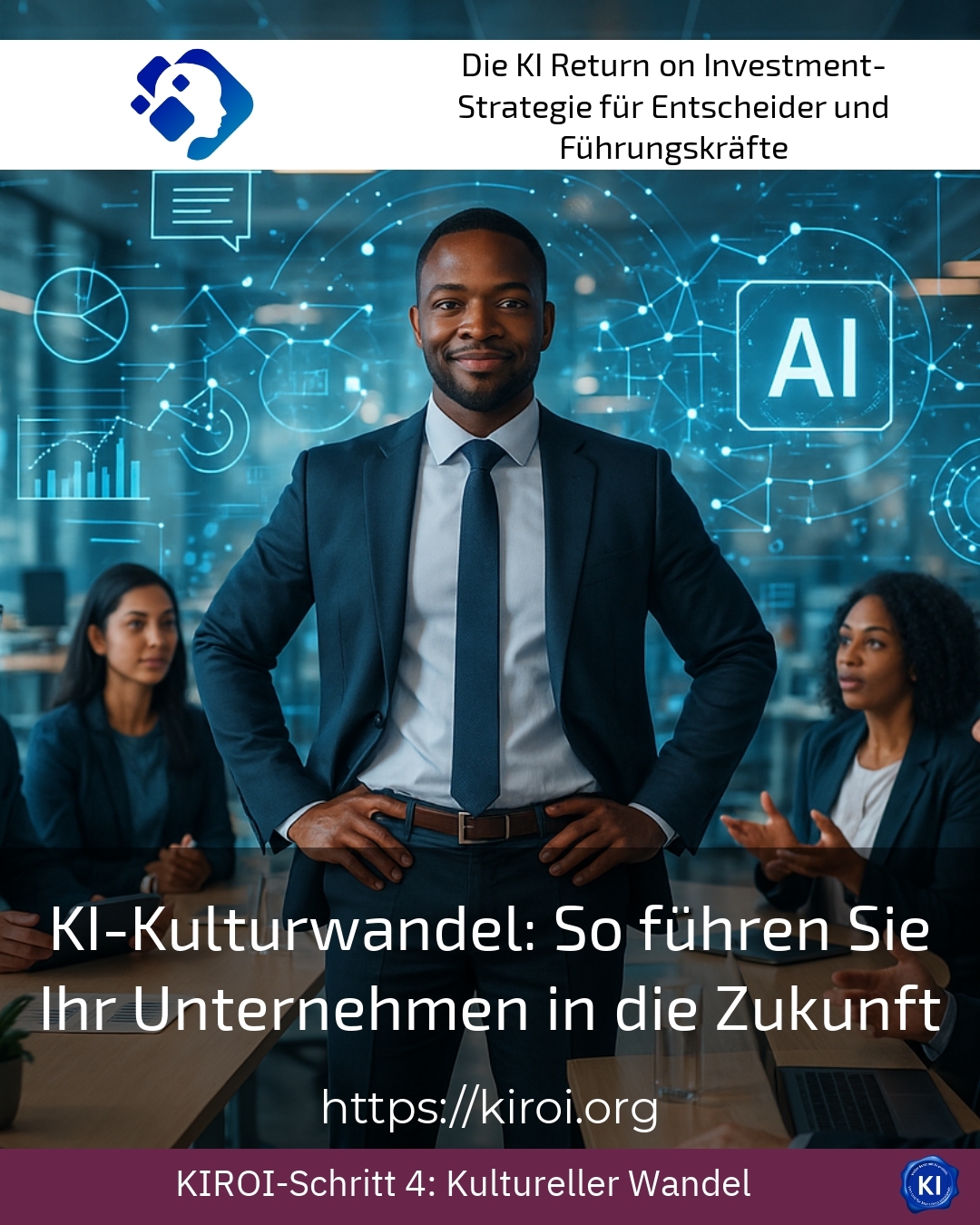
Have you ever wondered why some organisations seem to glide effortlessly into the digital era, while others tread water despite enormous investments and lose touch? The answer rarely lies in the technology itself, but rather in the way people within an organisation think, act and work together. The AI cultural change represents the fundamental transformation that goes far beyond the mere implementation of new software solutions and sustainably alters an organisation's entire value system. In this article, you will learn which concrete steps are necessary to future-proof your organisation while bringing your people along rather than leaving them behind.
Why the traditional approach no longer works
The traditional approach to technological change followed a simple pattern. One bought new systems, trained the employees and then expected a smooth adaptation. However, this method falls short today because complexity has increased exponentially. Leaders frequently report massive resistance within their teams. This resistance does not arise from malice or a lack of intelligence on the part of those affected. Rather, it is a natural protective reaction against perceived threats to one's job and professional identity.
For example, a medium-sized mechanical engineering company invested considerable sums in automated quality control systems. However, the experienced test engineers felt degraded and subtly boycotted the new systems. They no longer reported faults, failed to keep proper records and deliberately made the technology look bad. A logistics company experienced similar challenges when introducing route optimisation. The drivers systematically ignored the suggestions because they felt their years of experience were not being appreciated. A traditional retailer also initially failed when digitalising its sales processes. The long-standing sales advisors saw the new systems as a threat to their customer relationships.
Best practice with a AIROI customer
A manufacturing company in the field of precision mechanics faced the challenge of intelligently automating its production processes, with the long-standing skilled workers initially showing massive reservations and feeling that their expertise was under threat. As part of the transruptions coaching support, a comprehensive sentiment analysis was first carried out, which brought to light surprising insights and revealed the true fears of the workforce. It turned out that the resistance stemmed less from being overwhelmed by the technology and more from the concern that the specialist knowledge built up over decades would suddenly become worthless and no longer needed. The solution was to actively involve the experienced employees in the development process and turn them into internal ambassadors. They were appointed as mentors for the new systems and given the task of feeding their knowledge into the digital processes. This approach not only led to significantly higher acceptance, but also considerably improved the quality of the implemented solutions, because the practical empirical knowledge of the specialists was incorporated into the systems, making them more practical for everyday use.
The AI culture change begins in people's minds
True transformation first takes place at the level of beliefs and attitudes. Before new tools are introduced, people must understand why this change is necessary. They need to grasp what personal benefit they can gain from it. And they require the reassurance that their jobs are not under immediate threat. This understanding does not come about through PowerPoint presentations or management circulars.
It requires real conversations, authentic listening, and credible commitments. A pharmaceutical company, for instance, introduced weekly dialogue sessions where concerns could be openly addressed. A financial services provider set up anonymous feedback channels that provided astonishing insights into the actual worries of the workforce. A technology corporation went even further and had skeptical employees actively participate in the selection of new systems.
Leaders as drivers of AI cultural change
The role of leaders in this process cannot be overstated. They are the ones who interact with their teams on a daily basis and signal through their own behaviour what really matters. A leader who themselves exhibits reservations about new technologies will hardly be able to advocate for their introduction with any credibility. At the same time, leaders must not become mere tech evangelists who ignore the legitimate concerns of their employees.
An energy supplier intensively trained its department heads in change communication before the actual technical transformation began. A healthcare provider invested in leadership programmes specifically tailored to supporting transformation processes. A retail company established a mentoring system in which digitally savvy young managers supported experienced colleagues, thereby enabling cross-generational knowledge exchange.
Best practice with a AIROI customer
A medium-sized corporate group from the service sector had already been through several failed transformation attempts when it decided to use transruptive coaching support and chose a completely new approach. The previous projects had always been carried out by external consultants who were technically proficient, but did not understand the company culture and consequently failed. In the coaching process, a detailed cultural analysis was carried out first, uncovering hidden patterns and unspoken rules that had sabotaged previous efforts. It became apparent that a strong informal hierarchy existed, running parallel to the official organisational structure and having a significant influence on all decisions. The solution consisted in specifically identifying these informal opinion leaders and involving them in the transformation process at an early stage, rather than bypassing them. These key individuals were turned into allies for change, which fundamentally altered the entire process and ultimately led to success because the actual decision-making pathways were now taken into account.
Practical steps towards sustainable transformation
The path from the status quo to a future-proof organisation requires a systematic approach that addresses various dimensions simultaneously. It is not enough to tweak just one adjustment screw. Rather, structures, processes, competencies and culture must be developed further in synchronisation. This sounds overwhelming at first, but can be broken down into manageable steps that can be tackled sequentially or in parallel.
The first step is always an honest assessment of the current situation. Where do we really stand, not where do we think we stand? What competencies are already present, which are missing? Which cultural patterns support the change, which hinder it? An automotive supplier carried out a comprehensive skills analysis that revealed significant knowledge gaps in middle management. An insurance company realised that its corporate culture was strongly geared towards risk avoidance, which systematically prevented innovation. A media company discovered that despite modern technology, internal communication channels were outdated and information was not flowing.
Skills development as the key to success
The development of new skills is a central building block of any successful transformation. This is by no means just about technical capabilities, although these are naturally important. So-called soft skills such as critical thinking, creativity and the ability to collaborate in diverse teams are at least as significant. These competencies cannot be taught in traditional training sessions, but require new learning formats.
A consulting firm established internal learning communities where employees could learn from each other and exchange experiences. An industrial company set up digital experimentation spaces where new technologies could be tried out without production pressure. A telecommunications provider introduced job rotation programmes that fostered understanding of other company departments and broke down silo mentality.
The importance of a culture of error and psychological safety
Transformation inevitably means entering uncharted territory and making mistakes along the way. Organisations that punish or stigmatise mistakes will never be able to unlock the full potential of their employees. Instead, people will play it safe and keep innovative ideas to themselves. A genuine culture of learning from mistakes is not created through lip service, but by the management team actively leading by example.
A software company introduced so-called Failure Fridays, where failed projects were analysed and the learnings shared. A consumer goods corporation established a reward system that also gave recognition for well-reasoned but ultimately unsuccessful experiments. A family-owned business in the construction industry set up an anonymous reporting system for near misses, which provided valuable insights into potential vulnerabilities without exposing individual employees.
Best practice with a AIROI customer
A traditional food industry company was struggling with a pronounced fear-based culture that had grown historically and stifled every change initiative in the bud because nobody wanted to take risks. As part of the transruptions coaching support, a safe environment was initially created in which employees could speak openly about their experiences for the first time without having to fear consequences. The discussions revealed that in the past, several employees had been demoted or even dismissed after failed projects, which had deeply embedded itself in the collective memory. The management then decided on a symbolic act and publicly apologised for past poor decisions in dealing with mistakes. In addition, new guidelines were developed that regulated the constructive handling of mistakes as binding rules and provided for sanctions for exposing colleagues. Over several months, these measures led to a noticeable change in the company climate and, for the first time, enabled genuine innovation and a willingness to experiment, as the fear of negative consequences was gradually dismantled.
Communication as a success factor in the AI cultural shift
No transformation succeeds without well-conceived and continuous communication. People want to understand what is happening, why it is happening and how it affects them personally. One-off announcements are not enough to meet these needs. Instead, what is needed is an ongoing dialogue that uses various channels and formats to reach different target audiences.
A chemical company established a weekly transformation newsletter that reported on progress and challenges alike. A logistics group set up an internal podcast series in which employees from various departments talked about their experiences. A fashion company used its internal social network to share success stories while simultaneously enabling an open exchange that reduced the distance between management and the workforce.
My AIROI Analysis
The AI cultural change is not a one-off initiative, but an ongoing process that is never truly completed because the technological and social framework conditions are constantly evolving. Organisations that successfully shape this change are characterised by a few common features that I have repeatedly observed in my work and which can serve as guidance.
First, they consistently put people at the heart of their efforts. Technology is a tool, not an end in itself. Second, they create spaces for genuine dialogue and take their employees' concerns seriously. Third, they invest sustainably in skills development and view learning as a continuous process. Fourth, they establish a culture of error that enables experimentation and learns from failures rather than punishing them.
The transruptions coaching support helps organisations to translate these principles into their specific reality and develop tailored solutions. This is not about off-the-shelf recipes, but about individual paths that fit the respective culture and available resources. Clients frequently report that it was only through this intensive support that the true obstacles became visible and could be overcome [1]. Investing in a consciously designed cultural shift pays off many times over, not only in better business results, but also in higher employee satisfaction, lower staff turnover and a positive corporate reputation, which is becoming increasingly important in the competition for talent [2].
Further links from the text above:
[1] AIROI-Blog: Artificial Intelligence and Transformation
[2] transruptions Coaching: Contact and Consultation
For more information and if you have any questions, please contact Contact us or read more blog posts on the topic Artificial intelligence here.







 Deutsch
 English (UK)