
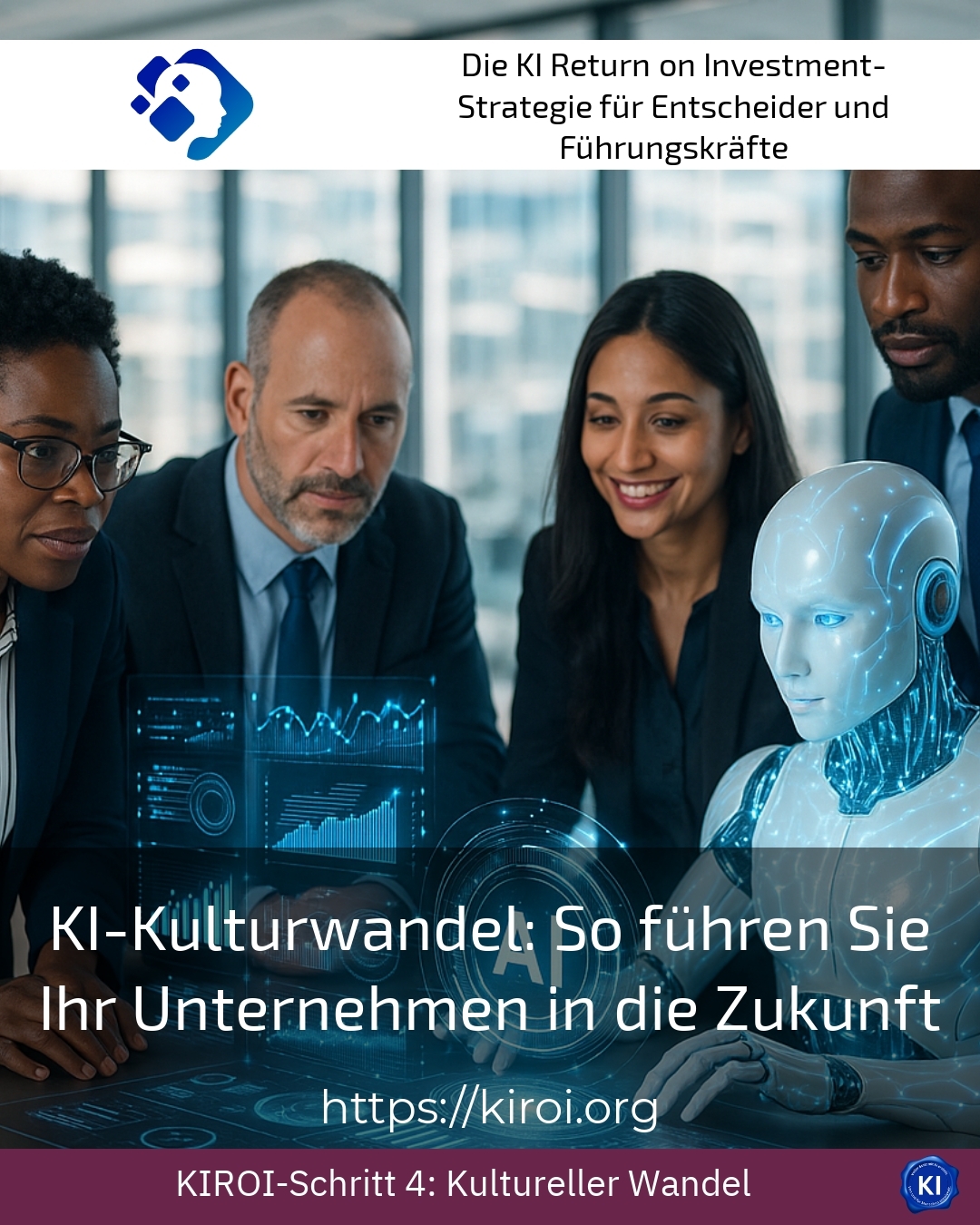
Imagine your company fully utilises intelligent systems. Employees work more efficiently and are more satisfied. Customers receive faster responses. Does that sound like science fiction? AI cultural change makes precisely this possible. However, many companies face enormous challenges. They may have the technology, but the people are not on board. This is exactly where this article comes in. It shows you concrete ways for your transformation. You will learn which steps really work. Furthermore, you will learn from real-life case studies. The change doesn't start with machines. It starts with the people in your company.
Why the AI cultural shift means more than just technology
Many executives underestimate a crucial factor. They invest millions in software and infrastructure. But they forget the human component. A manufacturing company in the automotive sector installed state-of-the-art analysis systems [1]. However, employees barely used them. The reason was a lack of training and fear. A logistics company experienced something similar when introducing automated route planning. The drivers preferred to trust their experience. Only after intensive discussions did behaviour change. A third example comes from the retail sector. There, intelligent inventory management systems were introduced. The branch managers consistently ignored the recommendations at first. All these cases clearly show one thing. Technology alone does not solve problems. You need a real cultural change. This change affects values, attitudes, and daily habits. transruptions-Coaching supports companies precisely with this challenge. The support includes communication, training, and leadership development.
The three pillars of successful change
Successful transformation rests on three stable pillars. The first pillar is communication. Employees must understand why something is changing. A financial services provider communicated the introduction of new systems transparently. They explained the benefits for each individual role. The result was significantly higher acceptance. The second pillar encompasses qualification and further training. People need competence to use new tools. A medium-sized mechanical engineering company set up internal academies. There, employees learned at their own pace. The third pillar concerns the leadership culture itself. Managers must embody and promote the change. An energy supplier intensely trained its leaders. They became ambassadors for the new way of working. All three pillars interlock. If one is missing, the entire project falters.
Best practice with a AIROI customer
An internationally operating mechanical engineering group faced a huge challenge. The company wanted to introduce intelligent maintenance systems in all production halls. Initial scepticism among the technicians was enormous. Many feared their expertise would be devalued. Others were afraid of job losses due to automation. Management opted for a supported transformation process. Within the framework of the AIROI methodology, we first analysed the existing corporate culture. We identified key individuals in various departments and plants. These individuals were trained and supported as internal champions. They received special training on the new systems. At the same time, they learned to address the concerns of their colleagues. The company established and maintained regular dialogue forums. There, all employees could ask questions and provide feedback. Managers actively participated in these forums. They demonstrated their openness to discussion. After six months of intensive support, a significant change was evident. Acceptance of the new systems increased by over fifty percent. Employees frequently reported positive experiences in their daily work. They recognised the added value of the technology for their work. The group today saves considerable costs through predictive maintenance.
Understanding and constructively using resistance in AI-driven cultural change
Resistance to change is entirely normal and human. It often contains valuable information for leadership. A pharmaceutical company experienced massive rejection during digitalisation [3]. The research department did not want to give up established processes. Management initially did not listen properly. Only when projects failed did the approach change. They began to take the concerns seriously. This resulted in improved solutions for everyday work. An insurance group had similar experiences in customer service. Clerks resisted automated claims processing. They feared for the quality of customer relationships. This concern was justified and valuable. The company adjusted the degree of automation accordingly. A retail company used the resistance of its salespeople productively. Employees had concerns about algorithmic sales recommendations. Their objections led to a hybrid model. Today, the systems provide support but do not replace expertise.
Practical strategies for addressing concerns
The first step is active listening without judgment. Employees immediately sense whether their concerns are being taken seriously. A telecommunications provider introduced structured feedback rounds [4]. These took place weekly during the transition phase. Every voice was documented and addressed. The second step involves transparent communication about consequences. People are less afraid when they have clarity. A construction company communicated openly about changes in roles. There were no layoffs, but new areas of responsibility emerged. This honesty built trust in the process. The third step includes quick successes for everyone involved. People need positive reinforcement for new behaviour. A media company celebrated small milestones publicly and regularly. This motivated even sceptical employees to participate.
Best practice with a AIROI customer
A large retail chain with several hundred branches embarked on an ambitious project. The goal was to implement intelligent demand forecasting for all locations. Initially, the store managers showed considerable scepticism. They trusted their many years of experience more than algorithms. Many also had concerns regarding data security and surveillance. We supported this transformation process intensively with the AIROI methodology. First, we conducted one-on-one interviews with selected store managers. We wanted to understand their specific concerns and needs. This revealed a recurring pattern quite clearly. People felt overlooked and undervalued. Their experience seemed to count for nothing suddenly. Based on these findings, we developed an adapted approach. The intelligent systems were positioned and communicated as assistants. They were intended to complement and support human expertise. Store management retained the final decision-making authority at all times. Additionally, we established a mentoring programme between the branches. Experienced managers mutually supported colleagues during the onboarding process. This peer learning proved to be extremely effective. After nine months, over eighty percent of the branches were using the systems regularly. Stock accuracy measurably improved by approximately thirty percent.
Leaders as drivers of cultural change
The role of leaders cannot be overstated. They are role models, communicators and enablers all at the same time. An automotive supplier comprehensively trained its entire management level [5]. The managers didn't just learn about the technology. They also developed new leadership skills for the transformation. A chemical company chose a different, interesting approach. There, leaders and employees were trained together. This significantly promoted mutual understanding. A third example comes from the food industry. The managing director used the new analysis tools himself daily. He thereby demonstrated the practical relevance visibly to everyone. This role model function was more effective than any presentation. transruptions-Coaching supports leaders in this demanding task. The coaching provides impetus for authentic communication and leadership.
New skills for a new world of work
Leaders today require different skills than they did years ago. A basic technical understanding is becoming increasingly important for all levels. An industrial company therefore offered special courses for its management [6]. The managers learned the fundamentals of intelligent systems. At the same time, the importance of emotional intelligence in leadership positions is growing. People need special attention during times of change. A logistics group therefore integrated coaching elements into its management development. The managers were made aware of their teams' anxieties. Furthermore, the ability to tolerate ambiguity is gaining importance. Not everything can be clearly planned during transformation phases. A retail company explicitly trained its managers in this competence. They learned to deal with uncertainty constructively and to lead.
Sustainable anchoring of the AI culture change within the organisation
One-off initiatives often fizzle out again after a short time. Cultural change must be permanently embedded in structures. A financial institution therefore adjusted its promotion criteria accordingly [7]. Digital competence and a willingness to change became important factors. A technology company explicitly integrated transformation goals into its objective agreements. Each manager had measurable targets for cultural change. An energy provider established a permanent staff unit for cultural development. This unit coordinated all activities in a long-term and systematic manner. Such structural measures ensure the sustainability of the change. They prevent old patterns from returning after the implementation phase. Transruptions Coaching also supports companies in this critical phase. The support helps to stabilise and expand the progress made.
Establish measurability and continuous improvement
What isn't measured can't be improved. This is why companies need key performance indicators for cultural change. A mechanical engineering firm developed its own transformation index for itself [8]. This measured employee acceptance, usage, and satisfaction. A pharmaceutical company conducted regular pulse surveys on change-related topics. The results were directly incorporated into strategy adjustments. A third example highlights the importance of qualitative data as well. An insurance group conducted in-depth interviews with selected employees. These discussions provided valuable insights beyond the numbers. The combination of quantitative and qualitative methods has proven effective through experience. It enables a comprehensive picture of cultural development.
Best practice with a AIROI customer
A medium-sized logistics provider with a European network sought our support. The company had already invested significantly in intelligent route optimisation. The technical implementation was complete and was generally working well. Nevertheless, the expected efficiency gains fell far short of the forecasts. The drivers used the systems only reluctantly and sporadically. Many ignored the recommendations and continued to drive their usual routes. We began with a comprehensive analysis of the on-site situation. We personally accompanied drivers on their daily routes. We conducted informal discussions in break rooms and during vehicle handovers. It became clear that the implementation had been too rapid. The drivers had had no opportunity to get to know the systems. Furthermore, they lacked an understanding of the underlying logic. At our recommendation, the company launched a supplementary training initiative. Experienced dispatchers explained how the systems worked in an understandable way. Additionally, we set up a feedback system for route suggestions. The drivers could now contribute their practical experience and make improvements. This feeling of co-creation fundamentally changed their attitude. After four months, system usage increased to over ninety percent. Fuel costs decreased by twelve percent compared to the previous year.
My AIROI Analysis
The AI cultural change presents companies with fundamental challenges. My experience from numerous support projects shows clear patterns. Successful transformations always begin with people and never with technology. Companies that involve their employees early on achieve better results. They build trust through transparent communication and genuine participation from everyone. Leaders play an absolutely crucial role in the entire process. They must live the change and actively support their teams. Technical competence alone is not enough for this in everyday work. Emotional intelligence and empathy are becoming increasingly important for leaders. The AIROI methodology addresses precisely these human factors systematically and in a structured way.
What seems particularly important to me is the sustainable anchoring of all changes. Too many initiatives fade away without a trace after initial enthusiasm. Structural adjustments, such as revised promotion criteria, ensure long-term success. Continuous measurement and adaptation of the strategy are equally important. Cultural change is not a project with a defined end. It is an ongoing process that requires permanent attention. Companies that understand this will reap the rewards of their investments. They will become more competitive and attractive to talent in the job market. The satisfaction of their employees will increase measurably and sustainably. AI cultural change succeeds when people and technology can grow together.
Further links from the text above:
[1] McKinsey: The State of AI
[2] Harvard Business Review: Change Management
[3] BCG: Intelligenza Artificiale Insights
[4] Gartner: Change Management Research
[5] Deloitte: Human Capital Consulting
[6] PwC: AI and Business Transformation
[7] Accenture: Applied Intelligence
[8] Forbes: AI and Enterprise Transformation
For more information and if you have any questions, please contact Contact us or read more blog posts on the topic Artificial intelligence here.










 Deutsch
  English (UK)