
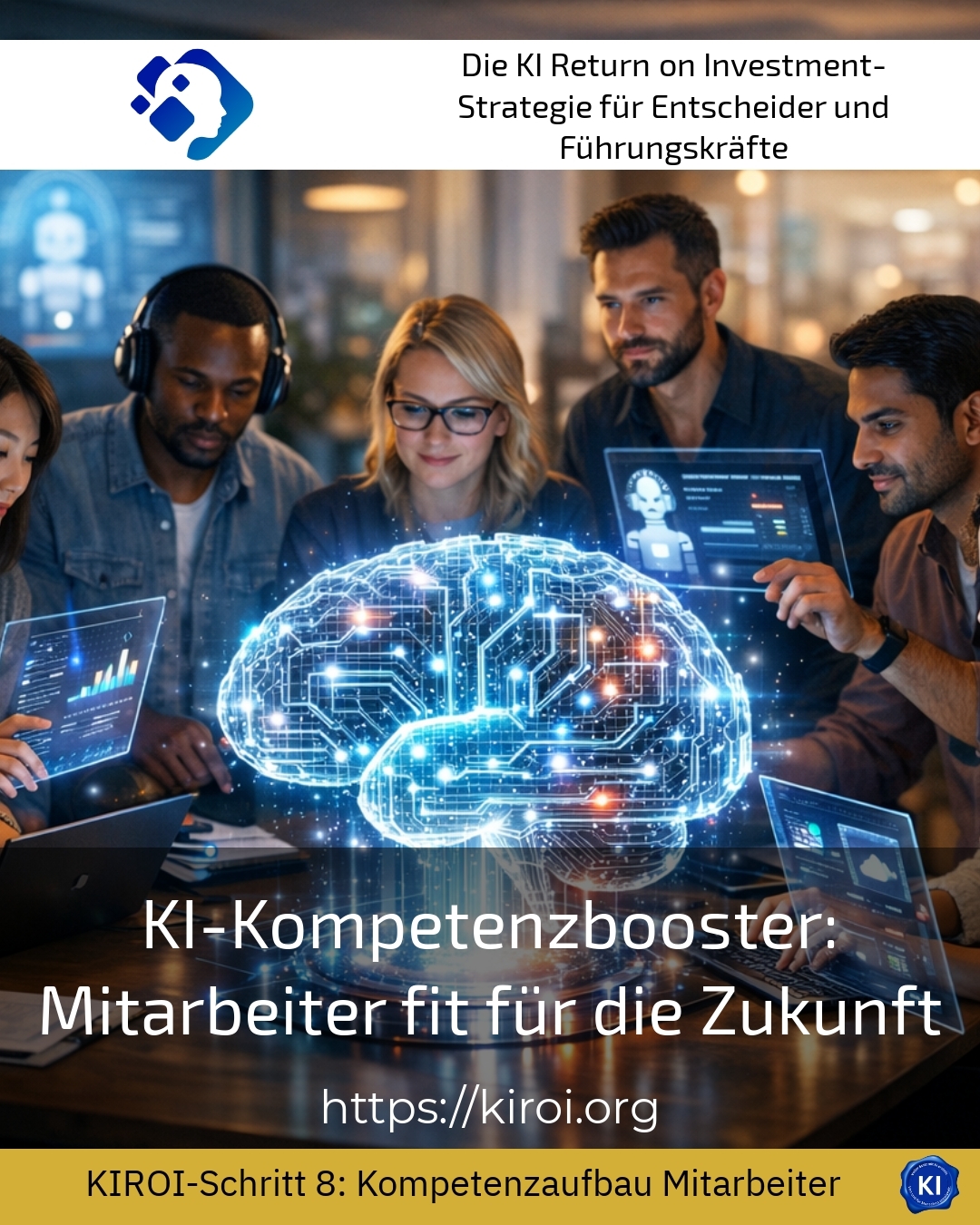
Have you ever wondered why some companies seem to master digital transformation effortlessly, while others are hopelessly lagging behind and losing their footing? The answer often lies not in the technology itself, but in the people who use and understand that technology. A well-thought-out AI Skills Booster It can make employees fit for the future and decisively determines the success or failure of digital initiatives. Many executives report on the challenge of preparing their teams for the rapid changes. It is no longer just about technical knowledge; rather, the ability to work with intelligent systems and utilize their potential is at the center of the issue.
Why traditional further education is no longer enough
The workplace is changing at a pace that has long surpassed traditional training concepts. One-time seminars and static learning programs can hardly keep up with the dynamics of intelligent technologies. Therefore, organizations need new approaches that understand learning as a continuous process. In the field of financial services, for example, banks are already using automated advisory systems for investment decisions. Employees need to understand how these recommendations are generated and when human expertise is required. Insurance companies are using intelligent systems for damage assessment, which requires completely new skills among claims handlers. Even accounting firms are fundamentally transforming their working methods through automated data analysis.
The challenge lies in the fact that knowledge is becoming obsolete faster than ever before. What was considered an innovation yesterday is already standard practice or even outdated tomorrow. Therefore, companies must invest in the learning capabilities of their employees, not only in concrete content. This is particularly evident in healthcare, where imaging procedures are supported by intelligent analysis systems. Radiologists and pathologists require new skills in handling these technologies. Nursing staff increasingly work with documentation systems that automatically recognize patterns and make suggestions. In pharmaceutical research, intelligent systems are also significantly accelerating drug development [1].
The AI Skills Booster as a Strategic Instrument
A systematic approach to competence development differs fundamentally from conventional training measures. It views the organization as a learning system and involves all levels. It is not about making every employee a technology expert. Instead, the focus is on the ability to work meaningfully with intelligent tools. In the logistics industry, freight forwarders already use route-optimizing systems that accompany drivers daily. Warehouse employees work with picking systems that intelligently suggest and adapt workflows. Even in the customer service of the logistics industry, chatbots handle simple inquiries, while employees handle complex cases.
Best practice with a AIROI customer
A medium-sized manufacturing company in the mechanical engineering sector faced the challenge of introducing its experienced skilled workers to intelligent manufacturing systems. Initial skepticism was high, as many employees feared for their jobs. As part of our transruptive coaching support, we developed a multi-stage qualification program that was implemented within the employees’ daily tasks. First, we collaborated with the teams to analyze which tasks could be supported by intelligent systems. It turned out that the employees themselves had many ideas that no one had previously asked about. We integrated these suggestions into the transformation concept, creating high acceptance. The employees were not turned into passive users, but into active agents of change. After six months, the team leaders reported a significantly increased productivity and a surprisingly positive mood. Particularly noteworthy was that older employees brought their years of experience to the optimization of the systems. This expertise would have been lost in a purely technology-driven approach.
Which competences are crucial in the future
The skills that employees need to collaborate with intelligent systems go far beyond technical understanding. Critical thinking is gaining importance as automated recommendations must be questioned. Communication skills remain essential as people will continue to interact with humans. Creativity is even becoming more important as routine tasks are increasingly taken over by machines. In retail, sales consultants work with systems that generate product recommendations based on customer data. Branch managers use forecasting tools for personnel planning and inventory management daily. Buyers analyze market trends with intelligent systems and continuously optimize assortment decisions.
An effective AI Skills Booster Therefore, it addresses multiple dimensions of employee development simultaneously. It combines technical background knowledge with ethical considerations and practical application skills. In the media sector, for example, journalists must understand how automated text generation works. At the same time, they need the ability to critically evaluate and verify AI-generated content. Editors work with systems that can analyze thematic trends and predict reach. In marketing, agencies also use intelligent tools for personalized campaigns and audience analysis [2].
Employees prepared for the future through hands-on learning formats
The most successful competence development programs are characterized by high practical relevance and immediate applicability. Theoretical knowledge alone is not enough to reduce fear of change and inspire enthusiasm. Employees must have the opportunity to try new technologies in safe environments. This allows them to make mistakes without having to fear negative consequences. In the construction industry, project managers already regularly use intelligent planning tools for complex large-scale projects. Project managers work with systems that can predict material requirements and optimize supply chains. In the trades, digital assistants are increasingly supporting calculation and customer consultation.
Transruptions coaching helps companies create and sustainably establish such learning environments. This involves more than just one-time training sessions; it involves continuous development support. Clients often report that only through this support have they been able to achieve real behavioral changes. In the energy sector, for example, grid operators face enormous challenges in transforming their operations due to decentralized generation. Staff in control rooms must learn to deal with intelligent predictive systems and understand them. Service technicians use mobile assistants for diagnosis and repair instructions in the field on a daily basis. Sales representatives also work with systems that analyze consumption patterns and generate individual tariff recommendations.
Best practice with a AIROI customer
A service company in the field of technical inspections approached us with the request to prepare its testing engineers for the use of intelligent analysis tools. The employees had excellent expertise, but were reluctant to use digital tools. Our transruptive coaching began with a careful analysis of the existing workflows and pain points. Together with the testing engineers, we identified activities that were considered particularly time-consuming or prone to errors. We used this knowledge to position the use of intelligent tools as a real improvement in workflow. We developed learning modules that directly applied to real testing tasks and enabled immediate success experiences. The testing engineers quickly realized that the technology complemented their expertise rather than replacing it. They could focus on complex cases while routine analyses were automated. After completing the program, processing times had significantly reduced and employee satisfaction had increased measurably. What was particularly valuable was the realization that the most experienced employees became the most committed advocates.
Leaders as the key to successful transformation
The role of leaders in developing digital skills cannot be overstated. Through their own behavior, they significantly shape the learning culture within their teams. When supervisors themselves exhibit fear of confrontation, this inevitably transfers to their employees. Therefore, a sustainable approach to digital transformation begins with a clear understanding of the role of leaders. AI Skills Booster This is also true at the management level. In the automotive industry, managers face the challenge of transforming entire production lines. Team leaders in manufacturing work with intelligent systems that can detect quality issues early on. Development engineers use simulation tools that effectively support design decisions through machine learning. Intelligent systems also help significantly with configuration and pricing in vehicle sales.
Leaders must learn to create an atmosphere of psychological safety in which experimentation is allowed. They should frame mistakes as learning opportunities instead of sanctioning them as failures. Only in this way does the openness necessary for real competence development emerge. In the banking sector, branch managers must prepare and accompany their teams for changing customer interactions. Many standard transactions are already being taken over by digital channels and intelligent assistants. The remaining personal interactions require higher consulting expertise and emotional intelligence from employees. In credit scoring, analysts also work with systems that automate risk assessments [3].
Sustainable embedding of learning competencies in the company
The biggest challenge lies in not viewing competence development as a one-time project but as a continuous process. Companies must create structures that enable and promote lifelong learning. This includes time for further training, access to resources, and recognition of learning progress. In the chemical industry, laboratory technicians work with intelligent analysis devices that significantly accelerate trial evaluations. Plant operators use systems that optimize process parameters and detect anomalies early. In quality assurance as well, intelligent image recognition systems effectively support visual inspection.
Transruptions coaching provides insights into how companies can build such learning-promoting structures in a sustainable way. In doing so, we view organization, culture, and individual development as a cohesive system. Clients often report that this holistic approach has really enabled lasting change. In the field of food production, employees must deal with systems that continuously monitor quality parameters. Logistics workers work with intelligent warehouse management systems that constantly optimize picking operations. Predictive systems also support sales planning for different locations in the food distribution sector.
My AIROI Analysis
In my opinion, the successful integration of intelligent technologies and cases involving the people who are supposed to use these technologies are crucial. A well-thought-out AI Skills Booster It addresses not only knowledge gaps but also emotional barriers and organizational obstacles. The companies I have had the opportunity to accompany consistently showed similar patterns in successful transformations. They invested time in analyzing existing competencies and carefully identified specific development needs. They involved employees early on in the design of change processes. They created spaces for experimentation and consciously tolerated mistakes as part of the learning process.
Organizations that consistently treated competence development as a strategic priority were particularly successful. They provided resources and signaled the importance of the topic clearly. The top management led the way as an example and publicly demonstrated a willingness to learn. At the same time, they remained realistic in their expectations regarding the speed and scope of change. Transformation takes time, and people need reliable guidance along this path. Technological possibilities will continue to grow and new demands are expected. Therefore, the ability to continuously learn is the most important skill of all. Those who embed this ability in their organization create the foundation for long-term success in a sustainable way.
Further links from the text above:
[2] World Economic Forum: Future of Jobs Report
[3] BCG: Intelligenza Artificiale Insights
For more information and if you have any questions, please contact Contact us or read more blog posts on the topic Artificial intelligence here.






 Deutsch
 English (UK)