
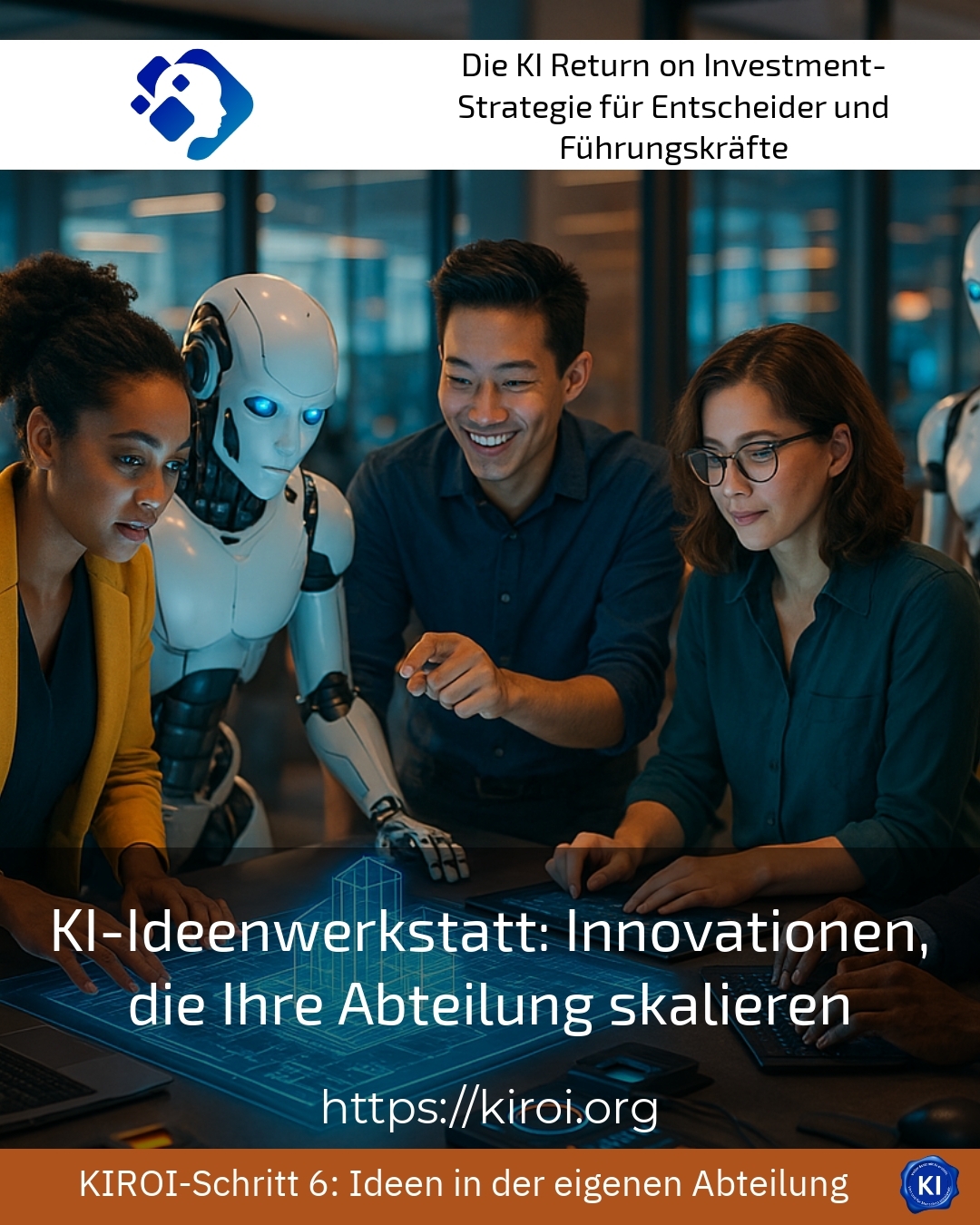
Imagine your department could achieve innovation leaps in a matter of weeks that previously took years. The AI Ideas Workshop: Innovations to scale your department opens up precisely these possibilities. Companies worldwide are currently discovering the transformative potential of intelligent systems. These systems analyse data, recognise patterns, and generate creative approaches to solutions. Many managers report impressive increases in efficiency within their teams. At the same time, the challenges of meaningfully integrating these technologies are growing. This article will guide you through the most important aspects of modern innovation processes. You will learn how intelligent tools can support your work.
Understanding the fundamentals of an AI idea workshop
Before departments can scale, they must understand the mechanisms of intelligent innovation processes. Machine learning forms the foundation of many modern applications. Algorithms process vast amounts of data and identify hidden connections. These insights then feed into strategic decisions. Leaders often report surprising insights from automated analyses. The technology does not replace human creativity, but rather complements it meaningfully.
In the field of product development, intelligent systems support, for example, market analysis. They scan customer reviews and social media posts for relevant trends. Furthermore, they can analyse patent databases and identify innovation gaps [1]. Logistics companies use similar methods to optimise their supply chains. This measurably reduces warehousing costs and improves delivery times. Finance departments also benefit from automated forecasting models for budget planning.
The use in human resources is developing particularly excitingly. Here, intelligent systems provide support in analysing application documents. They identify promising candidates and reduce unconscious biases. At the same time, they help with planning further training measures for existing employees. The combination of data analysis and human intuition often creates better results.
Best practice with a KIROI customer
A medium-sized company in the industrial manufacturing sector faced the challenge of accelerating its innovation processes due to steadily increasing competitive pressure, rendering traditional methods insufficient. Transruption coaching supported the project team over several months in implementing a structured innovation workshop. Together, we developed a framework that linked technological possibilities with the employees' specific industry expertise. The product development department received impetus for systematic idea generation using intelligent analysis tools. Within three months, twelve new product concepts were developed, four of which have already moved into the development phase. Employees reported increased motivation because they could now validate their ideas more quickly. The company was able to reduce its time-to-market for new products by approximately thirty percent. These results demonstrate how professional support in such transformation projects can create real added value.
AI Ideation Workshop: Innovations to Scale Your Department – Practical Approaches
The practical implementation often begins with a thorough inventory of existing processes. Which tasks are repeated regularly and tie up valuable resources? Where do bottlenecks arise that hinder the department's growth? These questions form the starting point for targeted transformation. Transruptions coaching supports companies in carrying out these analyses in a structured manner.
For example, marketing departments use intelligent text generation for initial drafts of campaign copy. These drafts serve as a starting point for creative development by human experts. Sales teams use automated lead scoring systems to prioritise promising contacts. Customer service departments implement chatbots for frequently asked questions, thereby relieving their employees [2].
Research departments in the pharmaceutical industry are accelerating their work through automated literature searches. The systems analyse thousands of scientific publications and extract relevant insights. In the architecture industry, generative design tools support the development of building designs. They automatically consider various parameters such as structural integrity, energy efficiency, and costs.
Scaling through intelligent automation
The true strength of modern innovation labs lies in their scalability. Once developed, processes can be transferred to different business areas. A successful analysis tool from the finance department, for example, can also be adapted for controlling. These synergistic effects significantly multiply the benefit of the original investment.
Motor manufacturers already make extensive use of these principles in their development departments, simulating vehicle characteristics digitally before physical prototypes are created. Insurance companies are automating parts of their claims processing through intelligent document analysis. Energy providers are optimising their grid control using predictive analytics.
Best practice with a KIROI customer
A sales department within an international trading company was struggling with the challenge of scaling its processes without proportionally increasing its headcount. Management had set ambitious growth targets, but the existing team was already operating at its capacity limit. As part of the transruption coaching, we jointly analysed the most time-consuming activities in the daily sales routine. It emerged that the creation of quotes and the qualification of leads were particularly time-intensive. We developed a structured approach to integrating intelligent support tools into these core processes. Sales representatives could now use automatically generated quote templates and received prioritised lead lists. The average processing time per quote decreased by approximately forty percent, while the quality of customer engagement increased. Within a year, the department boosted its revenue by twenty-five percent with the same number of staff. This transformation demonstrates how scaling can be achieved without a loss of quality.
Challenges and opportunities in implementation
The introduction of innovative technologies naturally brings challenges. Many employees initially react to change with scepticism or uncertainty. Taking these concerns seriously and actively addressing them is an important factor for success. Transruption coaching therefore places particular emphasis on supporting cultural change.
For example, in the media industry, there were initial fears regarding the future of editorial work. However, through transparent communication and gradual integration, a successful transformation was achieved. Journalists today use research tools that give them more time for in-depth analysis [3]. We are seeing similar developments in the legal sector, where automated document reviews are becoming standard. In the education sector too, intelligent tutoring systems support teachers in providing individual support.
Technical integration places further demands on companies. Existing IT infrastructures often need to be adapted or expanded. Data protection policies require careful examination and possibly new compliance structures. The quality of available data is a key factor in the success of intelligent applications.
Embedding innovation sustainably in the department
Sustainable transformation requires more than one-off projects or isolated pilot tests. Successful companies establish continuous learning processes and iterative improvement cycles. They create structures that foster innovation as a permanent part of the corporate culture.
Technology companies often practise so-called innovation sprints, where teams rapidly prototype new ideas. Retail companies are experimenting with smart recommendation systems for personalised customer engagement. Construction companies are relying on digital twins of their projects for more efficient planning and monitoring. These examples demonstrate the diversity of possible application fields.
The AI Ideas Workshop: Innovations to scale your department must always be adapted to specific needs. Industry-specific particularities, corporate culture, and available resources influence the optimal approach. Professional guidance can provide valuable impetus and help to avoid typical pitfalls.
My KIROI Analysis
Intensive engagement with innovation workshops and scaling strategies reveals a multifaceted picture of the current corporate landscape. Departments that scale successfully are characterised by a combination of technological openness and human expertise. They understand intelligent systems not as a threat, but as tools to expand their capabilities. This attitude often requires a cultural shift that takes time and conscious leadership effort.
Particularly noteworthy is the observation that successful transformations rarely follow a linear path. Companies go through phases of euphoria, disillusionment, and finally, productive integration. Support from experienced partners can shorten these phases and mitigate their intensity. Transruption coaching positions itself as a reliable companion for such complex projects.
The future belongs to organisations that understand innovation as a continuous process. They will be more competitive, more attractive to talent, and more resilient to market changes. The approaches and examples presented here can serve as inspiration and guidance for your own transformation journey. The crucial element in the end remains the first step: the conscious decision to actively shape change.
Further links from the text above:
[1] World Intellectual Property Organization – Patent Databases
[2] Gartner Research – Artificial Intelligence Insights
[3] Reuters Institute – Digital News Project
For more information and if you have any questions, please contact Contact us or read more blog posts on the topic Artificial intelligence here.











 Deutsch
  English (UK)