
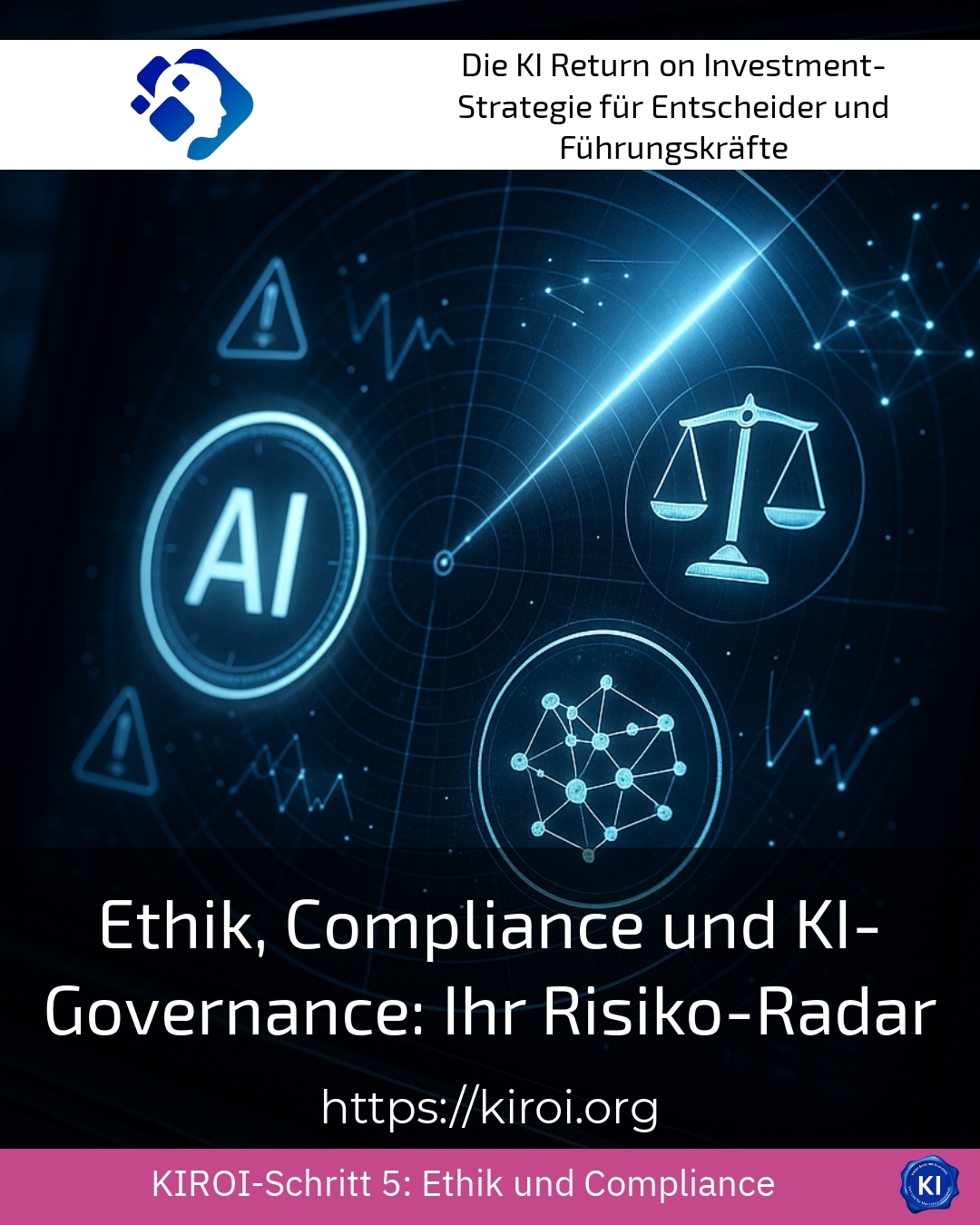
Imagine your company is facing a decision that could cost millions or save them, and you only have a few seconds to grasp it's full implications. It is precisely here that the fascinating journey into a world begins, where Ethics, Compliance and AI Governance: Your Risk Radar becoming an indispensable navigation aid. The digital transformation has long since taken hold of all areas of our economy. This creates as many opportunities as risks. Those who do not set the right course today will lose out tomorrow. Therefore, organisations need a systematic approach. This approach must combine values, rules, and technological control.
Why responsible management is more important today than ever before
The rapid development of intelligent systems has raised fundamental questions. These questions concern not only technical aspects but also touch upon the foundations of our social coexistence. Companies are increasingly relying on automated decision-making processes. These systems analyse data, recognise patterns, and make predictions. But who bears the responsibility when something goes wrong? This question is occupying leaders worldwide.
A medium-sized manufacturing company implemented a quality control system. The system identified defects faster than human inspectors. However, it also rejected flawless products. The financial damage was considerable. Only a thorough review of the algorithms brought the problem to light. This example demonstrates the necessity of transparent control mechanisms.
Another example comes from the finance sector. A bank used a machine learning-based credit lending system. The system unconsciously favoured certain demographic groups. Regulators intervened. The institution had to pay hefty fines and completely overhaul its system. Such cases highlight why Ethics, Compliance and AI Governance: Your Risk Radar does not represent an optional supplement.
Similar challenges are emerging in healthcare. A hospital implemented a diagnostic system. Its purpose was to assist doctors in the early detection of diseases. The system was trained on data that did not take regional specificities into account. The accuracy rate was significantly below expectations. An ethical pre-assessment might have prevented this problem.
The three pillars of a robust control framework
An effective governance framework rests on three supporting pillars. These pillars complement each other and form a stable foundation. The first pillar encompasses value-based principles. They define what is considered acceptable behaviour. The second pillar consists of rule-based guidelines. These establish clear boundaries and instructions for action. The third pillar includes technical control mechanisms. They ensure the practical implementation of the principles and rules.
In retail, a large trading company used price optimisation software. This software adjusted prices in real-time to demand and competition. Customers complained about unfair price differences. The company responded by introducing ethical guardrails. Now, clear rules limit the maximum price fluctuation. Customer satisfaction improved measurably.
A logistics company implemented a route planning system. It was intended to optimise delivery times and reduce costs. However, the system did not take into account the drivers' workload. The result was overtired employees and an increase in accidents. Only the integration of compliance requirements solved the problem. Today, the system automatically accounts for legal rest periods.
A telecommunications provider relied on chatbots for customer service. The bots were intended to process enquiries quickly and efficiently. However, they sometimes led to contract agreements without complete customer clarification. The supervisory authority initiated proceedings. The company had to fundamentally revise its governance structures.
Ethics, Compliance, and AI Governance: Your Risk Radar in Practical Application
Practical implementation requires a structured approach. Firstly, businesses must identify their existing risks. Then, they develop suitable control mechanisms. Finally, they establish continuous monitoring processes. This trio forms the foundation for sustainable results.
Best practice with a AIROI customer
An international company in the energy sector was facing considerable challenges when it came to introducing intelligent control systems for its plants. Senior management recognised early on that technical excellence alone would not be enough to meet the complex regulatory requirements while maintaining stakeholder confidence. The company turned to transruptions-Coaching for comprehensive support in developing an integrated control framework. Together, we first analysed the existing processes and identified critical interfaces between man and machine. In several workshops, the managers developed a deep understanding of the ethical implications of their technological decisions. We implemented a multi-level control system that combines both automated checks and human supervision. Employees received comprehensive training on the responsible use of intelligent systems. The establishment of a continuous improvement process, which includes regular audits and adjustments, was particularly valuable. After six months, those responsible reported a significant reduction in compliance incidents and increased trust from the supervisory authorities. The transruption coaching helped the company to combine technological innovation with ethical responsibility.
Understanding and implementing industry-specific requirements
Every industry has its own particularities and challenges. In the manufacturing sector, questions of occupational safety are paramount. Intelligent systems monitor production facilities and warn of dangers. At the same time, they collect sensitive data on employee behaviour. The balance between security and privacy requires careful consideration.
An automotive supplier implemented a predictive maintenance system. The system analysed machine data and predicted failures. In doing so, it also captured information about operator behaviour. The works council initially had concerns. Through transparent communication and clear data protection policies, a mutually agreed solution was reached. The example shows how important dialogue with all stakeholders is.
In the insurance industry, companies are using intelligent systems for claims processing. These systems review claims and detect potential fraudulent cases. However, they carry the risk of unfair rejections. One insurer had to revise its system because it systematically disadvantaged certain customer groups. The regulatory consequences were considerable.
The public sector faces particular transparency requirements. A municipal administration implemented a system for awarding social benefits. Citizens complained about non-transparent decisions. The administration had to make improvements and implement explanation functions. Today, affected individuals can understand why certain decisions were made.
Practical tools for daily management
Managers need practical tools for their daily work. A proven instrument is the risk matrix. It categorises potential problems according to their likelihood and impact. This creates clear priorities for action. Another tool is the ethics board. This committee assesses new projects before their implementation.
A pharmaceutical company established such an assessment committee. Every new system must undergo scrutiny before implementation [1]. The committee comprises representatives from various departments. Legal experts, technicians, and ethicists collaborate. This interdisciplinary composition ensures a thorough evaluation.
In the field of personnel selection, particular sensitivities are evident. A service company used an applicant management system with automated pre-selection. The system sorted candidates according to defined criteria. However, it unconsciously favoured certain educational pathways. The introduction of fairness metrics helped to resolve the issue.
A trading group implemented a fraud detection system. It analysed transaction patterns and reported suspicious activities. Initially, it produced many false alarms, causing staff to lose faith in the system. Only continuous improvement of the algorithms eventually restored acceptance.
The role of transruption coaching in supporting projects
Many organisations report feeling overwhelmed when implementing new systems. Technical complexity is only part of the challenge. Cultural and organisational aspects often weigh heavier. This is where transruption coaching comes in. We guide companies on their journey towards responsible technology use.
Clients often report uncertainty regarding regulatory issues. They are unsure which regulations apply to their company. We offer insights to help structure these complex subject areas. Together, we develop pragmatic solutions. These solutions consider both legal requirements and practical feasibility.
A media company approached us with questions regarding automated content moderation. The system was intended to detect and filter problematic content, while simultaneously not unduly restricting freedom of expression. Through our guidance, the company developed a balanced approach. This approach respects both protective interests and liberties.
The need for guidance is also growing in the education sector. A university implemented a system for student support. It was intended to identify dropout risks early on [2]. The ethical implications were complex. Our support helped to develop transparent policies.
Future-oriented strategies for sustainable value creation
Technological advancement is progressing unstoppably. Companies must continuously adapt. A static control framework is not sufficient. Instead, organisations need adaptive structures. These structures enable rapid responses to new developments.
A manufacturing company established an agile governance process. Regular reviews adapt policies to changing circumstances. New technologies undergo a structured evaluation process. This allows the company to remain both agile and responsible.
Similar developments are evident in the transport sector. A logistics provider is investing in autonomous vehicles. Regulatory requirements are constantly changing. The company has set up a team to continuously monitor these developments. This allows it to react quickly to new requirements.
Agriculture is also experiencing a technological transformation. A farm is using intelligent systems for irrigation control. These systems optimise water consumption and increase yields. At the same time, data protection requirements must be adhered to. The integration of all aspects requires careful planning.
My AIROI Analysis
An analysis of numerous projects and consulting experiences reveals clear patterns. Companies that invest early in Ethics, Compliance and AI Governance: Your Risk Radar Investing in this area yields better long-term results. They avoid costly rectifications and regulatory sanctions. At the same time, they strengthen the trust of their stakeholders. In an increasingly digitised world, this trust becomes a decisive competitive advantage.
Successful implementation requires a holistic approach. Technical measures alone are insufficient. Organisations must adapt their culture and processes. Leaders play a central role in this. They must lead by example and communicate clear expectations. Only then can sustainable change be achieved.
Continuous development of the control framework is particularly important. The technological landscape is changing rapidly. What is considered best practice today can be outdated tomorrow. Therefore, companies need flexible structures and learning organisations. Regular training and awareness measures support this process.
In conclusion, responsible technology use is not a brake on innovation. On the contrary, it promotes sustainable growth and societal acceptance. Companies that consistently pursue this path position themselves as trustworthy partners. They create value for all stakeholders and contribute to a better future. Investing in a robust governance system pays off in the long term.
Further links from the text above:
[1] European Commission – Artificial Intelligence Strategy
[2] Bitkom – A Guide to Artificial Intelligence in Companies
For more information and if you have any questions, please contact Contact us or read more blog posts on the topic Artificial intelligence here.







 Deutsch
  English (UK)