
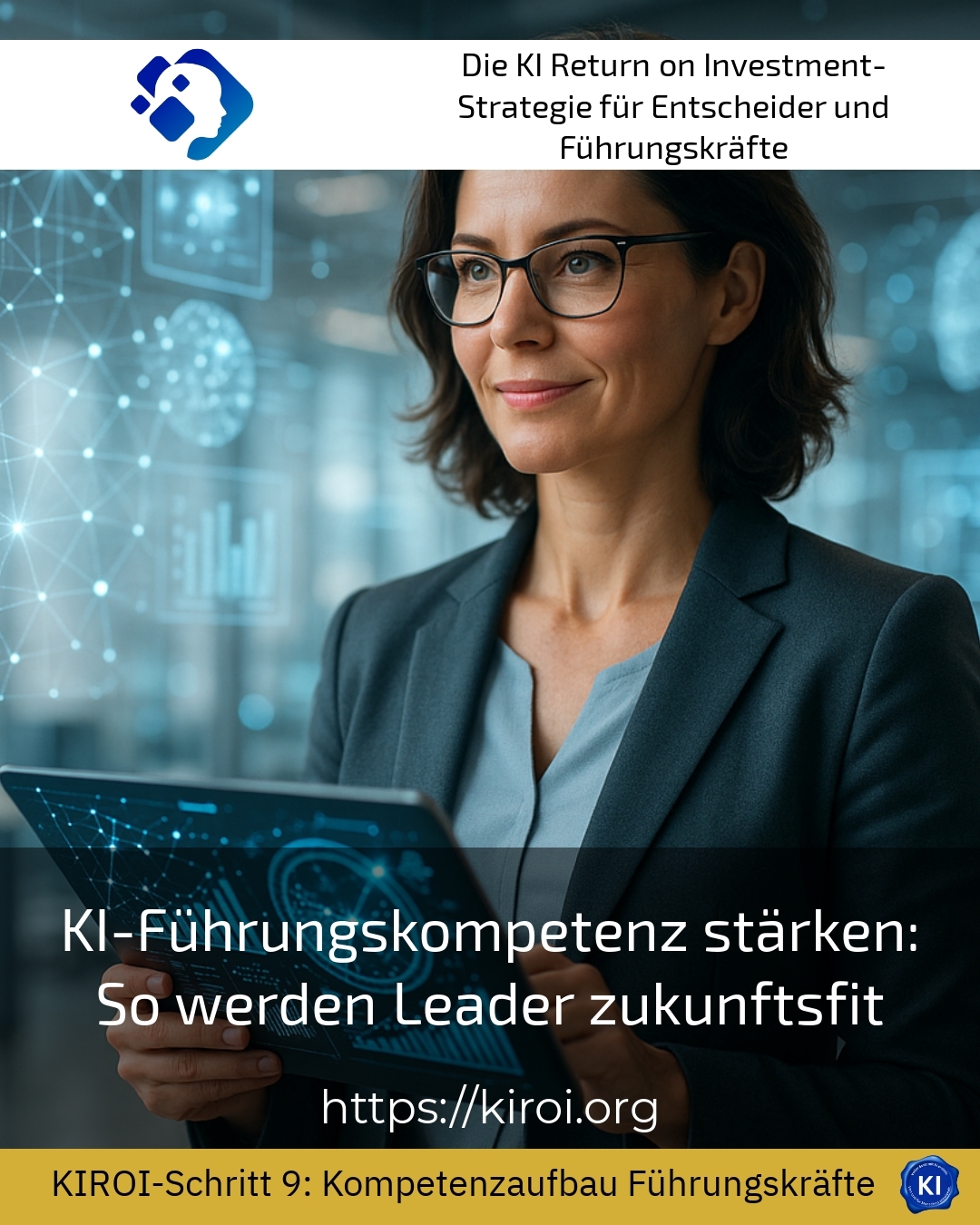
The world of work is changing rapidly. Leaders are facing entirely new challenges. Those who manage teams today must be able to understand and use digital technologies. This is no longer just about technical knowledge. The real challenge lies in combining leadership with technological competence. This is precisely where the topic Strengthening AI Leadership Competence Because intelligent systems are increasingly taking over operational tasks. Leaders must therefore fundamentally rethink their role. They are becoming architects of a new collaboration between humans and machines. This transformation requires courage, openness, and continuous learning. The good news is that every leader can develop these skills. With the right guidance, change can be successful, sustainable, and authentic.
Why modern leadership requires new competencies
The demands on leaders have fundamentally changed. Previously, expertise and assertiveness were sufficient. Today, leaders need a broad range of skills. They must be able to assess technological developments. At the same time, they are expected to lead their teams through uncertainty. This combination presents many with enormous challenges.
Managers often report similar concerns. They feel overwhelmed by the pace of change. Some question their relevance in an automated world. Others struggle to get their teams excited about new technologies. Still others don't know how to address ethical questions. All these concerns are valid and understandable.
A real-world example illustrates this. A sales manager introduced an intelligent analysis system. The system recognised customer needs faster than experienced employees. Suddenly, the manager had to redefine their role. They went from knowledge broker to process designer. This transformation succeeded through intensive reflection and support.
Another example comes from the HR department. An HR director implemented automated pre-selection processes for applications. Initially, she feared her expertise would become redundant. However, the opposite happened. She was able to concentrate on strategic personnel development. Her leadership role gained importance and depth.
These dynamics are also clearly evident in finance. A CFO used predictive analytics for budget planning. The prediction accuracy significantly exceeded human assessments. The CFO had to learn to work with these systems. He developed new competencies in interpreting complex data. His leadership quality increased through this expansion of his repertoire.
Strengthening AI leadership skills through conscious development
The development of future-oriented leadership skills does not happen by chance. It requires conscious engagement with one's own strengths and areas for development. This is not about becoming a technology expert. Rather, the integration of technological knowledge into everyday leadership is the priority. This integration is best achieved through structured support and reflection.
transruptions-Coaching supports leaders with this transformation. It offers a safe space for questions and uncertainties. At the same time, it provides practical impetus for everyday work. The coaching is always oriented towards specific projects and challenges. This results in sustainable changes rather than short-term adjustments.
A production manager approached coaching with a specific concern. He was tasked with integrating robotics systems into his manufacturing process. His employees reacted with fear and resistance. During the coaching sessions, he developed communication strategies and participation formats. The implementation was ultimately successful with significantly fewer hitches.
A marketing manager faced another challenge. She was tasked with introducing generative text systems into her department. Her creative employees felt threatened and undervalued. Through coaching, she developed a process of appreciative introduction. The systems now supplemented human creativity instead of replacing it.
A similar pattern emerged in customer service. A service manager implemented chatbots for standard enquiries. His employees feared job losses and a loss of importance. Together with the coaching process, he developed a new vision. The employees took on more complex advisory tasks with higher added value.
Best practice with a KIROI customer
A medium-sized company in the mechanical engineering sector was facing a comprehensive digital transformation. The management had already made considerable investments in intelligent production systems. However, implementation at the management level below had stalled considerably. The division managers did not feel sufficiently prepared or involved. They had difficulties leading their teams through the changes. The KIROI coaching started at precisely this point. First, we analysed the individual development needs of each manager. This revealed a heterogeneous picture of different levels of expertise and attitudes. Some leaders had an affinity for technology but were weak leaders in change processes. Others had excellent people management skills but were afraid of new systems. The coaching programme specifically combined individual sessions with group formats. The managers worked on their specific issues over a period of several months. They developed a shared understanding of future-orientated leadership. At the same time, they strengthened their individual ability to act in specific projects. The result was a significant improvement in the speed of transformation throughout the company. The managers became active shapers instead of passive stakeholders. This development had a positive impact on the entire workforce.
Strengthening technological understanding as a basis for AI leadership competence
Leaders do not need to become programmers. Nevertheless, they require a solid fundamental understanding of current technologies [1]. This knowledge enables well-informed decisions and realistic assessments. It protects equally against exaggerated expectations and unfounded fears.
A logistics manager illustrates this impressively. Initially, he didn't understand how optimisation algorithms worked. As a result, he couldn't critically assess their recommendations. Following targeted further training, he gained confidence in using the systems. He recognised their limitations and possibilities much more clearly than before.
A quality manager had similar experiences with image recognition. She implemented a system for automatic defect detection. Initially, she trusted the results blindly and uncritically. Only by understanding the underlying principles did she enable appropriate use. She learned when human oversight remained indispensable.
Procurement provides another instructive example. A purchasing manager used supplier risk prediction systems. The systems provided warnings that he couldn't interpret. Through training, he gained a better understanding of the database and algorithms. His decisions became more informed and comprehensible to his team.
Ethical competence in technologised leadership
The deployment of intelligent systems raises numerous ethical questions [2]. Leaders must be able to recognise and address these questions. They bear responsibility for fair and transparent decision-making processes. This responsibility cannot be delegated to machines.
A HR manager was faced with a concrete ethical dilemma. Their analysis system systematically favoured certain applicant profiles. The reasons for this were not immediately clear. They had to decide how to handle this insight. Through coaching, they developed a considered approach to algorithmic recommendations.
A sales manager encountered another ethical issue. Her system used extensive customer data for personalised offers. Some employees expressed concerns regarding data privacy and manipulation. She had to find a way to combine business success with ethics. This was achieved through transparent communication and clear usage policies.
In healthcare, ethical questions are becoming more acute. A clinic director implemented diagnostic systems to support her doctors. Statistically speaking, the systems provided recommendations with a high degree of accuracy. Nevertheless, human decision-making authority had to be maintained. She developed protocols for the responsible use of the technology.
Communication and change management as key competencies
The successful implementation or failure of new technologies hinges on communication. Leaders must be able to explain complex contexts in an understandable way [3]. They need to take fears seriously and offer perspectives. These communication skills can be specifically developed and strengthened.
A department head in the insurance industry illustrates this vividly. He introduced an automated claims processing system. Many case workers feared for their jobs and relevance. Through open communication and involvement, the transformation was successful. The employees were further developed into specialists for complex cases.
A retail team leader had similar experiences. She implemented intelligent warehousing systems in her area. Initially, she communicated too little about the reasons and goals. Resistance was correspondingly high and delayed everything. After a realignment of her communication, acceptance improved significantly.
The importance of change management is particularly evident in the banking sector. A branch manager should integrate advisory robots into his branch. His experienced advisors reacted with open rejection and scepticism. Through a structured change process, he transformed resistance into commitment. The advisors eventually recognised the relief provided by the technology.
Best practice with a KIROI customer
An international retail company implemented a comprehensive intelligent analysis system for its entire business. The system was designed to optimise demand forecasting, pricing and inventory management. The challenge was not in the technology, but in the leadership. Dozens of managers had to fundamentally change and adapt the way they worked. KIROI coaching provided intensive support for this process over several quarters. We worked with individual managers on their specific challenges and blockages. At the same time, we facilitated workshops to develop a common management culture. A particular focus was on the communication skills of all the leaders involved. The managers learnt how to explain and communicate technological changes in an understandable way. They developed methods to constructively address the concerns of their teams. They also developed strategies for dealing with resistance and uncertainty. The results were remarkably positive and sustainable. Acceptance of the new system increased significantly throughout the company. The managers were perceived as competent guides through the transformation. The company realised the planned efficiency gains faster than originally calculated. The investment in management development paid off several times over in the results.
Strengthening AI leadership skills through continuous learning
Technological development is progressing relentlessly. Leaders must therefore continuously learn [4]. This requires an attitude of openness and curiosity. At the same time, structured learning formats and opportunities are needed in everyday life.
The managing director of a medium-sized company illustrates this impressively. He reserved time weekly to engage with new technologies. This investment enabled him to make sound strategic decisions long-term. His team benefited considerably from his technological orientation and expertise.
A divisional manager systematically established learning circles within her department. Employees and managers regularly exchanged ideas about technological developments. This culture of shared learning sustainably strengthened the entire team. The manager positioned herself as an enabler of development and growth.
In the technology sector, continuous learning is especially critical and relevant. A development lead had to be able to cope with ever-shorter innovation cycles. He developed methods to distinguish relevant innovations from irrelevant ones. This filtering competence became an important part of his overall leadership role.
My KIROI Analysis
The analysis of numerous coaching processes reveals clear patterns and insights. Leaders who actively engage with technological changes develop more rapidly. They gain significantly more confidence and capability to act in uncertain situations. Their teams benefit from this strengthened leadership competence immediately and sustainably.
Leaders who can combine humility and curiosity are particularly successful. They admit to themselves that they don't need to know everything at all times. At the same time, they continuously invest in their own development and competence. This attitude has a positive impact on their entire organisation.
Coaching repeatedly proves to be valuable support in transformation projects. It offers the safe space that leaders need for honest reflection. At the same time, it provides practical impetus for the challenging day-to-day work. The combination of reflection and a focus on action makes a tangible difference.
The most important takeaway from my work is the following central statement. Technological competence and human leadership skills significantly reinforce each other. Leaders who develop both dimensions are best placed for the future. They will become shapers of a working world that connects people and technology.
The topic Strengthening AI Leadership Competence remains highly relevant and current for the foreseeable future. Technology continues to evolve, constantly posing new demands. Leaders who invest in their development today secure their effectiveness in the long term. They successfully position themselves as indispensable architects of digital transformation.
Further links from the text above:
[1] McKinsey – The State of AI
[2] World Economic Forum – AI Ethics
[3] Harvard Business Review – Change Management
[4] Forbes – Leadership Insights
For more information and if you have any questions, please contact Contact us or read more blog posts on the topic Artificial intelligence here.








 Deutsch
  English (UK)