
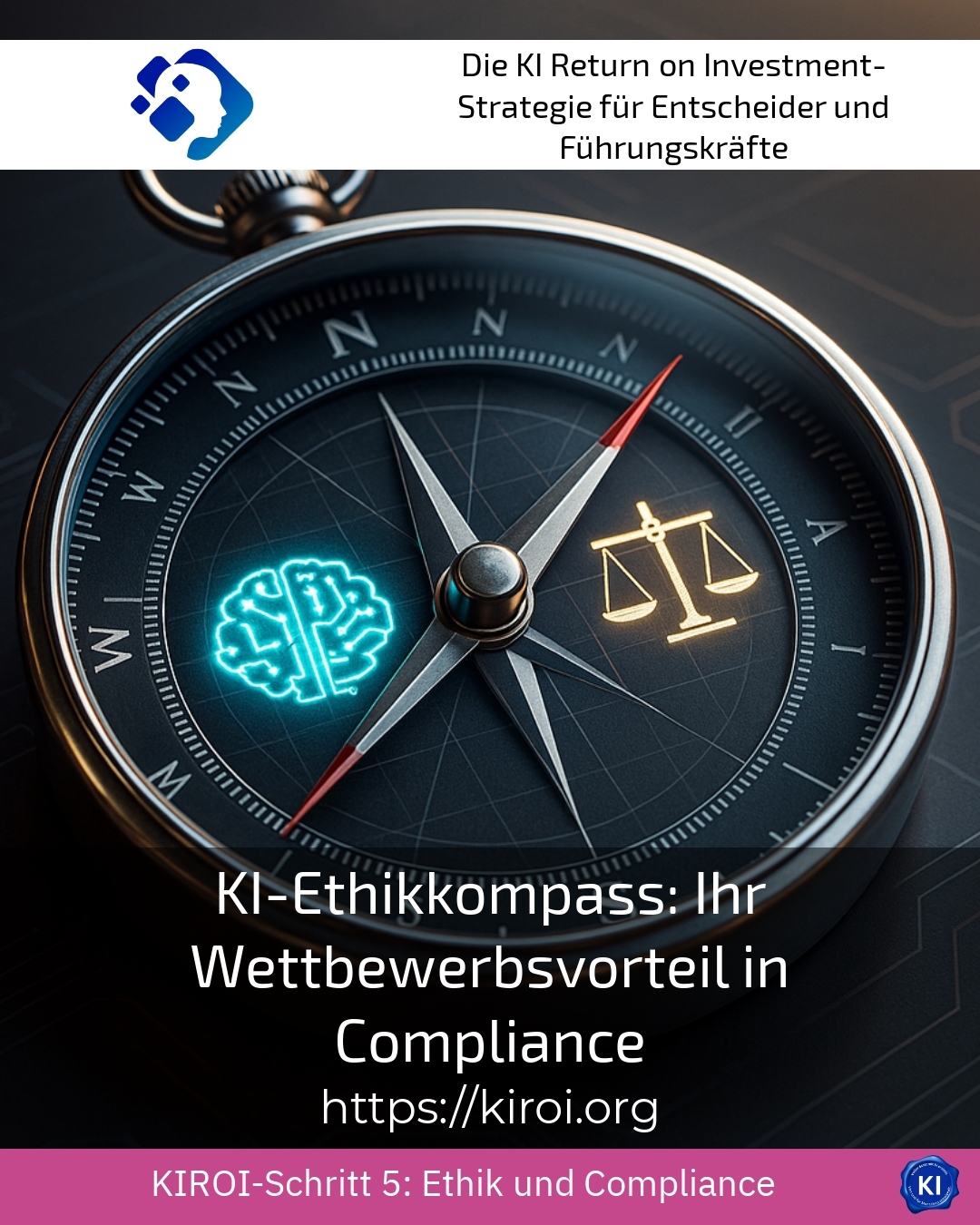
In a world in which algorithmic decisions increasingly permeate our daily lives, companies face a fundamental challenge that goes far beyond technical implementation issues. The AI Ethics Compass: Your competitive advantage in compliance becomes a crucial differentiating factor for organisations that not only strive for economic success, but also wish to assume social responsibility. While many leaders still hesitate and underestimate the ethical implications of their technological investments, forward-thinking decision-makers have long recognised that moral integrity and economic success are not opposites, but can mutually reinforce one another.
Why ethical guidelines are essential today
The rapid development of automated systems has reached a complexity that pushes traditional governance structures to their limits. Companies are deploying algorithmic decision-making systems in almost all business areas. At the same time, regulatory requirements are growing exponentially. European legislation is continuously tightening the rules for transparent and fair systems [1].
Financial institutions use credit scoring algorithms, for example. These analyse thousands of data points in fractions of a second. However, this can give rise to unconscious patterns of discrimination. An algorithm might systematically disadvantage certain postcodes. This would indirectly exclude socio-economic groups. Insurance companies face similar challenges in risk assessment. Human resources managers also need to be vigilant when it comes to automated application processes. The danger of hidden biases exists everywhere.
Healthcare providers are implementing diagnostic support systems with increasing frequency. These systems can save lives. However, they can also cause serious errors. For example, a diagnostic algorithm was trained predominantly on data from light-skinned patients. This led to poor detection performance in other population groups. Such cases illustrate the need for ethical frameworks.
The AI ethics compass as a strategic tool
A thoughtful AI Ethics Compass: Your competitive advantage in compliance acts as a navigational tool. It helps in complex decision-making situations. It creates orientation in ethical grey areas. Companies use it to develop clear guidelines for action. These guidelines are binding for all employees.
Retail groups deploy price optimization algorithms. These dynamically adjust prices to fluctuations in demand. Without ethical guardrails, this could lead to extortionate pricing. This would be particularly problematic in times of crisis. An ethics compass defines clear boundaries here. It protects both consumers and the company's reputation. Logistics companies optimize supply chains with algorithmic support. In doing so, the working conditions of employees must be taken into account. The ethics compass prevents inhumane performance targets.
Best practice with a AIROI customer
A medium-sized company in the financial sector approached the transruptions coaching team with a specific challenge. The company had implemented an automated credit decision-making system which initially promised significant efficiency gains; however, after a few months in operation, it began to reveal worrying patterns suggesting systematic discrimination against certain groups of applicants. The management recognised that urgent action was required to minimise regulatory risks and maintain customer trust. As part of the AIROI support programme, a comprehensive analysis of the existing decision-making processes was first carried out, with particular emphasis on identifying hidden bias factors. Together with the internal team, we developed a multi-stage ethical framework that defined clear assessment criteria for algorithmic decisions whilst also setting out practical implementation steps. Staff were trained in workshops to recognise ethical issues independently and address them appropriately. After six months, the company was able to demonstrate a significant improvement in fairness metrics and received positive feedback from the regulatory authority, which ultimately led to a tangible competitive advantage in customer acquisition.
Treating compliance as a competitive advantage
Many companies view compliance requirements primarily as a cost factor. However, this view does not go far enough. Forward-looking organisations recognise the strategic potential. They use the AI Ethics Compass: Your competitive advantage in compliance actively for differentiation. Customers and business partners are placing increasing importance on ethical behavior [2].
Car manufacturers are integrating decision-making systems into driver assistance features. These systems make potentially life-saving decisions in a fraction of a second. Ethical programming is becoming a selling point here. Customers trust manufacturers with transparent ethical standards. Telecommunications providers are using chatbots for customer service. An ethically programmed chatbot identifies vulnerable customer groups. It transfers them to human staff. This measurably improves customer satisfaction.
Pharmaceutical companies use algorithmic systems for clinical trial planning. The selection of study participants must be carried out with sensitivity to diversity. An ethics compass ensures representative study populations. Drug efficacy can thus be validated for all population groups. Energy suppliers implement smart grids with predictive control. Algorithms decide on load distribution during peak times. Ethical guidelines prevent social hardship in the event of supply bottlenecks.
Practical implementation steps for the AI ethics compass
The development of an effective ethical framework requires a structured approach. First, an inventory of all algorithmic systems must be carried out. In the process, risk categories are identified and prioritised. Clear responsibilities are then defined. An ethics committee should meet regularly.
Media companies curate news content using recommendation algorithms. These algorithms can reinforce filter bubbles. An ethical compass demands diversity criteria in content recommendations. This prevents one-sided provision of information. Educational institutions deploy adaptive learning systems. These tailor learning content to individual needs. Ethical guidelines protect learners' privacy in the process. They also prevent stigmatising categorisation.
Agri-tech companies are optimising crop forecasts using satellite analytics. Smallholder farmers could be disadvantaged by algorithmic market predictions. An ethical framework ensures fair market participation for all. Law firms use document analysis for case preparation. The algorithms must not reproduce biased patterns in the process. Ethical review procedures guarantee neutral analyses.
Best practice with a AIROI customer
An internationally active trading company sought support in the ethical design of its personnel selection systems after internal analyses had revealed significant discrepancies in the hiring rates of different applicant groups. transruptions coaching accompanied the project from the initial problem analysis through to the successful realignment of the algorithmic pre-selection. Together with the human resources department, we identified problematic variables in the evaluation model that correlated indirectly with protected characteristics and thus produced unintentionally discriminatory effects. In several workshops, those involved developed a deep understanding of the mechanisms of algorithmic bias and worked out practicable countermeasures. The resulting ethics compass not only defined prohibited data categories, but also established regular fairness audits and channels for candidate complaints. The implementation led to a significantly more diverse workforce, which in turn had positive effects on innovative strength and the working atmosphere. Today, the company actively uses this development in its employer branding communication and is thereby able to appeal to talent that pays particular attention to ethical corporate governance.
Challenges and solutions in practice
The implementation of ethical guidelines frequently encounters practical obstacles. Departmental silos can block transparency initiatives. Short-term profit interests collide with long-term value orientation. Technical personnel often possess little ethical training. This is precisely where transruption coaching intervenes.
Real estate companies use algorithmic valuation models for properties. These could systematically devalue certain neighbourhoods. An ethical framework prevents redlining practices. Tour operators employ dynamic pricing systems. These adapt offers to individual willingness to pay. Ethical boundaries prevent exploitative pricing [3].
Security companies implement surveillance systems with facial recognition. The technology harbours significant potential for misuse. An ethics compass strictly defines permissible deployment scenarios. Sports associations use performance analysis systems for talent identification. Algorithms could potentially favour certain body types or backgrounds. Ethical guidelines promote equal opportunities in youth sports.
Long-term perspectives and continuous development
One AI Ethics Compass: Your competitive advantage in compliance is not a static document. It must be continuously adapted to technological and social developments. Regular reviews are essential. Stakeholder feedback should be systematically gathered. The integration of external expertise strengthens the quality.
Chemical companies are optimising production processes with predictive maintenance systems. These systems indirectly affect jobs and environmental impacts. Ethical considerations must take these dimensions into account. Food manufacturers use quality control algorithms in production. The systems must respect cultural and religious requirements. An ethical framework ensures inclusive product standards.
Cultural institutions use recommendation systems for visitor experiences. These should promote cultural diversity rather than restrict it. Ethical programming actively broadens horizons. Public administrations are increasingly automating citizen services. Particularly stringent ethical standards are required here. Every citizen deserves fair and transparent treatment.
My AIROI Analysis
The intensive support of numerous transformation projects has shown me that ethical frameworks for algorithmic systems represent far more than regulatory tick-box exercises, as they act as fundamental building blocks for sustainable corporate success in an increasingly digitalised economy. Organisations that invest early in the development of comprehensive ethical guidelines frequently report measurable improvements in areas such as employee satisfaction, customer trust and the speed of innovation, because this clear sense of direction accelerates decision-making processes and reduces uncertainties. Support through transruptions coaching assists companies in translating often abstract ethical principles into concrete, action-guiding measures, with the interdisciplinary exchange between technical, legal and business perspectives providing particularly valuable impetus.
My observation is that the greatest progress occurs where leaders do not view ethical responsibility as a restriction, but rather as a strategic opportunity, and authentically model this attitude. The coming years will show which companies have done their ethical homework and which will be severely hit by regulatory sanctions or reputational damage. I therefore recommend that all decision-makers proactively shape the ethical dimension of their technological investments, rather than reacting to external requirements. Transruptions coaching is available as a companion that offers both strategic orientation and practical implementation support to help organisations on their individual path to responsible innovation.
Further links from the text above:
[1] European approach to Artificial Intelligence
[2] Bitkom – Artificial Intelligence in Companies
[3] Federal Ministry for Economic Affairs – Artificial Intelligence
For more information and if you have any questions, please contact Contact us or read more blog posts on the topic Artificial intelligence here.










 Deutsch
 English (UK)