
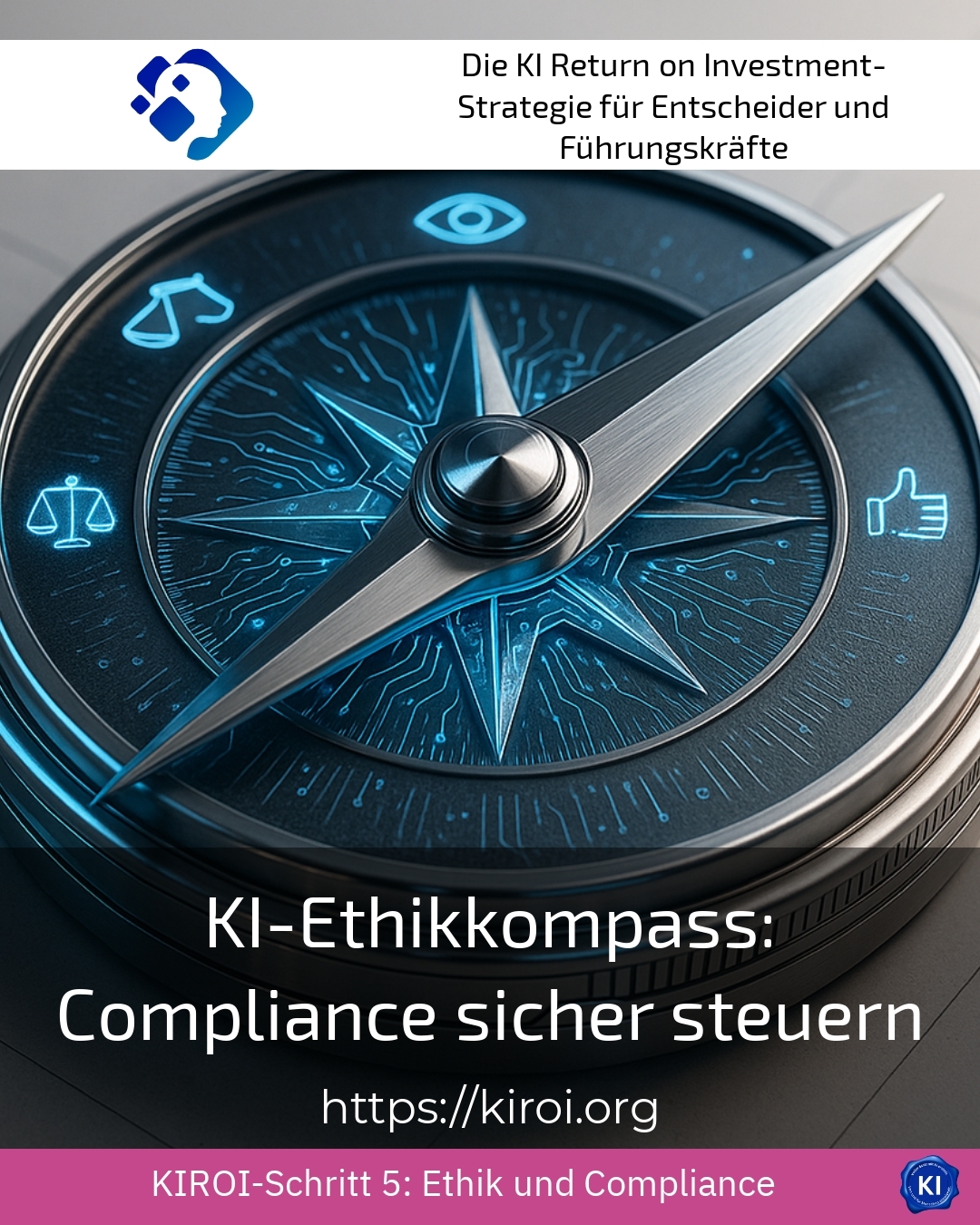
Imagine you could identify every ethical stumbling block in your company before it becomes a problem. The AI Ethics Compass: Ensuring Controlled Compliance is currently developing into an indispensable navigation aid for organisations seeking to combine technological innovation with moral responsibility. In a world where algorithmic decisions increasingly shape daily business, leaders face the challenge of complying with legal requirements while maintaining the trust of their stakeholders. This article outlines practical ways for you to master this balance.
Why moral guardrails are indispensable in digital transformation
The rapid development of automated systems has created a new reality. Companies today must not only operate efficiently. They also bear a societal responsibility for their technological decisions. A financial service provider, for example, uses algorithmic systems for credit lending. In doing so, there is a risk that historical data patterns could lead to discriminatory results. It is similar with insurance companies that automatically create risk profiles. Recruitment agencies also rely on the automatic pre-selection of applications. In all these cases, unconscious biases can arise that would remain undetected without ethical safeguards.
The regulatory landscape is continuously tightening at national and European levels. Organisations that adopt a structured approach early on gain a significant competitive advantage. They avoid costly rework while building trust with customers and partners. A logistics company, for example, that uses transparent algorithms for route planning can actively leverage this in its communications. Similarly, a retailer that uses understandable pricing models benefits. Energy suppliers that ensure fair tariff calculations also strengthen their market position with this approach.
The AI Ethics Compass: Steering Compliance Securely as a Strategic Instrument
A well-thought-out ethical framework does not act as a brake on innovation. Rather, it accelerates sustainable development. Companies often report that the implementation of clear guidelines has actually improved their innovation processes. A pharmaceutical company was able to optimise its research processes through structured ethical review procedures. A bank hastened its product development by incorporating ethical criteria early on. A telecommunications provider reduced its time-to-market because subsequent corrections were eliminated.
Best practice with a KIROI customer
A medium-sized manufacturing company faced the challenge of making its automated quality control systems ethically sound. Previous processes had led to employee dissatisfaction because the assessment criteria appeared intransparent. As part of a transruption coaching project, we collaboratively developed a comprehensive catalogue of criteria. This catalogue defined clear parameters for the algorithmic evaluation of work results. Employees were actively involved in the development process and gained insight into how the system worked. This significantly increased the acceptance of automated control. The company recorded a reduction in complaints by more than seventy per cent within the first half-year after implementation. At the same time, product quality improved because the criteria were now comprehensible and fair. Management reported a significantly improved working atmosphere and increased motivation within the team. This example powerfully demonstrates how ethical considerations can directly contribute to the improvement of operational key figures.
The practical implementation of ethical guidelines in everyday business operations
Implementing ethical principles requires a systematic approach. Firstly, all relevant stakeholders must be identified. In a trading company, this includes customers, suppliers, employees, and the wider public. An insurance company must also consider policyholders, brokers, and regulatory bodies. An industrial company includes suppliers, end customers, and local communities in its considerations.
Following the stakeholder analysis, a risk assessment is carried out for all automated decision-making processes. This involves systematically identifying and evaluating potential negative impacts. For example, a recruitment agency checks whether its matching algorithms treat all applicant groups fairly. A hotel chain analyses whether its dynamic pricing disadvantages social groups. A healthcare provider investigates whether its appointment scheduling systems provide equal access to all patient groups.
Training and awareness as cornerstones of success
Ethical guidelines remain ineffective if they are not understood throughout the entire organisation. Regular training and workshops are therefore essential. An automotive supplier introduced monthly ethics dialogues in which current issues are discussed. A management consultancy integrated ethical case studies into its onboarding programme for new employees. A media company established an internal network of ethics ambassadors across all departments.
Transruptions-Coaching supports organisations in developing bespoke training concepts. Clients frequently report that external input is what makes them see blind spots. Guidance from experienced coaches enables the breaking of ingrained thought patterns. At the same time, internal competencies are built, which will have a long-term impact.
Best practice with a KIROI customer
A large retail chain approached us with a complex issue regarding personalised customer engagement. Existing algorithms had begun to treat customer groups inequitably, leading to public criticism. As part of our transruption coaching support, we developed a multi-stage process to review all personalised marketing measures. First, we analysed the data foundation together with the internal team and identified problematic patterns. Subsequently, we developed criteria that enable personalisation without disadvantaging individual groups. Implementation was carried out step-by-step over a six-month period. In parallel, we trained the marketing team in ethical decision-making. The outcome significantly exceeded the expectations of all involved. Conversion rates remained stable, while customer satisfaction demonstrably increased. Complaints regarding unfair treatment fell to almost zero. This project illustrates that ethical conduct and commercial success are not mutually exclusive.
The AI Ethics Compass: Steering Compliance Safely Through Continuous Monitoring
Ethical compliance is not a one-off project. It requires continuous attention and regular adjustments. An effective monitoring system includes both quantitative and qualitative components. For example, an airline continuously monitors whether its booking systems treat all customer groups equally. A power supplier regularly checks whether its tariff calculations remain understandable and fair. A credit institution conducts quarterly audits of its decision-making algorithms [1].
The documentation of all ethical decisions plays a central role in auditability. In the event of complaints or regulatory inquiries, companies can thus prove that they have acted responsibly. A chemical company introduced a digital ethics logbook that records all relevant decisions. An auditing firm developed a traffic light system for quick assessment of ethical risks. A construction company integrated ethical checkpoints into its project management software.
Transparency as a cornerstone of trust in stakeholder communication
Open communication about ethical principles fosters lasting trust among all stakeholders. Companies that proactively inform about their principles are perceived as more responsible. A food manufacturer regularly publishes reports on its algorithmic decision-making processes in the supply chain. A textile company transparently communicates how it assesses suppliers based on automated criteria. A furniture retailer clearly explains to its customers how personalised recommendations are generated [2].
The inclusion of external perspectives can further increase credibility. Some organisations appoint ethics advisory boards with independent experts. Others have their processes certified by external bodies. One technology company is collaborating with a university to have its algorithms scientifically reviewed.
Challenges and solutions in practice
The implementation of ethical guidelines often encounters practical obstacles. A scarcity of resources is one of the most frequently cited challenges. Many companies underestimate the effort required for thorough implementation. A mechanical engineering company solved this problem through stepwise introduction over several financial years. A real estate company initially prioritised areas with the highest risk potential. A logistics service provider used external support to bridge internal capacity bottlenecks.
Resistance to change is another common hurdle. Employees sometimes fear that ethical guidelines will make their work more difficult. Transruption coaching can provide valuable impetus here to build acceptance. Guidance through the change process supports organisations in bringing everyone involved along. Clients often report that an external perspective has opened up new possibilities.
Best practice with a KIROI customer
An internationally operating financial services provider faced the task of harmonising its ethical guidelines across multiple national borders. The differing legal frameworks and cultural expectations made this a complex challenge. In an intensive consulting process, we collaboratively developed a modular framework that combines global principles with local adaptation options. The core principles apply company-wide and are non-negotiable. At the same time, the structure allows for necessary adjustments to local conditions. Implementation initially took place at the head office and was then gradually rolled out to all locations. Local managers received intensive training and were used as multipliers. Feedback from the various regions continuously influenced the further development of the framework. After two years, the company reported a significantly improved reputation in all markets. Employee satisfaction increased, and the company successfully positioned itself as an ethical pioneer in its industry.
Future prospects for responsible technology use
The demands for ethical conduct will continue to increase in the coming years. Regulators are continuously tightening their requirements. At the same time, public awareness of these issues is growing. Companies that invest today will reap the rewards tomorrow. An automobile manufacturer is already investing in research projects on explainable algorithms. A consumer goods manufacturer is working on fully transparent supply chains. An insurer is developing new approaches to fair risk assessment [3].
The AI Ethics Compass: Ensuring Controlled Compliance will have to continuously evolve. New technological possibilities bring new ethical questions with them. Flexibility and willingness to learn are therefore indispensable qualities for future-proof organisations. An energy company has established a permanent innovation committee that evaluates new technologies early on from an ethical perspective. A retail chain conducts regular horizon scanning activities to anticipate upcoming challenges.
My KIROI Analysis
The engagement with ethical questions in the context of automated decision-making systems clearly shows that compliance means far more than merely adhering to regulations. Instead, it is about a fundamental attitude that combines economic success with social responsibility. Numerous examples from various industries illustrate that this approach is not at odds with business objectives. On the contrary: companies that establish ethical guardrails early on often report improved business results and increased stakeholder trust. However, practical implementation requires a systematic approach and continuous commitment from all parties involved.
The role of external support, such as through transruption coaching, can be crucial in this process. An outside perspective helps to identify blind spots and break down entrenched thought patterns. At the same time, internal competencies are built up, which have a long-term impact. The documented best practices impressively show what positive changes are possible when organisations genuinely embark on this journey. For the future, it will be essential to keep the developed structures flexible and continuously adapt them to new challenges. Only in this way can companies fulfil their responsibilities while remaining competitive.
Further links from the text above:
[1] BSI – Criteria Catalogues for IT Security and Compliance
[2] European Commission – Ethical and Legal Requirements for Artificial Intelligence
[3] AlgorithmWatch – Information on Algorithmic Decision-Making Systems
For more information and if you have any questions, please contact Contact us or read more blog posts on the topic Artificial intelligence here.











 Deutsch
  English (UK)