
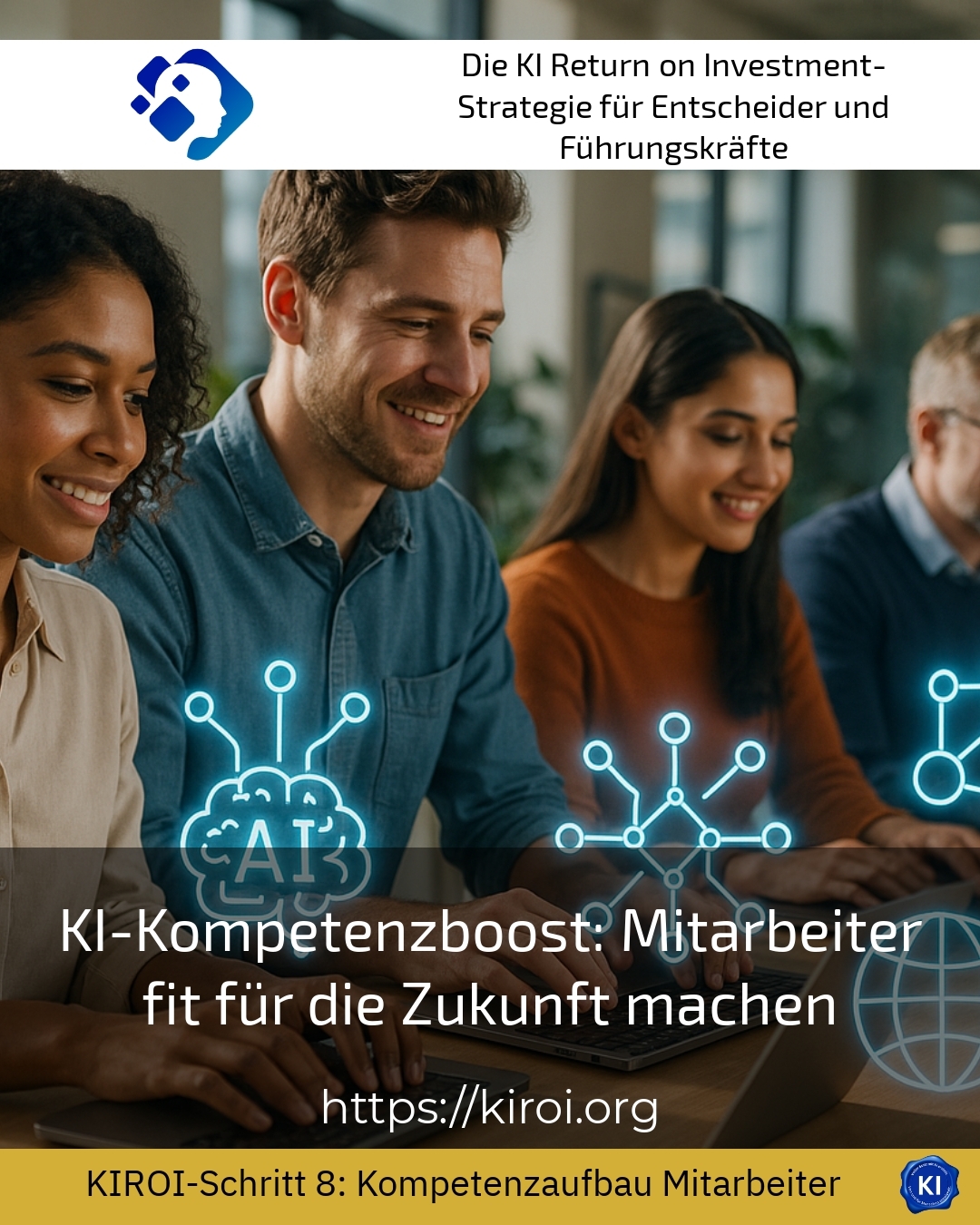
Digital transformation is changing all industry sectors at a breathtaking pace. Companies are faced with the challenge of preparing their workforce for upcoming requirements. The AI Skills Boost: Getting Employees Ready for the Future is at the heart of strategic workforce development. Anyone who does not act today risks losing ground tomorrow. But how can teams be sustainably empowered? This article shows practical approaches and provides valuable insights for decision-makers.
Why AI skills have become indispensable today
The world of work is undergoing fundamental change. Algorithms are taking over repetitive tasks and relieving the burden on human workers. At the same time, completely new fields of activity and job profiles are emerging. Employees therefore require continuously updated skills. Many workers feel overwhelmed by this development. They frequently report uncertainty when dealing with new technologies. This is precisely where well-conceived skills development comes in. It provides guidance and builds confidence in one's own abilities.
Companies are increasingly recognising the strategic importance of continuing professional development measures. Investments in human capital pay off in the long term. Studies demonstrate a direct link between qualification and increases in productivity [1]. Organisations with a strong learning culture exhibit higher rates of innovation. They can respond more quickly to market changes and maintain their competitive position. The AI Skills Boost thus not only serves individual development. It safeguards the future viability of entire companies.
Fundamental strategies for sustainable skills development
A successful upskilling strategy begins with an honest stocktake. Leaders must understand which skills are already present. Equally important is the identification of skills gaps. Structured assessments and staff appraisals help with this. The insights gained form the basis for tailored development programmes. These programmes should combine various learning formats. Classroom training, online courses and practical projects complement each other ideally.
The principle of experiential learning proves particularly effective. Employees acquire new skills best through concrete application. Theoretical knowledge alone is not enough. It must be tested and deepened in practice. Mentoring programmes offer valuable support here. Experienced colleagues accompany learners during their first steps with new tools. At the same time, this approach promotes knowledge transfer within the organisation. Teams grow together and develop joint problem-solving skills.
Individual learning paths as the key to success
Every employee brings different prior knowledge and learning preferences. Standardised one-size-fits-all solutions do not do justice to these differences. Successful companies therefore rely on personalised learning paths. These take individual strengths and areas for development into account. They adapt to the personal learning pace. Adaptive learning systems make this individualisation possible on a large scale. They analyse learning progress and adjust content accordingly.
Learners' motivation plays a crucial role. Intrinsic motivation leads to more sustainable learning outcomes than external pressure. Managers can foster this motivation through various measures. Recognising learning achievements acts as a strong motivator. Equally important is the creation of scope for self-directed learning. Employees who can organise their own learning times show higher engagement. They take responsibility for their own development.
Best practice with a AIROI customer
A medium-sized manufacturing enterprise faced the challenge of preparing its workforce for digital processes. Management turned to transruptions-Coaching for comprehensive support. Together, we developed a multi-stage training programme for all hierarchy levels. In the first step, we conducted awareness-raising workshops. These made the relevance of digital skills tangible for each individual. Subsequently, together with the specialist departments, we identified concrete areas of application. Employees received tailored training for their respective areas of responsibility. The establishment of learning partnerships proved particularly valuable. Experienced colleagues supported less tech-savvy team members. After six months, participants reported a significantly increased self-confidence in dealing with digital tools. Productivity in the relevant departments increased measurably. Management was enthusiastic about the sustainable impact of the programme. Today, the company acts as a role model for other businesses in the region.
The role of leaders in boosting AI competence
Leaders occupy a key position in skills development. They significantly shape the learning culture of their teams. Their own behaviour serves as a role model for the entire workforce. When supervisors themselves demonstrate a willingness to learn, employees follow this example. Conversely, anti-learning leadership styles stifle any development initiative. Leaders should therefore regularly reflect on their own attitude towards learning.
Specifically, leaders can support learning processes in a variety of ways. They create time for further training activities. They show a genuine interest in the learning progress of their team members. They celebrate successes and deal constructively with setbacks. Creating a safe learning environment is particularly important. Employees must be allowed to make mistakes without fearing negative consequences. It is only in such an atmosphere that a genuine willingness to learn emerges.
Overcoming resistance and promoting acceptance
Changes initially cause scepticism in many people. This reaction is completely natural and understandable. Experienced change managers know the importance of resistance management. They take employees' concerns seriously and address them openly. Transparent communication about goals and backgrounds counteracts fears. Employees want to understand why changes are necessary.
The involvement of multipliers from the workforce is particularly helpful. These so-called change agents carry messages into their teams. They enjoy the trust of their colleagues. Their positive attitude rubs off on others and reduces resistance. Companies should specifically identify and involve such informal leaders. Investing in their further development pays off many times over.
Practical implementation: From concept to reality
Many companies do not fail due to a lack of concepts, but rather because of execution. Transforming plans into concrete measures requires perseverance and resources. First of all, it is essential to set clear priorities and develop realistic schedules. Overly ambitious projects overwhelm organisations and lead to frustration. A step-by-step approach with manageable milestones proves to be more effective.
The selection of suitable learning formats deserves particular attention. Not every format suits every organisation and target group. Traditional seminars are well suited to complex foundational topics. Short learning units, known as learning nuggets, fit better into a busy working day. Webinars enable location-independent learning for distributed teams. The right mix depends on the specific framework conditions.
Best practice with a AIROI customer
A retail group with multiple locations was looking for ways to upskill its entire workforce. The decentralised structure made traditional face-to-face training extremely difficult. As part of our advisory service, we developed a hybrid learning concept. The core elements consisted of a digital learning platform and regional practical workshops. The online component delivered theoretical foundations in flexibly accessible modules. Employees were able to work through these at their own pace. The practical workshops took place at various locations. They provided an opportunity for deeper understanding and the exchange of experiences. Particularly innovative was the integration of peer-learning elements. Employees from different branches connected via a digital community. They exchanged best practices and supported each other with challenges. This networking also fostered team spirit across location boundaries. After one year, the evaluation showed impressive results. Participation rates were well above the industry average. Employee satisfaction with the learning opportunities reached peak levels. The concept is now being rolled out to further company divisions.
Measurable success through systematic monitoring
Competence development must be measurable to prove its effectiveness. Companies require suitable metrics to measure success. These range from simple participation rates to complex competence assessments. Learning analytics offer valuable support here. They provide insights into learning behaviours and progress. On this basis, programmes can be continuously optimised.
Alongside quantitative metrics, qualitative aspects deserve attention. Regular feedback sessions provide insight into learner satisfaction. They uncover potential for improvement and strengthen the commitment of those involved. The long-term application of what has been learned should also be reviewed. Transfer evaluations show whether new knowledge is actually being implemented in the daily working routine.
The AI Skills Boost as an ongoing process
Competence development is not a one-off project with a defined end. It must be understood as an ongoing process. Technological development is continuously advancing. Knowledge acquired today may already be obsolete tomorrow. Organisations therefore require structures for lifelong learning. These structures must be embedded in the corporate culture.
A learning organisation is characterised by specific features. It encourages curiosity and a willingness to experiment among all employees. It provides resources for continuous professional development. It rewards readiness to learn and acknowledges personal development. Such organisations attract talented employees and retain them in the long term. They thereby create a sustainable competitive advantage [2].
My AIROI Analysis
Upskilling employees for future requirements is one of the central challenges of our time. My experience from numerous accompaniment projects shows clear patterns of success. Companies that invest systematically in skills development achieve measurable advantages. They react more quickly to changes and exploit new opportunities more effectively. Their employees show higher satisfaction and lower staff turnover.
Crucial to success is the holistic approach. Isolated training measures often fizzle out without effect. Only embedding them within a comprehensive strategy unfolds a lasting impact. This strategy must address leaders, structures and culture alike. Transruption coaching accompanies organisations through this complex transformation. We provide impulses, moderate processes and support implementation.
The future belongs to companies with workforces capable of learning. They possess the adaptability that is indispensable in volatile times. The path there requires investment in time, resources and persuasion. Yet these investments pay off manifold. Employees who develop continuously identify more strongly with their employer. They bring in more commitment and creativity. Ultimately, all participants benefit from a strong learning culture.
Further links from the text above:
[1] McKinsey Insights – The Organisation of the Future
[2] Harvard Business Review – Organisational Learning
For more information and if you have any questions, please contact Contact us or read more blog posts on the topic Artificial intelligence here.









 Deutsch
  English (UK)