
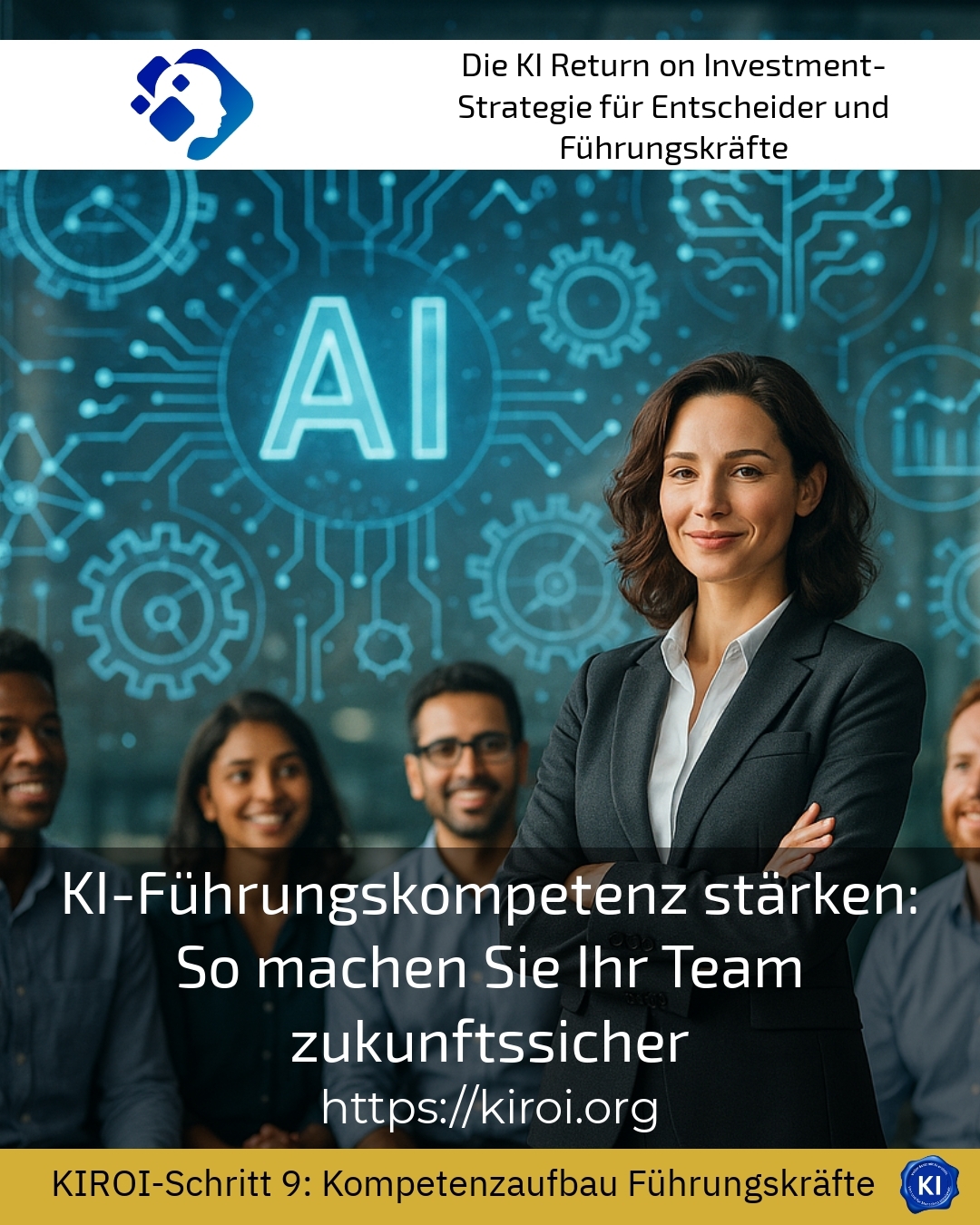
Imagine your company is at a turning point, where technological changes can no longer be stopped. Leaders who do not develop digital skills today will be overtaken by developments tomorrow. The ability to navigate teams through this transformation will determine success or failure. Strengthening AI Leadership Competence means far more than just developing technical understanding. It's about a fundamental reorientation of how we lead, decide, and work together. But how can this change be achieved specifically within your organisation?
Why modern leadership skills are indispensable today
The world of work is changing at a pace that presents many leaders with significant challenges. Traditional leadership models are no longer sufficient to successfully guide complex digital transformation projects. Employees today expect their superiors not only to be technically competent but also to understand and contextualise technological trends. A practical example clearly illustrates this: a medium-sized manufacturing company implemented new automated systems, but the leadership could not adequately address the workforce's anxieties. The project failed not due to the technology, but due to a lack of change management.
Clients often report feeling torn between technological progress and human leadership. However, this tension can be resolved when leaders understand that both aspects go hand in hand. Transruption coaching accompanies companies precisely at this interface and provides impetus for sustainable integration. Another example comes from the financial sector: A bank introduced digital consulting tools, but the customer advisors felt replaced rather than supported. It was only through targeted leadership development that the successful introduction was achieved. Such situations show how important emotional intelligence has become in the digital age.
The connection between technology and leadership
Successful leaders understand that technology is not an end in itself. They use digital tools to empower their teams and unlock potential. For example, a logistics company used predictive analytics to optimise supply chains. However, the team leaders, who communicated the new processes to their employees and built trust, played a crucial role. In contrast, a retail company implemented a new merchandise management system without adequate leadership support. This resulted in frustration, errors, and significant productivity losses in the initial months. The third example concerns an insurance company that implemented chatbots for customer service. The service managers had to learn to focus their teams on consultation-intensive cases and communicate the new division of labour positively [1].
Strengthening AI leadership competence through systematic development
The development of modern leadership skills requires a structured approach. It is not enough to simply attend individual training sessions. Instead, a continuous learning journey is needed that addresses various dimensions of leadership. The AIROI Masterplan Model offers a proven framework for companies to support this transformation. Leaders must first reflect on their own mindset and become open to change. Subsequently, it is essential to build specific competencies and apply them in everyday work.
An automotive supplier faced the challenge of preparing its production managers for networked manufacturing. The managers had decades of experience but little exposure to data-driven decision-making processes. Through a multi-stage development programme, fears were allayed and new competencies were built. A pharmaceutical company used a similar approach to prepare its laboratory managers for automated research processes. The managers learned to redefine their roles as coaches and enablers, rather than acting purely as controllers. In the food industry, transruption coaching supported a company in qualifying its shift managers for digital production control [2].
Best practice with a AIROI customer
A globally active mechanical engineering company with over three thousand employees faced the challenge of preparing its entire management team for digital transformation. Management recognised early on that technical investments alone would not be enough to remain competitive. Together with the AIROI framework, a comprehensive development programme was conceived that involved all management levels. In the first phase, consultants analysed existing competencies and identified key development areas among the managers. It was particularly important to recognise that technical knowledge and leadership skills had to be strengthened simultaneously, as both are inextricably linked. Team leaders in production initially received basic training on data-driven decision-making processes and their application in day-to-day work. Subsequently, coaches accompanied the managers in practical implementation within their teams, providing continuous feedback. After twelve months, there was significantly improved acceptance of new technologies in the workforce, as well as increased willingness to innovate. The turnover rate among qualified specialists noticeably decreased because employees felt more engaged and developed trust in the company's leadership. Management today reports a more open communication culture and faster decision-making processes in all departments of the company.
Concrete areas of action for future-proof teams
Strengthening leadership skills in the digital context involves several key areas that should be systematically addressed. Firstly, developing a basic understanding of technological possibilities and limitations is necessary to make informed decisions. Leaders don't need to be able to code themselves, but they should be able to assess what is possible and what appears unrealistic. A retail company trained its store managers in the basics of predictive analytics to better understand and comprehend workforce planning. The managers were subsequently able to explain to their teams why certain shifts were staffed differently and what data helped in this regard.
The second area of action concerns the communication and mediation of changes to employees, as this is often underestimated. An energy provider introduced smart meter technology and had to prepare its customer service employees for new queries related to it. Team leaders required support to explain complex technical connections in an understandable way and to take concerns seriously. A third area of action includes the ethical reflection of technological decisions, which is becoming increasingly important today. In a hospital, an assistance system for diagnostic suggestions was tested, but management had to develop clear guidelines on how to deal with the recommendations and who bears responsibility [3].
How to strengthen AI leadership skills in your company
The path to strengthening digital leadership skills begins with an honest assessment of your organisation's current situation. Where do your leaders stand today, and where do they need to be in the coming years to remain successful? These questions are best answered through dialogue, which is why transruption coaching focuses on individual support and does not offer standard solutions. For instance, a construction company realised that while its project managers had excellent technical expertise, they struggled with digital planning tools. Through targeted development measures and continuous support, this gap was successfully closed and acceptance was increased.
A media company faced the challenge of preparing its editorial leaders for new content management systems and data-driven content ideation, which represented a significant shift. Leaders had to learn to connect journalistic intuition with analytical insights and to value both. The example demonstrates that it's not about replacing established competencies, but rather complementing and expanding them meaningfully. In the tourism sector, AIROI supported a hotel in preparing its department heads for personalised guest experiences through data analysis. Leaders developed an understanding of how guest data can be used ethically to improve service without being intrusive [4].
Overcoming resistance and building motivation
Every transformation encounters resistance, which is completely normal and even healthy for an organisation. Experienced leaders know that scepticism is often based on legitimate concerns that must be taken seriously and not ignored. Transruption coaching helps to understand these resistances as valuable indicators and to use them constructively for the change process. A telecommunications company experienced massive resistance when introducing a new CRM system because employees feared becoming redundant. The leaders learned to address these fears openly and to show concrete development perspectives that were motivating.
In the chemical industry, AIROI supported a company whose lab managers were resisting and blocking automated documentation processes. Through workshops and individual discussions, it became clear that the concern about loss of control was paramount and needed to be addressed. The managers, together with their teams, developed new ways of working that provided autonomy while simultaneously increasing efficiency. A third example comes from the healthcare sector, where nursing service managers had to introduce digital documentation systems and encountered resistance. Overcoming this resistance was only successful once the managers themselves were convinced and could authentically convey this conviction [5].
Sustainable transformation through continuous support
The development of leadership skills is not a one-off project, but an ongoing process that requires attention. Markets change, technologies evolve, and the demands on leadership are also continuously and steadily transforming. Therefore, the AIROI framework focuses on long-term support rather than short-term interventions, which often vanish without lasting impact. A textile company has been working with this approach for several years and reports continuous improvements in the company's leadership culture.
The sporting goods industry also demonstrates the importance of continuous development for long-term success. One manufacturer regularly upskills its managers to keep pace with the rapid changes in e-commerce and remain competitive. Team leaders in the logistics centre were initially trained on automated picking systems, and later on predictive inventory planning and further innovations. This iterative approach has proven effective because it avoids overwhelming participants and enables sustainable learning for all involved. A furniture manufacturer uses a similar approach to prepare and support its production managers for networked production lines. Managers receive regular training and coaching to integrate and apply new developments [6].
Best practice with a AIROI customer
A medium-sized, family-run business in the packaging industry, employing around 800 people, wanted to fundamentally modernise its leadership culture and make it future-proof. The third generation had taken over management and recognised the need for digital transformation across all areas of the company. Transruptions coaching supported the company over an 18-month period during this comprehensive change process. Initially, all 22 managers were interviewed individually about their skills and development wishes, and involved in the process. Based on this, the AIROI team developed a bespoke programme that included both group workshops and individual coaching, integrating various learning formats. Particularly innovative was the establishment of learning partnerships, where experienced managers collaborated with younger colleagues, learning from each other. The older managers contributed their process knowledge, while the younger ones shared digital skills, and both sides benefited. This mutual enrichment created a new culture of openness and continuous learning throughout the company. Following the completion of the programme, the managing directors reported noticeably faster decision-making processes and a greater willingness to innovate among all involved. Customer satisfaction also increased because the teams could respond more flexibly to individual requirements and communicated better with customers.
My AIROI Analysis
The analysis of numerous transformation projects clearly shows that the success of digital initiatives depends crucially on leadership quality and not primarily on the technology itself. Companies that invest solely in technology and neglect the human dimension are more likely to fail than those that treat and integrate both aspects equally. Strengthening leadership competencies in the digital context requires a holistic approach that combines and promotes technical understanding, emotional intelligence, and strategic thinking. The AIROI framework has proven to be particularly effective in this regard because it systematically addresses these different dimensions and makes them practically implementable.
The insight that leadership development cannot be a one-off measure but must be understood as a continuous process seems particularly important to me. The speed of technological change requires a permanent willingness to learn at all levels of the organisation and in all functional areas. At the same time, tried-and-tested leadership principles such as trust, transparency and appreciation must not be discarded because they form the foundation. Rather, they form the foundation on which new competencies can and must be built to be sustainably effective.
The examples from various industries make it clear that there is no one-size-fits-all solution that works equally well for all companies. Every organisation brings its own prerequisites, cultures, and challenges that must be taken into account when designing development programmes. Transruption coaching therefore supports companies individually, adapting methods and content to specific needs rather than offering standard programmes. Those who invest in the development of their leaders today lay the foundation for sustainable success in a rapidly changing world.
Further links from the text above:
[1] Harvard Business Review – Leadership Insights
[2] McKinsey – People and Organisational Performance
[3] Gartner – Human Resources Research
[4] Forbes – Leadership Section
[5] MIT Sloan – Leadership Topics
[6] World Economic Forum – Leadership
For more information and if you have any questions, please contact Contact us or read more blog posts on the topic Artificial intelligence here.









 Deutsch
  English (UK)