
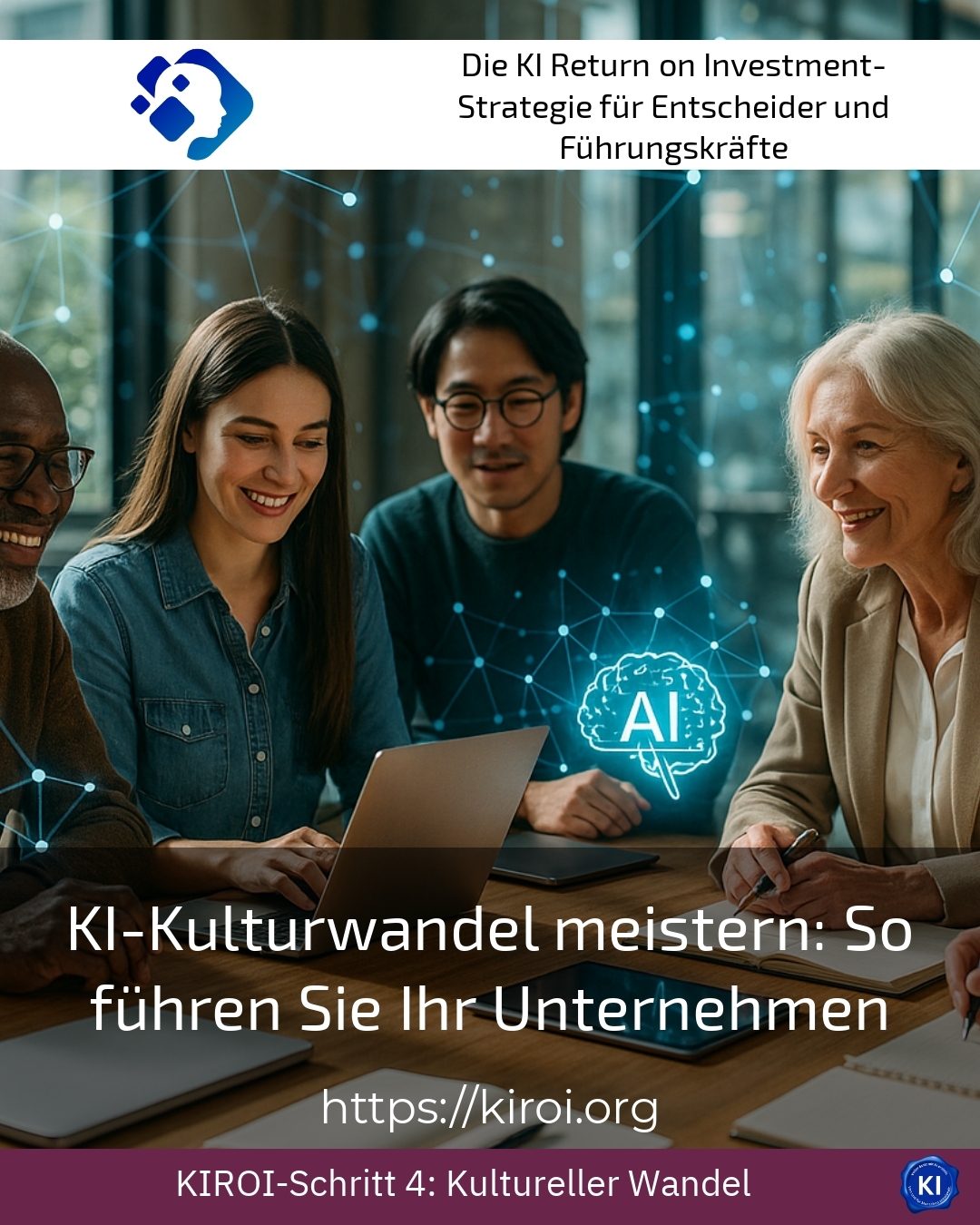
The rapid development of intelligent systems is fundamentally changing our working world and presenting managers with completely new challenges. Many decision-makers are currently asking themselves how they can Mastering AI cultural change can, without overwhelming their teams or losing valuable staff in the process. This transformation does not only affect technical processes, but also touches the self-image of entire organisations. The good news is: with the right strategy and empathetic leadership, this change can be achieved sustainably.
Why the AI cultural shift means more than just a technical transition
When companies introduce intelligent technologies, they often underestimate the human dimension of this change. Employees bring fears and uncertainties with them. They worry about their professional future. Some fear being replaced by automated systems. Others doubt their ability to learn new skills. These emotional reactions are completely understandable and deserve serious attention from management [1].
In the financial sector, many institutions report significant resistance to the introduction of automated analysis systems. Portfolio managers see their expertise called into question. Customer advisors fear that chatbots will devalue their relationship-building work. Tensions also arise in accounting when intelligent systems take over routine tasks. These examples clearly show that change begins in people's minds.
Transruptions-Coaching supports companies precisely through these sensitive processes. It assists leaders in developing an understanding of their employees' perspectives. This creates spaces for open discussions and constructive engagement. Clients frequently report that genuine acceptance only arises through this guidance.
Best practice with a AIROI customer
A medium-sized financial services company with around two hundred employees was about to introduce an intelligent risk assessment system. There was considerable initial scepticism amongst the team. Experienced analysts felt their professional expertise was under threat. As part of our AIROI support programme, we first developed a comprehensive understanding of the various perspectives within the company. We ran structured workshops in which staff could openly express their concerns. Together, we then devised a concept that combined human expertise with the strengths of the system. The analysts became active agents of change. They trained the system using their specialist knowledge. After six months, they reported a significant reduction in their workload. The quality of the risk assessments improved measurably. The team developed a genuine sense of pride in the innovation they had achieved together.
Developing leadership skills for a successful AI culture change
The demands on leaders are fundamentally changing as a result of this transformation. Authoritarian leadership styles rarely work successfully in this context. Instead, empathy, communication skills and the ability to manage change are gaining in importance. Leaders must learn to endure uncertainty and communicate transparently. They are becoming bridge-builders between technological possibilities and human needs [2].
This challenge is particularly evident in the insurance sector. Leaders in claims management must explain why automated systems will handle routine cases in future. At the same time, they need to convey to their teams that complex cases will continue to require human judgement. In sales, the goal is to strike the balance between digital assistants and personal advice. New leadership tasks are also arising in product development.
Successful leaders rely on continuous professional development. They invest time in understanding new technologies. However, they do not neglect their core task: leading and developing people. Transruption coaching provides impetus on how to achieve this balance.
Mastering Communication as the Key to AI Cultural Change
Open and honest communication forms the foundation of every successful transformation. Employees deserve clear information about planned changes. They require realistic assessments of the impacts on their work. Vague statements or sugar-coating permanently undermine trust. Therefore, we recommend a proactive communication strategy from the very beginning [3].
Banks have had varying experiences here. Some institutions informed their staff only late about planned automations. The result was uncertainty and rumour-mongering. Other organisations chose the transparent route and involved their teams early on. This approach led to greater acceptance and constructive suggestions. Similar patterns can be seen in wealth management firms and investment companies.
Regular dialogue formats effectively support the communication process. Town hall meetings provide space for company-wide updates. Smaller discussion groups allow for deeper discussions. Anonymous feedback channels can also deliver valuable insights. The combination of different formats reaches different types of employees.
Involve employees as active agents of change
The most successful transformations arise through genuine participation of the workforce. Employees possess valuable practical knowledge about existing processes. They recognise optimisation potentials that remain hidden from management. Their involvement not only increases the quality of the solutions. It also strengthens commitment to the change.
In credit processing, participatory approaches have achieved impressive results. Administrative staff developed optimised processes together with technology experts. They identified cases in which automated decisions appeared sensible. At the same time, they defined constellations that continue to require human judgment. This collaboration led to practical solutions.
Insurance companies are recording similar successes in the development of digital customer services. Call centre employees contributed their experience. They knew precisely which customer queries could be processed automatically. Broker support managers also made important contributions to the system design. This involvement resulted in solutions with a high level of acceptance.
Best practice with a AIROI customer
A nationwide building society wanted to enhance its customer advisory services using intelligent assistance systems. The management recognised the importance of staff involvement at an early stage. As part of our AIROI project, we facilitated a comprehensive co-creation process. Advisers from various regions contributed their perspectives. We collected typical customer enquiries and jointly analysed advisory situations. The staff themselves defined what kind of support they wanted from the system. They also determined the limits of automation. The result was an assistance system that genuinely took the pressure off the advisers. It prepared for customer meetings and provided relevant information in real time. The advisers saw the system as a genuine help rather than a threat. Customer satisfaction rose significantly in parallel with staff satisfaction.
Take a systematic approach to qualification and skills development
The introduction of intelligent systems requires new competencies at all levels. Employees need basic knowledge of how the technologies work. They must learn to collaborate with automated systems. Critical thinking and the ability to evaluate results are also gaining in importance. Companies should therefore invest in comprehensive qualification programmes [4].
Successful banks have developed multi-stage learning concepts. Basic training courses provide all employees with a foundational understanding. In-depth workshops are aimed at teams that work directly with new systems. Specialised training qualifies selected employees to become internal experts. These then act as multipliers in their areas.
Insurance companies also rely on a variety of learning formats. E-learning modules enable flexible, self-directed learning. Classroom training sessions offer space for practical exercises and questions. Peer learning groups encourage exchange between colleagues. This combination reaches different learning types and levels of knowledge.
Develop corporate culture sustainably further
Technological change only succeeds with a corresponding cultural development. Traditional values such as diligence and customer orientation retain their importance. But they are complemented and expanded by new aspects. A willingness to experiment, a readiness to learn and adaptability are becoming more important. A constructive culture of error supports the innovation process [5].
In the financial sector, conservative cultures frequently collide with disruptive technologies. Private banking departments traditionally maintain a special service culture. This can be combined with digital innovation rather than replaced. New ways of working are also emerging in corporate client advisory. Analysts use intelligent tools for deeper insights into corporate data.
Successful cultural development takes time and patience. Rapid changes frequently lead to resistance and setbacks. Therefore, we recommend a step-by-step approach with clear milestones. Transruption coaching accompanies this process using proven methods.
My AIROI Analysis
The Mastering AI cultural change presents companies with one of the most significant leadership challenges of our time. The technological dimension of this transformation is only one aspect. The human side of change appears to be at least as important. Leaders must keep both dimensions equally in focus.
My experience with numerous AIROI projects has revealed clear patterns of success. Companies that involve their staff early on and honestly achieve more sustainable results. They manage to transform resistance into constructive energy. Their workforces become active shapers of change rather than passive participants.
The financial sector faces particular challenges and opportunities here. On the one hand, intelligent systems enable enormous efficiency gains and better decisions. On the other hand, customer trust in human expertise is an important asset. The art lies in combining the two.
I observe that successful transformations are always built on a clear vision. This vision does not just describe technical goals. It also shows what role people play in the new world of work. Employees need this direction for their own engagement. Therefore, I advise companies to work on their vision first.
Finally, I would like to emphasise: change is something we can shape. Companies are not helplessly at the mercy of technological developments. With the right strategy and empathetic leadership, work environments are created that bring together human and machine. Transruption coaching can accompany and support this journey in a valuable way.
Further links from the text above:
[1] McKinsey – The Future of Work
[2] Harvard Business Review – Leadership
[3] Gartner – Human Resources Research
[4] World Economic Forum – Future of Work
[5] MIT Sloan – Organisational Culture
For more information and if you have any questions, please contact Contact us or read more blog posts on the topic Artificial intelligence here.








 Deutsch
  English (UK)