
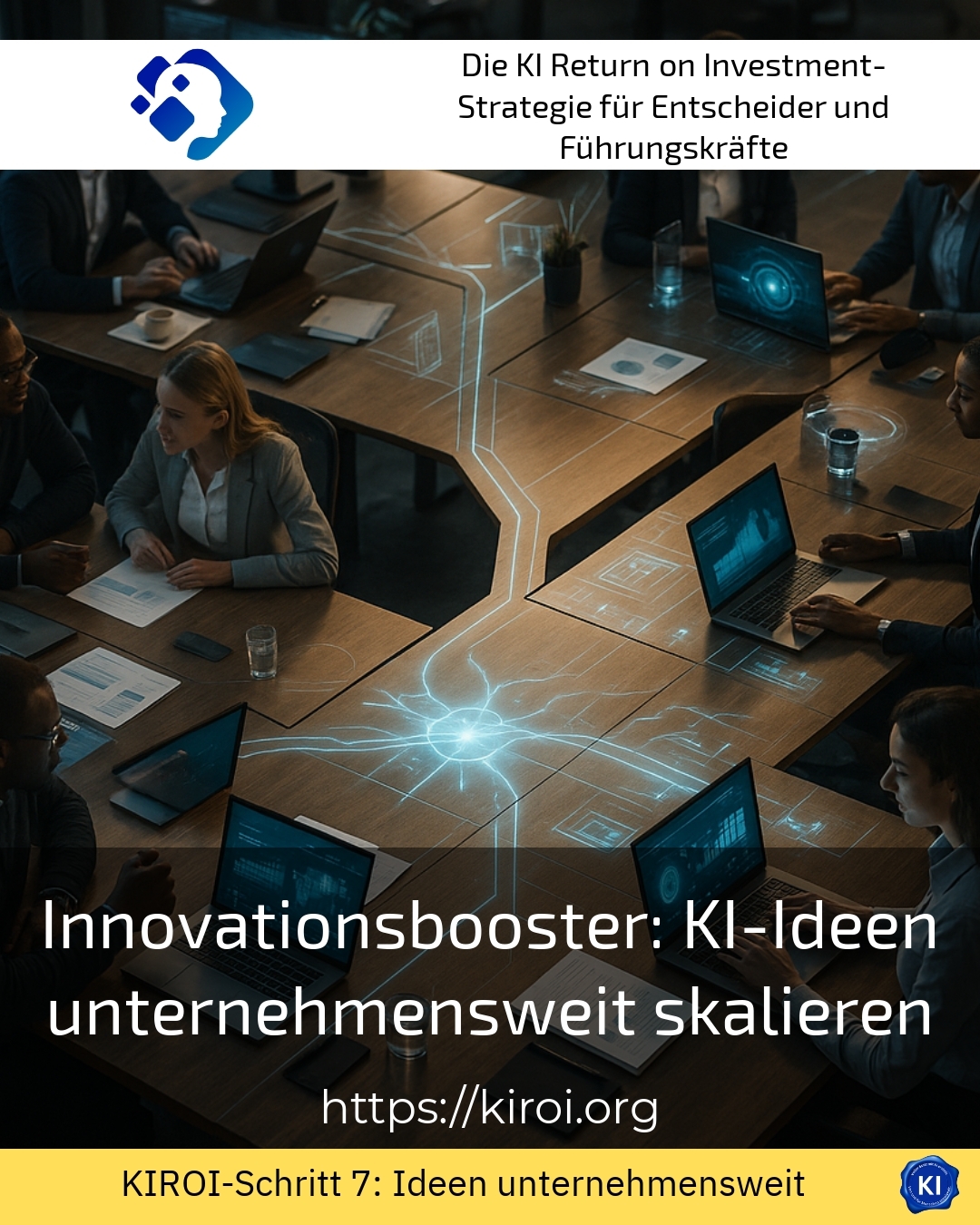
The digital transformation has presented companies with a crucial challenge, because while individual departments are already achieving impressive success with machine learning and automated processes, the true potential often remains untapped. The decisive breakthrough only occurs when it is possible to integrate the Innovation Booster: Scaling AI Ideas Company-Wide To activate and translate isolated pilot projects into a holistic strategy. This is where the exciting journey begins, which many organizations still have ahead of them and that with the right guidance can lead to transformative results.
Why isolated pilot projects are not enough
Many companies embark on their first experiments with intelligent systems with enthusiasm. One team develops a chatbot for customer service. Another department tests predictive analytics for warehouse management. A third team automates repetitive tasks in accounting. Yet these isolated solutions often remain exactly that: isolated islands in a sea of untapped potential. The true transformation begins only when organizations understand that individual successes must be multiplied to create a sustainable competitive advantage, and that this requires a systematic approach.
In practice, a similar pattern is often observed across different organizations. A medium-sized machine manufacturer successfully implements intelligent quality control. The results are impressive, and the error rate significantly decreases. However, this knowledge is limited to a single production line. At the same time, the logistics department struggles with inefficient routes, even though similar technologies could also support this here. Such situations illustrate why a structured approach to scaling is so important.
Best practice with a AIROI customer
An internationally operating plant builder faced the challenge of various sites experimenting with intelligent systems independently of one another. The plant in southern Germany had successfully developed predictive maintenance for production facilities. At the same time, the team in Eastern Europe was working on automated document processing for technical drawings. Through transruptive coaching, an initial inventory of all ongoing initiatives was conducted. It was revealed that many insights were transferable and that synergies had remained untapped until now. In the framework of the AIROI-framework, the company developed a central knowledge database for all sites. Additionally, an internal mentoring program was established, in which experienced teams shared their learnings. After a year, the management reported a significant acceleration in new projects. The time-to-value for new applications decreased significantly, as proven approaches were adapted more quickly. Particularly valuable was the realization that cultural differences between locations needed to be actively addressed. Transruptive coaching helped create a common framework that respected local specifics.
The innovation booster: Scaling AI ideas across the company through cultural change
Technology alone does not create transformation. The decisive factor lies in corporate culture and the willingness to change [1]. People need to understand why new technologies are being introduced. They need to develop trust and be able to reduce fears. An open culture of error allows teams to learn from experiments. Leaders play a central role as role models and facilitators.
In the manufacturing industry, we regularly encounter similar challenges. Experienced skilled workers fear for their expertise and their jobs. Engineers see new systems as a threat to their decision-making authority. Middle management is concerned about a loss of control over automated processes. These concerns are understandable and must not be ignored. Rather, they offer important impulses for a human-centric implementation strategy.
An automotive supplier recognized early on that involving the workforce was crucial. Instead of ordering new systems from above, employees became co-creators. They identified processes themselves where intelligent support seemed useful. The result was significantly higher acceptance and better results. A manufacturer of precision tools made similar experiences when it introduced internal innovation competitions. Employees from all departments were able to submit proposals and were involved in the implementation.
Communication as the key to scaling
The way new technologies are communicated significantly influences their acceptance. Abstract concepts must be translated into concrete benefits. For example, a logistics service provider did not communicate about „machine learning for route optimization“; instead, they spoke of „less stress through better tour planning and more time for the family.“ This wording directly addressed the drivers and sparked interest rather than resistance.
One pharmaceutical company chose a different approach and focused on transparent communication about success. Every milestone was celebrated and shared internally. Small successes in individual laboratories were documented and disseminated. This created a positive momentum that motivated further teams. The internal newsletter series „Intelligent Impulse“ became the most read format in the company.
Infrastructure and governance for the innovation booster: scaling AI ideas across the company
Without the right technical and organizational infrastructure, even the best ideas fail. Data silos must be broken down and central platforms created [2]. Governance structures regulate responsibilities and decision-making paths. Security standards ensure the responsible handling of sensitive information. These fundamentals form the foundation for sustainable scaling.
A chemical company initially invested in a uniform data platform for all locations. The challenge was not in the technology but in standardizing processes. Different laboratories used different designations for identical substances. Measurement methods varied between departments without any discernible reason. Harmonizing these fundamentals took more time than the actual technical implementation.
A manufacturer of industrial electronics established a central competence center for data-driven projects. This team supported all business units in the design of new applications. It provided tools and methods and trained local champions. At the same time, it collected insights and developed best practices for the entire organization. This approach significantly accelerated scaling and avoided redundant development efforts.
Best practice with a AIROI customer
A medium-sized food producer came to transruptive coaching with a specific request. The management had launched several successful pilot projects, but the expansion across the company was stagnating. The coaching through the AIROI framework began with a thorough analysis of the existing structures. It became clear that there was a lack of clear responsibilities and that resources were not being allocated systematically. Together, we developed a governance model with defined roles and decision-making processes. A steering committee was established that decided on priorities and resource allocation. Each business unit was assigned a local coordinator as a contact person and driver. These coordinators met regularly to exchange experiences and coordinate activities. In addition, a budget pool was created from which cross-departmental projects could be funded. After implementation, the managers reported a significantly improved level of collaboration. Projects that had previously failed due to issues of responsibility could now be implemented quickly. The combination of clear structures and flexible resources proved particularly valuable.
Measurable successes as the basis for further investments
Scaling requires continuous investments in technology, personnel, and processes. These investments must be justified by demonstrable results [3]. Therefore, systematic monitoring of project results is essential. Key performance indicators should be defined and regularly reviewed before the project begins. Only then can successes be documented and improvement potentials identified.
A packaging machine manufacturer implemented a dashboard for all ongoing initiatives. Executives could view the status and results at any time. Successful projects were highlighted and presented as examples. Projects with difficulties received additional attention and support. This transparency fostered constructive competition among teams and accelerated learning.
Building competence for sustainable transformation
The shortage of qualified professionals poses major challenges for many organizations. External expertise can help in the short term, but in the long term, internal competencies must be built. Training programs, mentoring, and learning-by-doing are proven approaches [4]. Collaboration with universities and research institutions opens up additional possibilities. Partnerships with specialized advisory services such as transruptive coaching can accelerate the development of competencies.
A mechanical engineering company launched a comprehensive qualification program for engineers and technicians. The content ranged from the basics of data analysis to advanced methods. Practical projects, in which participants worked on real problems, were particularly valuable. An energy provider took a different approach and specifically recruited entry-level employees with digital skills. These were brought together with experienced industry experts in mixed teams. The combination of fresh perspectives and deep expertise proved particularly productive.
A medical technology provider established an internal rotation program for young talent. Talented employees went through various departments and projects. They gained broad experience and built a corporate network. Upon completion of the program, they assumed key positions as bridge builders between departments.
The innovation booster: Scaling AI ideas across the company with external support
Not every organization has all the necessary resources and experience for successful scaling. External guidance can provide valuable insights and help avoid typical pitfalls. Transruptions coaching positions itself as a partner for companies that want to undertake their transformation holistically. The guidance includes strategic advice, methodological support, and practical workshops.
Clients often report similar starting situations when they come to transruptive coaching. They have already achieved initial success, but are running into limitations in scaling up. Organizational resistance hinders progress and frustrates dedicated teams. There is a lack of a clear framework for prioritization and resource allocation. This is where the AIROI-methodology comes in and offers structured solutions.
Best practice with a AIROI customer
A traditional family business in the metalworking sector turned to transruptive coaching with a complex request. The third generation had taken over the leadership and wanted to make the company future-proof. Initial experiments with intelligent systems in quality assurance had been promising. However, a strategy was lacking to expand these approaches to other areas. The coaching began with workshops at the management level to develop a shared vision. Subsequently, potential analyses were conducted for all business areas. It was revealed that the purchasing, production, and sales departments could particularly benefit from new approaches. A roadmap with prioritized initiatives was developed and approved by the leadership team. Implementation took place in waves, with lessons learned from earlier projects being incorporated into later ones. The external perspective was particularly helpful in overcoming internal resistance. The transruptions coaching served as a neutral mediator between different interest groups. After two years of intensive collaboration, the company had undergone a fundamental transformation. Productivity had increased and new business models had been explored.
My AIROI Analysis
Scaling intelligent systems across corporate boundaries remains one of the biggest challenges of our time. Technology is only one component among many. Culture, communication, and clear governance structures are at least as important. Organizations that address these factors holistically have significantly better chances of success than those that focus solely on technical solutions.
The AIROI-methodology offers a proven framework for this complex transformation. It combines strategic planning with pragmatic implementation, taking into account the human dimension. My experience from numerous mentoring projects shows that success often depends on seemingly small things. The right communication at the right time can overcome resistance. Involving skeptical employees transforms critics into supporters. Celebrating small successes creates momentum for larger projects.
Companies that take their transformation seriously should invest in competence building early on. External guidance can accelerate this process and help avoid typical mistakes. Transruptive coaching is available to accompany organizations on their journey. The future belongs to those who not only experiment but also systematically scale up. The innovation accelerator lies not in individual technologies but in the ability to disseminate ideas across the organization and continuously develop them.
Further links from the text above:
[1] Harvard Business Review: Organisational Culture
[2] McKinsey: The Data-Driven Enterprise
[3] MIT Sloan: Measuring AI Success
[4] World Economic Forum: The Future of Jobs Report
For more information and if you have any questions, please contact Contact us or read more blog posts on the topic Artificial intelligence here.










 Deutsch
  English (UK)