
Why do brilliant ideas fail in companies, even though they have the potential to revolutionise entire markets?
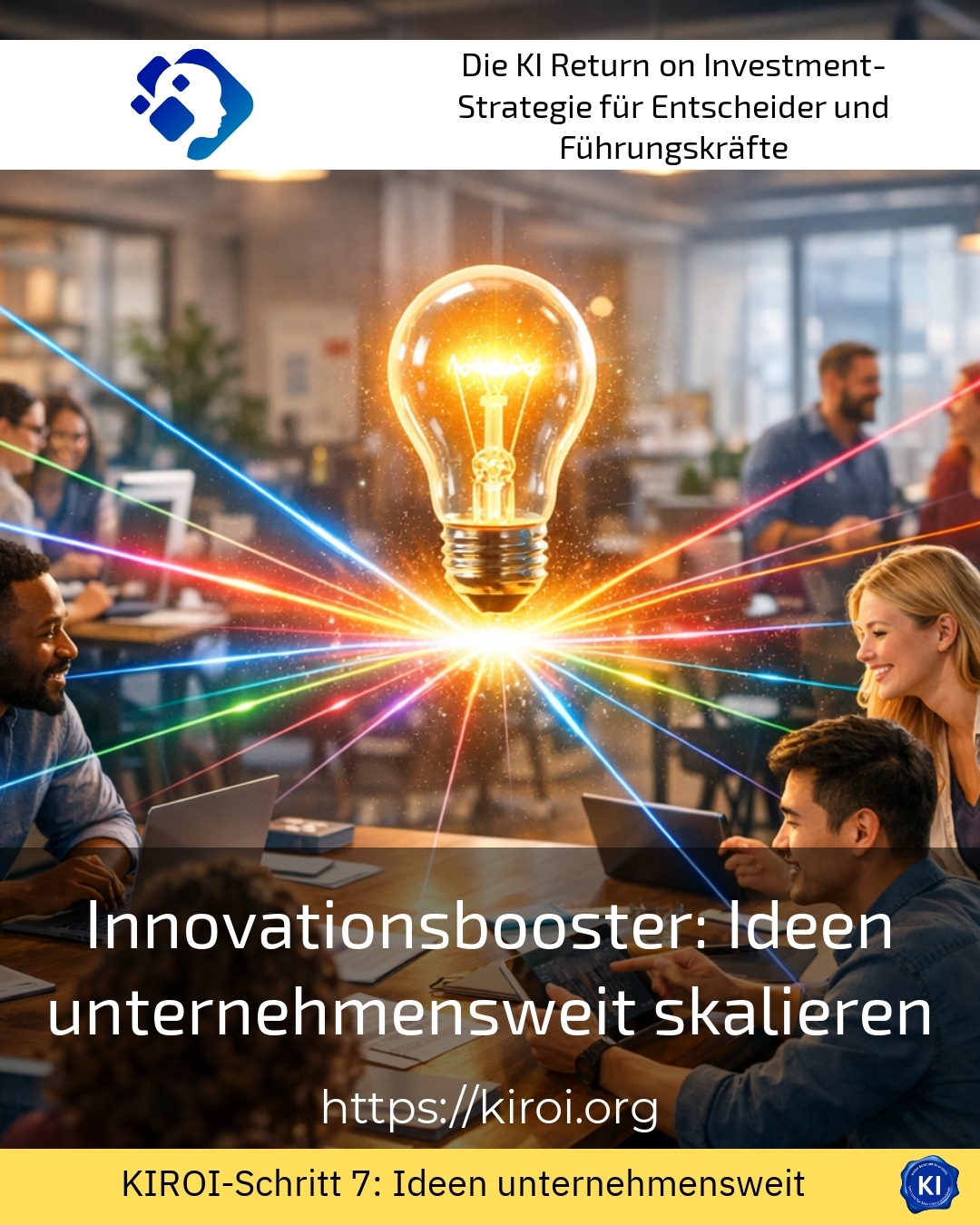
This question concerns executives and innovation managers alike. The real Innovation booster: Scaling ideas across the company It does not lie solely in the creative initial spark. It only takes off when organizations create systematic structures. These structures enable the dissemination of impulses across departmental boundaries. Clients often report isolated pilot projects that never fully achieved their full potential. Transforming individual flashes of inspiration into corporate-wide movements requires a profound rethinking. This rethinking affects culture, processes, and leadership understanding alike.
The anatomy of successful idea dissemination in organizations
Successful companies fundamentally differ in their approach to creative processes. They view every employee as a potential source of valuable inspiration. This attitude manifests itself in concrete structures and behaviors. Thus, advanced organizations establish so-called innovation labs with interdisciplinary teams. These teams work at the intersection of various departments. This creates synergies that isolated departments could never achieve.
A manufacturing company in the mechanical engineering sector implemented a digital proposal system. Employees were able to submit and evaluate improvement ideas directly. Within a few months, over three hundred actionable proposals were created. A logistics company took a different approach and organized monthly creative workshops. There, warehouse employees met with IT specialists and sales experts. The resulting diversity of perspectives led to surprising solutions. A financial services provider, in turn, established a mentoring program for idea generators. Experienced executives guided promising concepts until they reached market maturity.
Best practice with a AIROI customer
A medium-sized manufacturing company faced the challenge of bringing innovative ideas from production into the entire organization. The management recognized that valuable improvement proposals were often sent in individual units. Together, we developed a multi-stage scaling strategy within a transruptive coaching process. First, we identified local innovation ambassadors in each location. These ambassadors received specialized training in moderation techniques and idea evaluation. Subsequently, we established quarterly innovation forums where the best concepts were presented. The management committed to releasing at least three ideas per quarter for implementation. The result significantly exceeded all expectations. Within a year, the submitted proposals increased by over two hundred percent. The implementation rate improved from under ten to over forty percent. What was particularly noteworthy was the increased employee satisfaction in all areas. People felt included and valued in their creative contributions.
The innovation booster: Scaling ideas across the company through cultural transformation
Technical infrastructure alone is not enough for sustainable change. The most profound transformation takes place at the cultural level. Organizations must create an atmosphere in which experimentation is rewarded. At the same time, failures must not lead to stigmatization. Achieving this balance is one of the most challenging leadership tasks of all.
A retail conglomerate revolutionized its corporate culture through a so-called fail-forward program. Employees publicly shared their failed experiments and the insights gained from them. This practice normalized failure as a natural part of the innovation process. A telecommunications company conducted regular hackathons where mixed teams worked on real business problems. The winning projects received budgets and dedicated implementation time. A pharmaceutical company established so-called innovation sponsorships at the board level. Each board member assumed personal responsibility for selected future projects.
The role of leaders changes fundamentally in this context. They become facilitators and supporters for decision-makers. Their task is to open up spaces for creativity. At the same time, they must provide resources and reduce bureaucratic hurdles. Transruptions coaching supports leadership teams in this demanding transformation. The coaching includes both individual development and team-related interventions.
Structural prerequisites for the innovation booster
In addition to cultural factors, structural framework conditions play a crucial role. Companies need clear processes for the identification and evaluation of ideas. These processes must be transparent and comprehensible. Only then can trust be created among employees.
An energy provider implemented a three-stage evaluation system for submitted concepts. In the first stage, expert engineers assessed the technical feasibility. The second stage included an economic analysis by the controlling department. In the third stage, an innovation committee decided on the allocation of resources. One automotive supplier took a different approach and established agile innovation teams. These teams worked on prototypes in short cycles. Regular feedback loops with internal customers ensured practical relevance. One insurance company created its own innovation department with a start-up character. This unit operated largely independently of the corporate structures.
Best practice with a AIROI customer
An internationally operating service provider struggled with the challenge of scaling local innovations globally. Successful pilot projects in individual country companies saw little widespread adoption. The reason was a lack of communication structures between the units. In the course of our joint work, we developed a global innovation network with clear responsibilities. Each country company appointed an innovation champion with defined tasks. These champions met monthly in virtual exchange formats. There they presented current projects and discussed transfer possibilities. Additionally, we established a central knowledge platform for documented experiences. This platform enabled easy access to proven practices and learning insights. Management committed to systematically evaluating successful local innovations for transferability. To adapt to other markets, the company allocated dedicated budgets. The results were impressive after eighteen months. The average time from local innovation to global launch decreased by sixty percent. At the same time, the number of successful launches tripled.
Technological enablers for enterprise-wide scaling
Modern technologies support the dissemination of ideas in various ways. Digital platforms enable the cross-location exchange of concepts. Artificial intelligence can help identify similar approaches, creating synergies between different initiatives.
A consumer goods manufacturer is using an AI-powered platform to connect ideas [1]. The system automatically detects thematic overlaps between submitted proposals. This brings together employees with related approaches. A technology company relies on collaboration tools with integrated idea evaluation. All employees can comment on concepts and rate them with points. The most popular proposals automatically receive increased visibility. A construction company implemented a virtual reality environment for innovation workshops [2]. Participants from different locations meet in digital spaces. There they visualize and discuss new concepts together.
The one who is Innovation booster: Scaling ideas across the company The approach described above benefits significantly from these technological possibilities. At the same time, the technology must not become an end in itself. It must always be at the service of human creativity and collaboration.
Measurement and continuous improvement of innovation processes
What is not measured cannot be systematically improved. This principle applies to innovation processes as well. Companies need meaningful metrics for their creative activities. These metrics must encompass both quantitative and qualitative aspects.
A chemical company measures the so-called innovation speed as a key metric. This indicates how quickly ideas reach from submission to implementation. A media company tracks the participation rate of employees in creative processes. High participation indicates a vibrant innovation culture. A trading company systematically evaluates the economic contribution of implemented ideas. Annual reviews show which concepts have created the greatest added value.
Regular analysis of this data enables targeted improvements. Process bottlenecks become visible and can be addressed. Successful practices can be identified and reinforced. Transruptions coaching supports organizations in developing customized metrics systems. The process includes defining relevant metrics and interpreting them.
My AIROI Analysis
The systematic scaling of ideas represents one of the greatest challenges for modern organizations. My experience from numerous mentoring projects shows clear patterns. Successful companies combine cultural openness with structural clarity. They create psychological safety for experimentation. At the same time, they establish transparent processes for evaluation and implementation.
The technological component is becoming increasingly important. Digital platforms enable networking across locations and time zones. Artificial intelligence supports the identification of synergies. Nevertheless, the human being remains at the center of all innovation efforts.
Leaders must redefine their role in this context. They become facilitators and catalysts of creative energy. Their task is to open up spaces and remove obstacles. The personal role model function plays a crucial role in this context.
Organisations that Innovation booster: Scaling ideas across the company Take it seriously, invest in the long term. You understand that cultural transformation requires time and patience. Short-term results can motivate, but they should not become the sole measure. The most lasting impact is achieved over years of continuous development.
My recommendation to decision-makers is therefore clear. Start with an honest assessment of your current innovation culture. Identify structural obstacles and cultural barriers. Develop a realistic transformation plan with measurable milestones. Seek guidance for the most challenging phases of this journey. The effort is worth it, because innovative organizations are proven to be more future-proof and more attractive to talent.
Further links from the text above:
[1] Harvard Business Review – Innovation Management
[2] McKinsey – Insights on Innovation
For more information and if you have any questions, please contact Contact us or read more blog posts on the topic Artificial intelligence here.









 Deutsch
 English (UK)