
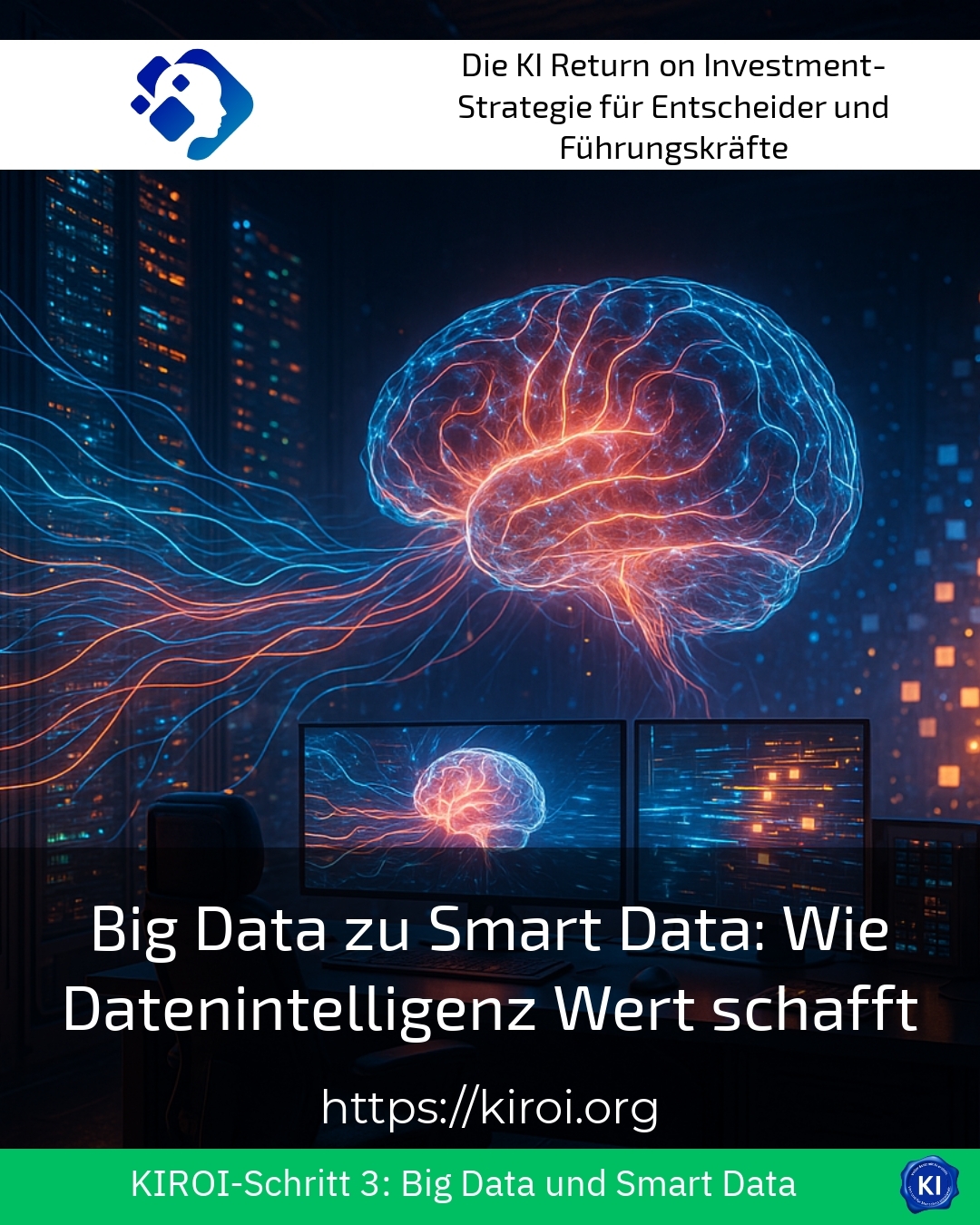
The sheer volume of information flowing daily through production plants, sensors and digital systems still overwhelms many companies. Yet this is precisely where enormous potential lies hidden. The shift from big data to smart data is fundamentally transforming how organisations work and make decisions. Those who understand this transformation and actively shape it gain a decisive competitive advantage. It is no longer just about the mere collection of figures and facts. Rather, intelligent refinement takes centre stage. Companies are increasingly recognising that quantity alone creates no added value. Only targeted analysis and interpretation turns raw data into valuable insights.
The evolution of data intelligence in an industrial context
In modern manufacturing plants, machines continuously record thousands of measured values. Temperatures, vibrations, flow rates and energy consumption are logged to the exact second. However, this enormous volume of information remains worthless if it sits unstructured in databases. The decisive step lies in intelligent processing and contextualisation. Manufacturing companies are therefore increasingly relying on algorithms that identify relevant patterns. This makes it possible, for example, to predict machine failures before they actually occur. Maintenance intervals can be optimised and downtime drastically reduced. This predictive maintenance not only saves costs, but also significantly increases productivity.
Another field of application can be found in quality assurance. Optical inspection systems analyse workpieces in real time and compare them with reference models. Deviations are detected immediately and faulty parts are sorted out. At the same time, the systems continuously learn and improve their recognition accuracy. The potential of data intelligence is also evident in logistics. Flows of goods can be optimised, inventory levels precisely controlled and delivery times shortened. The transformation from big data to smart data thus enables end-to-end process optimisation.
Automated production lines as pioneers of development
Highly automated production systems generate particularly large amounts of information. Robots, conveyor belts and testing stations communicate constantly with each other. Every movement, every gripping action and every positioning is documented. This transparency creates completely new opportunities for increasing efficiency. Production bottlenecks become immediately visible and can be targeted and eliminated. Cycle times can be optimised and throughput rates increased. In addition, the insights gained enable flexible adaptation to changing requirements. High-variant production thus becomes more economical and quicker to implement.
Best practice with a AIROI customer
A medium-sized mechanical engineering company faced the challenge of making its manufacturing processes more efficient. Although existing sensor data was being collected, it was not being systematically evaluated. Together with the transruptions coaching team, we developed a strategy for intelligent data utilisation. First, we identified the relevant key performance indicators for the most important production processes. We then implemented a dashboard that clearly visualises these metrics. For the first time, this gave managers a comprehensive real-time overview of all production lines. The automatic detection of anomalies in the machine data proved particularly valuable. The system now provides early warnings of impending failures and recommends suitable counter-measures. Within a few months, unplanned downtime was reduced by more than thirty per cent. At the same time, product quality improved measurably because manufacturing errors were detected earlier. Since then, the company has benefited from significantly higher overall equipment effectiveness and lower maintenance costs. The investment paid for itself completely within the first year of operation.
From big data to smart data: strategies for practical implementation
Successful transformation requires a well-thought-out multi-step approach. First, companies must systematically record and evaluate their existing data sources. Not all information is equally relevant to value creation. Clear prioritisation helps to deploy resources in a targeted manner and achieve quick wins. The next step involves selecting suitable technologies and tools. Cloud platforms now offer powerful analysis functions without high initial investments. Machine learning and artificial intelligence unlock additional potential for insight.
At least as important, however, is the organisational embedding of the new ways of working. Employees need training to correctly interpret the information provided. Managers must learn to make data-driven decisions and lead by example. An open corporate culture encourages the sharing of insights between departments. Silo mentalities, on the other hand, prevent the full potential from being realised. That is why, at transruptions-Coaching, we do not just support the technical implementation. We also assist organisations with the necessary cultural transformation.
Data intelligence in the connected value chain
The networking of companies along the supply chain opens up additional optimisation potential. Information on demand, capacities and delivery times can be exchanged in real time. This enables more precise planning and reduces inventory as well as delivery bottlenecks. Suppliers benefit from better sales forecasts and can manage their production accordingly. Buyers gain planning certainty and can make more reliable promises to their customers. Collaboration is significantly simplified and accelerated by shared data platforms [1].
A concrete example demonstrates the effectiveness of this approach particularly clearly. Today, automotive suppliers frequently exchange production data directly with their customers. Fluctuations in demand are recognised immediately and manufacturing is adjusted accordingly. Bottlenecks in critical components can be identified at an early stage. Alternative procurement channels can be activated in good time. As a result, the entire value chain gains flexibility and robustness. Disruptions propagate less severely and can be resolved more quickly.
Technological Foundations of Intelligent Data Processing
The realisation of data intelligence is based on the interaction of various technologies. Edge Computing enables data processing directly at the machine or plant. As a result, time-critical decisions can be made without delay. At the same time, the volume of data to be transmitted is significantly reduced. Only relevant, pre-processed information reaches central systems for further analysis [2]. This architecture combines speed with scalability and forms the technical foundation.
Modern analytics platforms use advanced algorithms for pattern recognition and forecasting. These tools identify correlations that often remain hidden from human observers. Complex interactions between various process parameters become transparent and controllable. The results can be presented in intuitive visualisations. Decision-makers receive all relevant information at a glance for well-founded resolutions.
Best practice with a AIROI customer
A precision tool manufacturer approached us with a specific concern. Quality fluctuations in production were causing high scrap rates and customer complaints. Together, we analysed all available manufacturing process data. In doing so, we discovered surprising correlations between environmental conditions and manufacturing quality. Temperature and humidity fluctuations affected certain machining steps more strongly than expected. Based on these insights, we developed an early warning system for critical parameter combinations. The system now gives machine operators timely prompts for process adjustment. In addition, we specifically optimised the climate control in the affected manufacturing areas. The scrap rate subsequently fell by more than forty per cent. Customers noticed the improved quality and expressed corresponding satisfaction. As a result, the company was able to sustainably strengthen its competitive position and win new orders. This project exemplifies how data intelligence enables tangible business success.
The shift from big data to smart data requires new skills
Technological equipment alone does not guarantee success in transformation. Companies need employees with new skills and knowledge. Data scientists analyse large amounts of information and develop predictive models. Domain experts contribute their specialist knowledge and validate the algorithmic results. The collaboration of these different profiles creates real added value [3].
Frequently, clients report difficulties in finding suitable specialists. The labour market for data specialists is fiercely competitive and salary demands are correspondingly high. We therefore recommend alternative approaches to skills development. Existing staff can be upskilled through targeted further training. They already bring valuable process knowledge and understand company-specific requirements. External expertise can be brought in on a project basis and internalised step by step.
Data intelligence as a basis for new business models
The systematic use of information opens up opportunities far beyond mere process optimisation. Companies can offer their customers completely new benefits and services. For example, machine manufacturers are increasingly selling availability rather than just products. They constantly monitor their systems at the customer's site and guarantee defined performance indicators. Remuneration is usage-based or performance-based rather than through one-off purchase prices.
This model requires a deep transformation of the entire organisation. Sales, service and product development must work closely together and establish new processes. Customer relationships become more long-term and collaborative than in traditional product sales. At the same time, more stable revenue streams and higher customer retention are created. The journey from big data to smart data thus also paves the way for innovative value creation models.
My AIROI Analysis
The transformation from pure data collection to intelligent value creation represents a fundamental shift. Companies that consistently pursue this path secure sustainable competitive advantages. Today, the technological prerequisites are largely available and also affordable for medium-sized organisations. Cloud services are significantly democratising access to powerful analytical tools. The real challenge therefore lies less in the technology than in the implementation.
From my consulting experience, several critical success factors are crystallising. Firstly, transformation projects require a clear strategic direction and backing from the executive board. Without this commitment, initiatives frequently get bogged down in day-to-day operations. Secondly, companies should start with manageable pilot projects and aim for quick wins. These lighthouse projects generate acceptance and motivation for further-reaching changes. Thirdly, the human component must not be underestimated. Employees must be involved, trained and convinced of the benefits. Resistance often arises from uncertainty and a lack of information. Transparent communication and genuine participation are effective countermeasures.
At transruptions-Coaching, we provide holistic support to organisations on this path to transformation. Our AIROI methodology combines technological expertise with change management skills. We provide impetus, support strategy development and guide the practical implementation. Every company has its own unique circumstances and challenges. That is why we develop bespoke solutions rather than applying standardised approaches. The results speak for themselves and motivate us to continue on this path together with our clients.
Further links from the text above:
[1] Platform Industry 4.0 – Information on connected value creation
[2] Bitkom – Big Data and Analytics in Business Use
[3] Fraunhofer-Gesellschaft – Artificial Intelligence and Data Analysis
For more information and if you have any questions, please contact Contact us or read more blog posts on the topic Artificial intelligence here.









 Deutsch
  English (UK)