
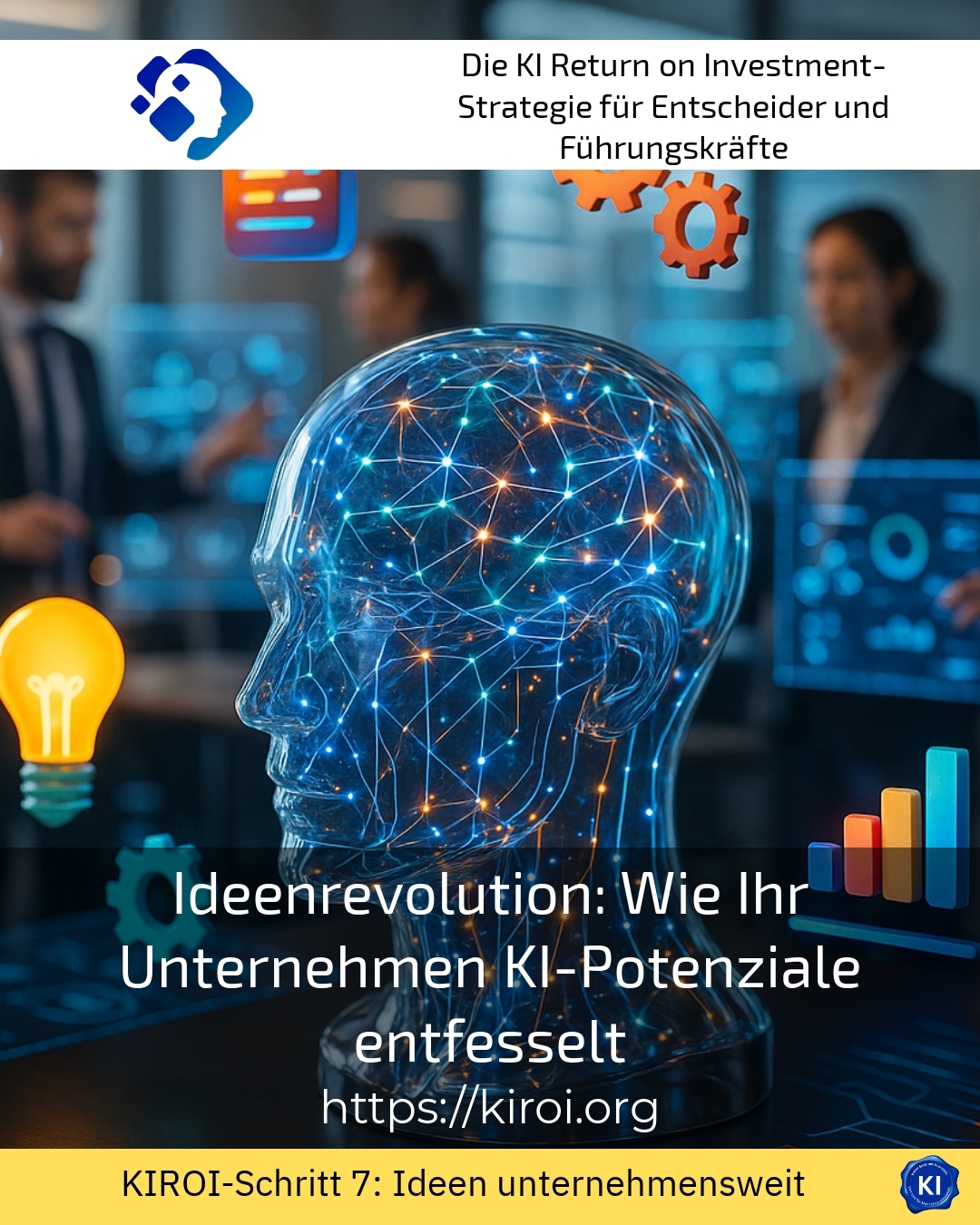
Imagine your employees developing groundbreaking concepts every day, while intelligent systems handle the routine work in the background. This vision is becoming a reality for more and more organisations because the Idea Revolution: How Your Business Unlocks AI Potential fundamentally changes how we drive innovation and create competitive advantage. In a rapidly changing world, the ability to undergo creative transformation determines success or stagnation. This is long no longer just about technology, but about a completely new mindset that unites humans and machines in a productive symbiosis.
The fundamentals of the idea revolution: How your business unlocks AI potentials
Intelligent algorithms are changing the way organisations develop innovations. They analyse market trends in a matter of seconds and identify opportunities that would remain hidden from human analysts. This capability supports teams in making informed decisions and opening up new business areas. In the manufacturing industry, production plants are already using predictive systems to forecast maintenance needs and drastically reduce downtime. Logistics companies optimise their supply chains through intelligent route planning, saving considerable resources in the process. Retailers personalise customer experiences at a level that would have been unthinkable a few years ago.
However, the true power of this transformation does not lie in the technology alone. It only unfolds fully when companies adapt their culture accordingly. Employees need to learn to view intelligent tools as partners rather than as a threat. This change in attitude requires time, patience and professional guidance from experienced coaches. Transruption coaching offers precisely this support and accompanies organisations on their path towards intelligent transformation.
Best practice with a AIROI customer
A medium-sized engineering firm based in southern Germany was faced with the challenge of speeding up its product development. Its existing processes often took several months, whilst competitors were bringing new solutions to market much more quickly. As part of the AIROI project, we first analysed the existing workflows and identified areas with high potential for automation. Together with the development team, we implemented an automated design support system capable of generating alternative design proposals within a matter of seconds. The engineers frequently reported that this support enabled them to work more creatively, as they had more time for conceptual thinking. After six months, the company had shortened its development cycles by around forty per cent whilst simultaneously significantly improving the quality of its innovations. Staff developed a new enthusiasm for their work because they were able to focus on challenging tasks.
Strategic approaches for sustainable innovation capacity
The path to becoming an intelligent organisation begins with an honest stocktake. Many companies underestimate the complexity of this transformation and launch projects that are too ambitious. A step-by-step approach has proven to be significantly more promising in practice. First of all, organisations should carry out pilot projects in manageable areas and gain valuable experience in the process. Financial service providers, for example, are experimenting with automated document analysis in their legal departments. Insurers are testing intelligent claims processing in selected branches. Banks are trialling personalised investment advice for specific customer segments.
This focused approach enables rapid learning cycles and significantly reduces the risk of costly misjudgements. The insights gained from pilot projects are then integrated into the company-wide strategy and form the basis for scalable solutions. It is crucial to involve the right stakeholders from the outset and build broad acceptance. transruptions coaching supports leaders in overcoming resistance and generating enthusiasm for change. Clients frequently report that the human dimension of transformation presents the greatest challenge.
Practical impulses for the idea revolution: How your business can unleash AI potential
Concrete measures make the difference between vision and reality. Successful organisations establish dedicated innovation laboratories where teams can try out new technologies. They create space for creative experimentation and also reward failed attempts because these offer valuable learning opportunities. In the automotive industry, suppliers have set up so-called sandbox environments where engineers experiment with generative intelligence. Chemical companies use similar concepts to accelerate their research processes. Pharmaceutical companies integrate intelligent systems into their drug development, thereby significantly shortening development times.
Networking different departments plays a pivotal role in a successful transformation. Silo mentality prevents the free flow of ideas and slows down innovation. Interdisciplinary teams that bring together different perspectives frequently develop the most creative solutions. A marketing expert contributes different viewpoints compared to a production engineer or a data analyst. This diversity enriches the innovation process and leads to more robust outcomes. Transruption coaching provides impetus on how companies can foster this collaboration and break down barriers between departments.
Best practice with a AIROI customer
An international retail group was struggling with a lack of innovation within its procurement department. The buyers spent a large proportion of their time on administrative tasks and had little capacity left for strategic supplier development. As part of the AIROI project, we jointly developed an intelligent assistance system that automatically analysed quotations and generated negotiation recommendations. Implementation took place in stages and was accompanied by intensive training, as staff buy-in was crucial to the project’s success. Following the roll-out, buyers frequently reported a complete transformation in their working methods and greater job satisfaction. They were now able to focus on value-adding activities and negotiate better terms. The company achieved significant savings whilst simultaneously strengthening its supplier relationships in the long term. The lessons learnt from this pilot project served as a blueprint for further transformation initiatives in other areas of the company.
Overcoming challenges and seizing opportunities
Every transformation brings obstacles that need to be overcome. Data protection concerns are frequently right at the top of the list of challenges faced by organisations. Employees worry about their jobs and react to changes with rejection. Leaders feel insecure because they lack the technical understanding and cannot assess the impacts. These issues require sensitive communication and professional guidance from experienced partners. Energy suppliers, for example, face the task of reconciling regulatory requirements with innovation efforts. Telecommunications companies have to manage massive investments in new infrastructures. Media companies struggle with the question of how to combine journalistic quality and technological efficiency.
Successful organisations tackle these challenges with transparency and the involvement of all stakeholders. They communicate openly about goals, timelines and the expected impacts of the transformation. They offer comprehensive training programmes and enable employees to develop new skills. In this way, they turn potential critics into dedicated ambassadors of change. The Idea Revolution: How your company can unleash AI potentials only succeeds sustainably when all stakeholders recognise and support the added value.
Cultural change as the foundation of transformation
Technology alone does not create innovation; rather, it is people with the right mind-set and suitable frameworks. A culture of openness, experimentation and continuous improvement forms the foundation of successful transformation. Leaders must exemplify and actively promote this culture by demonstrating a willingness to learn themselves. In the construction industry, forward-thinking companies are establishing agile working methods that enable rapid adaptations. Architectural practices are integrating intelligent planning tools into their creative processes. Real estate developers are using predictive analytics to identify attractive locations.
Transruption coaching guides companies through this cultural shift and provides valuable impetus for sustainable change. Experience shows that technological projects frequently fail due to cultural resistance rather than a lack of resources or expertise. We therefore place particular emphasis on the human dimension of transformation, supporting organisations in bringing their employees along on the journey.
Best practice with a AIROI customer
A long-established family-run business in the food industry wanted to modernise its quality assurance processes without abandoning its tried-and-tested artisanal traditions. The staff were initially sceptical about the project, as they feared that machines would replace their expert knowledge. Through AIROI coaching, we worked intensively on communication and organised workshops where staff could voice their concerns. Together, we developed a concept that combined human expertise with intelligent image analysis, bringing together the strengths of both worlds. The experienced specialists became trainers for the intelligent systems and came to see themselves as indispensable repositories of knowledge. This recognition significantly boosted motivation and transformed initial scepticism into enthusiasm. The company was able to significantly improve its quality standards whilst simultaneously increasing staff satisfaction. The story of this project impressively demonstrates how important it is to involve all stakeholders for the long-term success of a transformation.
My AIROI Analysis
The transformation towards a smart organisation is not a one-off project, but an ongoing journey comprising many stages. My experience from numerous AIROI projects shows that success depends on several factors, which must work in tandem. Firstly, a clear vision is required, one that is authentically communicated and exemplified by senior management. This vision must be specific enough to provide direction, yet flexible enough to allow for adjustments in response to changing circumstances.
The technological component is important, but it alone does not determine the success or failure of a transformation. Rather, what is crucial is how companies involve and empower their employees to use new tools productively. The human dimension requires at least as much attention as the technical implementation and is often underestimated. Clients frequently report that they initially placed too much focus on technology and neglected the cultural aspects.
For future projects, I recommend an integrated approach that gives equal consideration to strategy, technology and people. Pilot projects in manageable areas enable rapid learning and significantly reduce risks. The insights gained should be systematically documented and used for scaling. Transruption coaching can help to identify blind spots and professionally support transformation processes. The ideas revolution: How your company unleashes AI potential is not a question of if, but of how and when, because change has long been well under way.
Further links from the text above:
[1] AIROI Blog: Latest posts on smart transformation
[2] Contact page for consultancy enquiries
For more information and if you have any questions, please contact Contact us or read more blog posts on the topic Artificial intelligence here.








 Deutsch
 English (UK)