
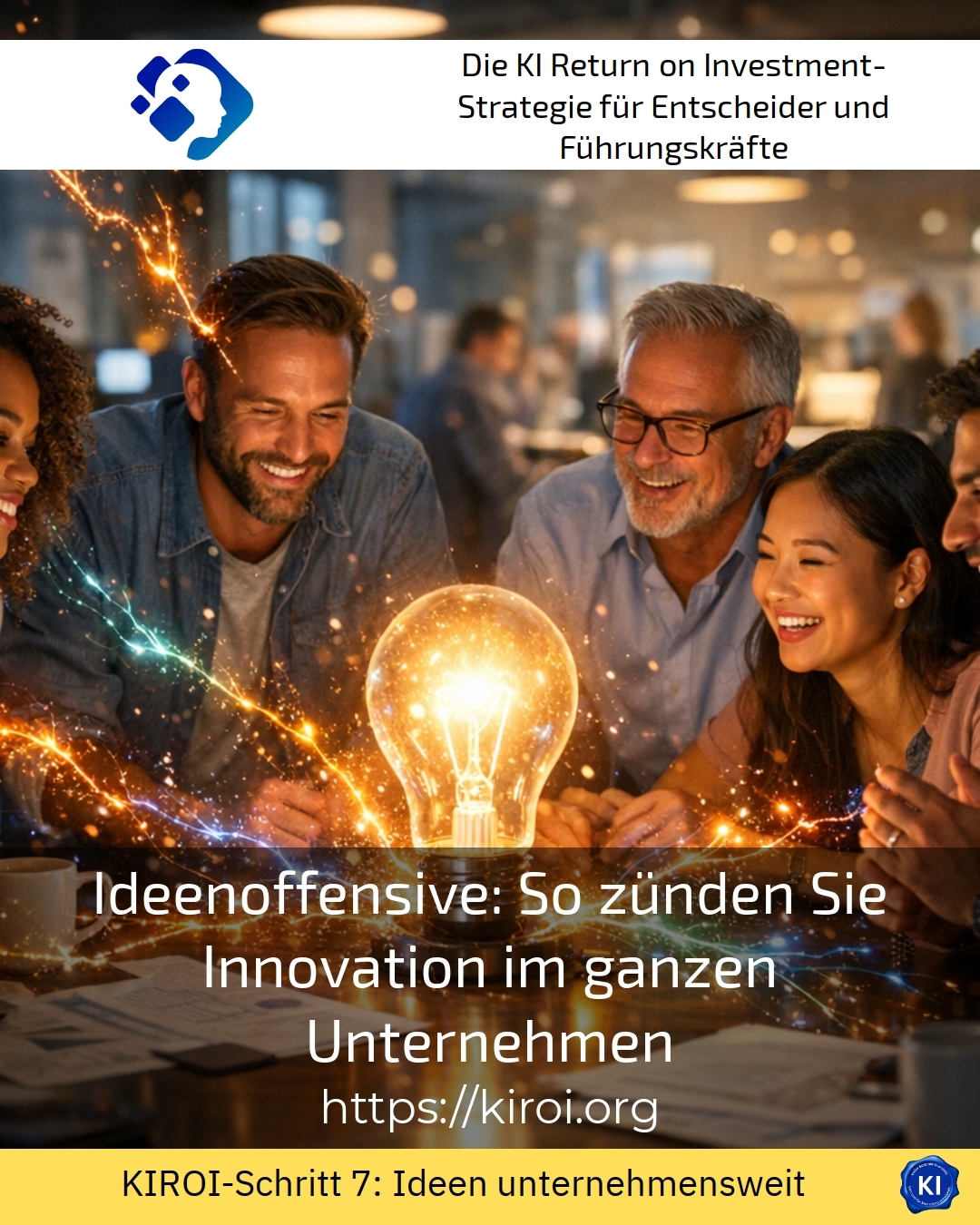
Have you ever wondered why some companies seemingly develop groundbreaking products effortlessly, while others, despite enormous efforts, remain mediocre? The answer often lies not in budgets or the number of patents, but rather in the ability to truly innovate. Ideas offensive To ignite a spark that involves every single employee and unleashes creative energies that had previously slumbered unused. In a world that is rapidly changing and where technological disruption has long since become the new norm, organizations need systematic approaches to ensure that innovation is not left to chance but is purposefully promoted and sustainably embedded within the core of the organization.
Why traditional approaches to innovation often fail
Many organizations invest considerable sums in research departments. They establish innovation labs and hire external consultants. Yet the hoped-for breakthroughs often fail to materialize. The reason lies in a fundamental misunderstanding. Innovation is viewed as a task for less specialized individuals. The other employees are merely considered auxiliary forces. This silo mentality wastes enormous potential. Creative ideas rarely emerge in sterile laboratories. They often stem from direct contact with customers, from everyday problems, or from unexpected connections between different departments [1].
For example, a medium-sized machine manufacturer realized that its service technicians had valuable insights into customer problems that had never been systematically recorded. Therefore, a structured feedback loop was introduced, which within a few months led to three new product ideas. A logistics company activated its warehouse workers as ideators. This resulted in process improvements with significant savings. Similarly, a financial services provider reported that customer advisors proposed innovative service offerings that management alone would never have developed.
The Ideas offensive understand as cultural change
A sustainable innovation culture does not arise through individual measures. It requires a profound cultural change. This change begins at the leadership level. Leaders must set an example that experimentation is desirable. Mistakes are seen as learning opportunities. Critical questioning is explicitly encouraged. Hierarchical barriers are actively dismantled. For creative ideas have no organizational structure. They arise where people are free to think.
An internationally operating chemical company eliminated formal approval loops for small projects, allowing employees to experiment independently and the number of submitted improvement proposals tripled within a year. An automotive supplier introduced so-called „mistake celebrations.“ Teams presented failed experiments there. This significantly reduced the fear of failure. An insurance company also reported positive effects. Regular brainstorming sessions promoted cross-departmental exchange.
Best practice with a AIROI customer
A medium-sized company in the industrial manufacturing sector faced the challenge that innovative ideas were present, but rarely found their way into implementation because rigid hierarchies and lengthy decision-making processes stifled any creativity. As part of a transruptive coaching process, we developed a multi-stage concept together that first transformed the leadership culture and then introduced low-threshold engagement formats for all employees. The management publicly committed to personally reviewing at least three ideas from the workforce each month and providing feedback within two weeks. Additionally, decentralized idea workshops were established where teams from different departments came together and worked on concrete problems together. After six months, the company experienced a noticeable increase in employee satisfaction as well as several promising product innovations that were already in the testing phase and showed enormous market potential.
Creating structures that enable creativity
Creativity needs spaces for freedom. It also requires supportive structures. These structures must not be restrictive. Instead, they should act as catalysts. Established formats include regular periods of innovation. Some companies reserve fixed hours per week. During these times, employees work on their own projects. Others rely on hackathons or design-thinking workshops. Still others establish internal startup programs. There, employees can develop entrepreneurial ideas.
A telecommunications provider introduced so-called „Innovation Fridays.“ Every Friday afternoon, teams worked on self-selected projects. A consumer goods manufacturer established an internal incubator. Employees could apply for start-up projects there. An energy provider also reported on successes. Regular creative retreats brought employees from different locations together.
Digital tools as accelerators of Ideas offensive
Modern technologies can significantly accelerate innovation processes. Digital platforms enable the collection and evaluation of ideas. They create transparency about ongoing initiatives. They connect people with similar interests. Artificial intelligence can help identify patterns in data. It can identify trends. It can even suggest idea combinations. Yet the human being remains at the center. Technology is a tool, not an end in itself [2].
A pharmaceutical company used AI-powered analysis to search patent databases, allowing researchers to more quickly identify relevant developments and avoid duplication of work, which measurably increased the efficiency of the research department. A trading company implemented idea management software. All employees could submit and comment on suggestions there. A media company relied on collaboration tools. Distributed teams thus developed new formats together.
Systematically integrating external stimuli
True breakthroughs rarely occur within closed systems. Companies need to look beyond their own boundaries. They should actively seek external impulses. This can be achieved through collaborations with universities. Partnerships with start-ups are also an option. Conferences and networking events broaden horizons. Even customers and suppliers can be valuable sources of ideas. Open innovation means making boundaries permeable.
A construction company established an innovation advisory board with external experts. Regular meetings brought fresh perspectives. A textile manufacturer invited design students to competitions. The results inspired their own collection. An IT service provider also reported on positive experiences. Joint development projects with customers led to tailor-made solutions.
Best practice with a AIROI customer
A traditional family business in the food production sector sought ways to strengthen its innovation capabilities without jeopardizing its established corporate culture. Therefore, a particularly careful transformation approach was required. As part of the transruptive coaching process, we developed a concept that recognized existing strengths while simultaneously opening up new spaces for creative thinking. We supported the introduction of so-called innovation stand-ups, in which an experienced employee worked alongside a younger professional to combine tradition with fresh perspectives. Additionally, we established quarterly foresight workshops where cross-industry trends were discussed and applied to one’s own business. After a year, the management reported that there had been a noticeable change in the culture of the company, with employees expressing more open ideas and discussing with each other in a more constructive way, which was also reflected in concrete product innovations that were successfully introduced on the market.
Recognizing and constructively addressing resistance
Any change generates resistance. That is normal and human. Ignoring these resistances would be fatal. Instead, they should be openly addressed. Frequent concerns relate to the workload. Employees wonder how they can be creative in addition. Others doubt the management’s seriousness. They have already seen previous initiatives fail. Others fear that their ideas could be stolen.
A mechanical engineering company overcame initial skepticism through transparent communication, with management personally explaining why innovation was important and what concrete resources would be made available. This significantly strengthened the trust of the workforce. A retail conglomerate introduced clear rules for handling ideas. Authors were named and, if appropriate, rewarded. A healthcare provider also reported initial difficulties. Patience and continuous communication eventually led to a breakthrough [3].
Make successes visible and celebrate
Nothing motivates like visible success. Companies should therefore communicate specifically. What ideas were implemented? What results were achieved? Who contributed to this? These stories inspire others. They show that commitment is worthwhile. They prove that change is possible. At the same time, small successes should also be acknowledged. After all, major breakthroughs often begin small.
A software company established a monthly innovation award. The award was publicly presented. A mobility provider produced short videos about successful projects. These were widely shared internally. A financial service provider also relied on storytelling. Regular newsletters reported on innovation successes from all sectors.
The Ideas offensive establish it in a sustainable way
A one-time initiative is not enough. Innovation must become an integral part of the company. This requires continuous attention. Regular review and adjustment are necessary. Leaders must continuously act as role models. Structures must be maintained and developed. Only in this way can a self-sustaining innovation culture be created. This then becomes real competitive strength.
An industrial corporation integrated innovation goals into the performance evaluation of all executives, thereby keeping the topic on the agenda permanently and not perceived as a short-term fad. A service company established an innovation board at the board level. It met monthly and oversaw all activities. A technology provider also reported on sustainable structures. A chief innovation officer coordinated all measures centrally.
My AIROI Analysis
Systematic promotion of innovation represents one of the most important strategic challenges for many companies, because it not only requires creative ideas but also requires a profound cultural change that involves all levels of the organization and challenges existing mindsets. My experience from numerous mentoring projects shows that the key to success lies in the combination of several elements; none of them alone is sufficient; only the interplay between them can achieve the desired effect. Leaders must authentically lead by example, as they expect from others, while at the same time creating structures that enable creative thinking without imposing them. Digital tools can support this process, but they can never replace the human exchange and personal interaction that are essential for genuine innovation. The biggest hurdle often lies not in a lack of ideas but in their implementation, which is why clear processes and responsibilities are just as important as spaces for experimentation. Companies that manage to find this balance regularly report positive effects that extend far beyond individual product innovations and are reflected in higher employee satisfaction, stronger customer loyalty, and improved adaptability. Transruptive coaching provides valuable guidance and support to successfully navigate this demanding transformation process.
Further links from the text above:
[1] Harvard Business Review – Innovation Insights
[2] McKinsey – The Innovation Commitment
[3] Forbes – Innovation and Technology News
For more information and if you have any questions, please contact Contact us or read more blog posts on the topic Artificial intelligence here.








 Deutsch
 English (UK)