
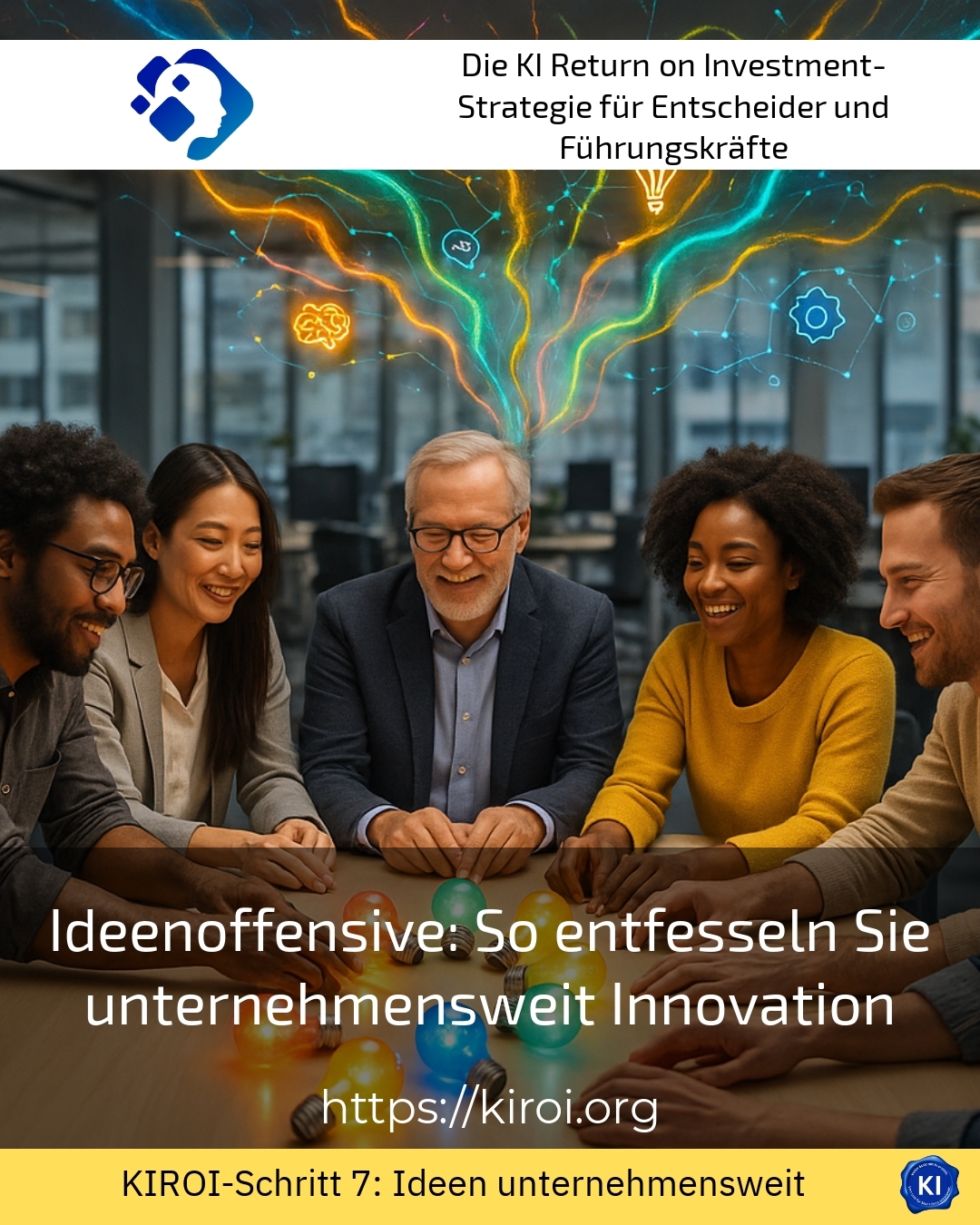
Imagine thousands of undiscovered ideas slumbering within your company, just waiting to be awakened and transform your entire organisation. These dormant potentials often remain untapped because systematic structures are lacking to capture creative impulses and turn them into concrete innovations. A well-thought-out Ideas offensive: Unleash innovation across your entire company can start exactly here and bring about sustainable changes. But how can employees at all levels be mobilised and a culture created where new ideas are not only welcome, but actively encouraged?
Why traditional approaches are no longer sufficient today
The classic approach, where innovations exclusively stem from specialised departments, is increasingly reaching its limits. In a rapidly changing world, isolated thinking is simply no longer enough. Companies often report that their best ideas come from employees who are in direct contact with customers every day. For example, a logistics company discovered that warehouse workers developed practical suggestions for improving picking processes. These suggestions significantly reduced error rates. A financial services provider recognised that administrative staff had valuable insights into digital process optimisation. A medium-sized mechanical engineering firm also benefited from ideas from the production line that made maintenance cycles more efficient.
These examples clearly show that innovation potential is not distributed hierarchically. Instead, it is hidden within the breadth of the organisation. A systematic Ideas offensive: Unleash innovation across your entire company therefore requires new ways of thinking and structures. It calls for platforms that are easily accessible. It also needs leaders who actively listen and take impulses seriously.
The psychological foundations of a creative corporate culture
Before technical systems or processes can be implemented, the foundation must be right. Psychological safety forms the basis for any successful innovation initiative. People only share their thoughts if they don't have to fear negative consequences. A retail group therefore deliberately created spaces where even half-baked suggestions were welcome. The result was surprisingly practical concepts for customer advice. A hospital established regular exchange formats where nursing staff could speak without hierarchical pressure. These formats brought about improvements for patient processes. A software company introduced anonymous idea channels, which significantly lowered initial inhibitions.
Clients frequently report that they come to us with the challenge of motivating their teams to actively participate. They often experience initial reluctance, which seems difficult to overcome. Transruption coaching supports organisations in systematically identifying and gradually dismantling these cultural barriers. Insights from behavioural psychology can help to initiate sustainable changes.
Creating structures that channel creative energy
Creativity needs space, but also direction, so that it doesn't fizzle out. Clear structures by no means contradict the spirit of innovation, but rather enable its development. An energy supplier established quarterly idea sprints that focused on defined thematic areas. This focused approach yielded more concrete results than open brainstormings. An insurance company linked suggestions directly to strategic company goals, thereby creating relevance. An automotive supplier introduced multi-stage evaluation procedures that ensured transparency in the decision-making process.
Best practice with a AIROI customer
A medium-sized manufacturing company with around eight hundred employees approached us because their traditional suggestion scheme was experiencing very little participation, and the ideas submitted rarely went beyond rudimentary concepts. Management had recognised that valuable knowledge from the workforce remained untapped but couldn't identify the lever for change. In an intensive support process, we first analysed the existing communication flows and identified critical breaking points between production and administration. Together, we developed a phased concept that combined low-threshold entry opportunities with qualifying development paths. Within six months, the company established digital idea boards in the production halls, which were easily accessible. Additionally, we created so-called innovation partnerships, where experienced employees supported younger colleagues in developing concepts. Managers received targeted guidance on how to respond appreciatively to suggestions and provide constructive feedback. After one year, the number of qualified submissions had quadrupled, and several ideas were actually implemented. The most important finding, however, was that general employee engagement and satisfaction had tangibly improved.
Digital Tools as Catalysts for an Offensive of Ideas
Technology can significantly accelerate and democratise innovation processes when used intelligently. Digital platforms make it possible to submit and discuss suggestions regardless of location or time. A trading company used collaboration software to connect branch employees from different locations. This cross-location networking generated ideas that would never have emerged locally. A pharmaceutical company used gamification elements to create playful incentives for participation. A telecommunications provider integrated artificial intelligence to thematically cluster submitted suggestions and highlight synergies [1].
The Ideas offensive: Unleash innovation across your entire company Benefits significantly from intelligent tools. However, these do not replace the human factor in any way. Technology supports and facilitates, but people must ultimately decide and implement. Transruption coaching supports organisations in finding the right balance between digital support and personal interaction.
Leaders as key figures for sustainable change
Management's attitude is a decisive factor in the success or failure of any innovation initiative. Leaders must not only allow room for manoeuvre but actively demonstrate that new ideas are valued. A construction company specifically trained its project managers in appreciative communication, which significantly increased the submission rate. A chemical company established a board sponsorship programme where top managers personally supported selected proposals. A media company introduced regular idea pitches to senior management, creating visibility and recognition for submitters.
Many leaders come to us with the question of how they can authentically foster a culture of innovation. They often experience a discrepancy between proclaimed values and lived reality. Transruption coaching provides impetus on how this gap can be closed. We support leadership teams in reflecting on their own attitudes and developing concrete behavioural changes.
Understanding and constructively resolving resistance
Every change initiative meets resistance that must be taken seriously. This resistance often has understandable reasons that need to be understood. An industrial company recognised that long-serving employees feared their experience would be devalued. This concern was resolved by involving them as innovation mentors. A financial institution found that middle management feared a loss of control and responded with transparent decision-making criteria. A healthcare provider identified a lack of time as the main obstacle and created dedicated innovation time.
Clients often report that they initially interpret resistance as personal rejection. In reality, systemic causes are usually hidden behind this. Transruption coaching helps to identify these causes and develop precisely tailored solutions. We support organisations through difficult phases and help to use setbacks as learning opportunities.
Best practice with a AIROI customer
A service company in the field of technical infrastructure had already attempted to establish a company-wide idea management system several times, but had failed each time due to internal resistance. The previous approaches were perceived by the workforce as an additional burden and by managers as a threat to their decision-making authority. In our accompanying process, we initially conducted confidential individual discussions with key personnel at various hierarchical levels to understand the actual concerns and needs. This revealed that previous initiatives had failed because suggestions were collected but never processed in a transparent manner. This experience had created deep mistrust, which had to be addressed first. Together, we developed a concept that guaranteed absolute transparency regarding the status of each submission and defined clear responsibilities. Managers were not tasked with evaluating ideas, but were made enablers who provided resources. In addition, we established a pilot project in one department, the success of which served as a reference for gradual expansion. After eighteen months, a vibrant innovation culture had developed, and the initial critics were among the most active supporters.
Establish measurability and continuous improvement
What isn't measured can't be systematically improved. Clear key performance indicators provide direction and enable informed adjustments. A logistics company tracked not only the number of submissions but also their implementation rate. This differentiated approach revealed optimisation potential in the selection process. A consumer goods group regularly surveyed submitters' satisfaction with the feedback they received. An IT service provider linked innovation metrics with the objective agreements of managers, thereby creating accountability.
The Ideas offensive: Unleash innovation across your entire company requires staying power and continuous attention. Quick successes are possible, but sustainable change requires time and perseverance. Transruption coaching supports organisations over longer periods and provides impetus for steady further development [2].
My AIROI Analysis
The systematic unlocking of an entire organisation's creative potential is one of the most challenging, yet also most rewarding, management tasks. My analysis of numerous accompanying projects clearly shows that technical solutions alone are never enough to establish a sustainable culture of innovation. The decisive success factor lies in the authentic attitude of leadership and the consistent work on psychological safety. Organisations that take their employees seriously as a source of valuable insights develop a self-reinforcing momentum. However, this positive spiral only arises if early successes are made visible and celebrated. At the same time, I repeatedly observe that companies are too impatient and give up before the seeds can sprout. A culture of innovation grows organically and cannot be forced, but it can be deliberately cultivated. The role of Artificial Intelligence is becoming increasingly important in this, as it can take over repetitive tasks in idea management. This frees up space for people to do the actual creative work. However, it remains crucial that technology serves people and not the other way around. I recommend a staged approach with clearly defined pilot areas for organisations wishing to embark on this path. This allows experience to be gained and adjustments to be made before company-wide scaling takes place. Investing in accompanying coaching typically pays off many times over, as external perspectives can reveal blind spots and change processes can be professionally facilitated.
Further links from the text above:
[1] Harvard Business Review – Innovation Management Insights
[2] McKinsey – The Eight Essentials of Innovation
For more information and if you have any questions, please contact Contact us or read more blog posts on the topic Artificial intelligence here.










 Deutsch
  English (UK)