
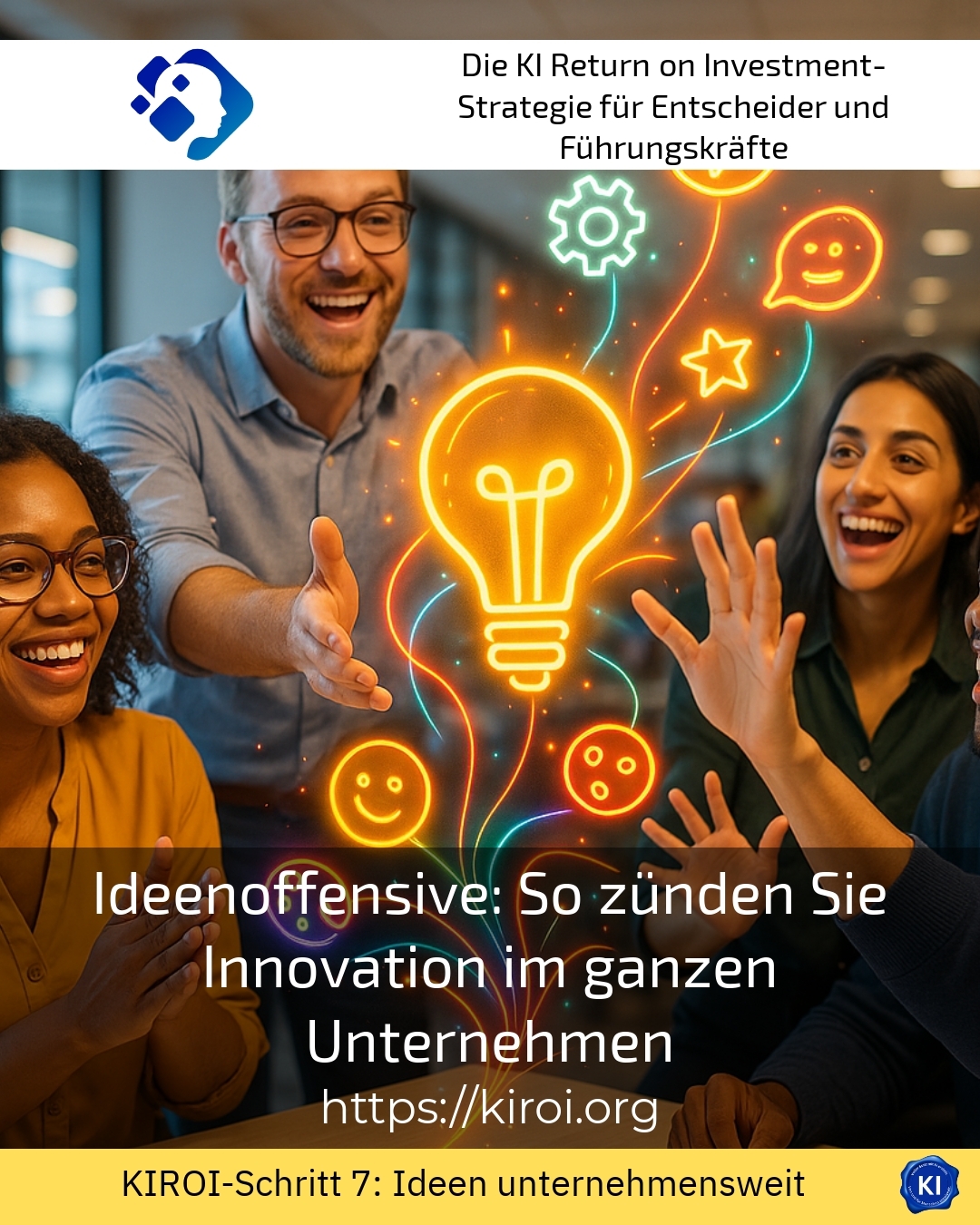
Imagine your company transforming into a living organism, generating new ideas daily and systematically turning them into marketable solutions. The Innovation Offensive: How to Ignite Innovation Throughout the Company doesn't start with expensive technologies or external consultants, but with a fundamental cultural change that makes every single employee an active shaper of the company's future. In a world that is changing at breathtaking speed, it is no longer enough to consider innovation the task of a specialised department. Rather, organisations must learn to unleash the creative potential of all employees and channel it in a structured way.
Understanding the fundamentals of a company-wide idea generation campaign
Before you can launch a comprehensive idea offensive, you need to create the psychological and organisational prerequisites. Many leaders underestimate how deeply ingrained the fear of failure is in most corporate cultures. Employees have often learned that new ideas are critically questioned or even rejected. Therefore, they prefer to remain silent and get on with their routine tasks. A successful transformation therefore begins with the conscious creation of psychological safety.
A medium-sized mechanical engineering company from Southern Germany recognised this problem and introduced so-called "failure celebration meetings". In these meetings, employees shared their failed experiments and the lessons learned from them. After six months, the number of submitted suggestions for improvement had tripled. A logistics company from Hamburg established open innovation circles that worked across all hierarchical levels. Ideas from the warehouse floor were suddenly taken just as seriously as suggestions from management. A financial service provider, in turn, set up digital idea platforms where contributions could initially be submitted anonymously.
Best practice with a AIROI customer
A family business with a long tradition in the manufacturing industry came to us for transruption coaching with a clear challenge. Management reported a growing sense of innovation fatigue among employees. New ideas were rarely put forward and even less frequently implemented. During the support phase, we first analysed the existing communication structures and discovered several blockages. Middle management filtered out suggestions before they reached top management. Together, we developed a three-stage innovation concept with direct access routes to management. We established monthly innovation drop-in sessions where every employee could personally present their ideas. Additionally, we introduced a digital evaluation system that ensured transparency about the status of each submission. After nine months of intensive support, the number of realised projects had tripled. Employee satisfaction increased measurably, and staff turnover decreased significantly.
Establishing structures and processes for sustainable innovation
One Innovation Offensive: How to Ignite Innovation Throughout the Company requires clear structures to avoid ending up in chaos. Spontaneous creativity is valuable, but only systematic processes make it reproducible and scalable. Successful organisations define transparent criteria for evaluating new ideas. They create dedicated time slots for creative work and provide appropriate resources.
A technology company from Munich reserves every Friday afternoon for experimental work on its own projects. Employees document their progress in a shared wiki. A pharmaceutical manufacturer has set up innovation labs that are physically separated from day-to-day business. Cross-functional teams work there on disruptive ideas without the pressure of operational objectives. A retail group, in turn, uses gamification elements and rewards submitted suggestions for improvement with points that can be exchanged for attractive prizes.
The role of leaders in this context is fundamentally changing [2]. They are becoming enablers and coaches instead of controllers and decision-makers. Modern innovation leadership means creating space while simultaneously providing direction. Leaders must learn to let go and develop trust in their teams' competence. At the same time, they must ensure that creative energy is channelled into strategically relevant topics.
Using digital tools to accelerate the offensive of new ideas
Modern technologies can significantly accelerate and democratise the innovation process. Artificial intelligence supports the analysis of market trends and customer needs. Collaboration platforms enable cross-location cooperation on new concepts. Virtual whiteboards replace physical creative spaces, making ideation sessions possible anytime and anywhere.
An insurance company is using AI-powered tools to automatically categorise customer feedback. This allows the system to identify potential product improvements and pass them on to the relevant teams. An automotive supplier is using virtual reality to visualise prototypes before physical models are built. A media company has implemented chatbots that guide employees through the idea submission process and assist with their development.
Best practice with a AIROI customer
An internationally operating service group sought support with the digital transformation of its innovation management. The previous analogue processes were slow and led to information loss between the various locations. As part of our support with transruptions-coaching, we developed a tailor-made digital innovation platform. This platform enabled employees from twelve countries to work together on ideas and develop them further. We integrated automatic translation functions to overcome language barriers. An intelligent matching system automatically linked similar suggestions from different regions. The platform also offered mentoring functions, where experienced innovators supported new idea generators. Within the first year of its introduction, over two thousand ideas were submitted and evaluated. More than one hundred of these are now in the implementation phase.
Overcoming resistance and engaging sceptics
Every change initiative encounters resistance. This is particularly true for innovation programmes that challenge established structures and habits [3]. Experienced employees may feel threatened if younger colleagues are suddenly heard. Middle management fears a loss of power if ideas reach the top without their input. These fears are understandable and must be taken seriously.
An energy provider encountered this problem by deploying experienced specialists as innovation mentors. Their expertise was valued, not devalued. A consumer goods manufacturer created special roles for long-serving employees who acted as bridges between tradition and innovation. A construction company organised intergenerational project teams, where the respective strengths of different age groups were specifically combined.
Communicating successes plays a crucial role in overcoming resistance. When employees see that their ideas are actually being implemented and are achieving positive results, their motivation to participate grows. Regular updates on the progress of ongoing innovation projects create transparency and trust. Public recognition for successful idea generators sends positive signals for the entire organisation.
Making the ideas offensive measurable and continuously improving
What isn't measured cannot be improved. Successful innovation programmes define clear key performance indicators and monitor them regularly. This isn't just about the number of ideas submitted, but also about qualitative aspects. How many suggestions reach the implementation phase? What financial benefit arises from realised innovations? How does employee participation develop over time?
A telecommunications company has developed a comprehensive dashboard that displays all relevant innovation metrics in real time. A chemical group conducts quarterly retrospectives to continuously optimise the innovation process. A retail company regularly surveys the participants in its innovation programmes and derives concrete improvement measures from the feedback.
Integrating innovation into regular performance reviews sends a strong signal about the strategic importance of the topic. Leaders will then be measured not only on operational results but also on their ability to foster creative potential within their teams. Employees will recognise that innovative thinking is career-enhancing and will adjust their behaviour accordingly.
Integrating external impulses and open innovation
The best ideas often arise at the intersection of internal knowledge and external perspectives. Successful companies deliberately open up their innovation processes to the outside, inviting customers, partners, or even competitors to co-create [4]. This form of open innovation significantly expands the idea pool and brings fresh perspectives into the organisation.
A sports equipment manufacturer regularly invites professional athletes into its development department to test products. A software company holds hackathons where external developers work on solutions to real business problems. A food producer operates co-creation platforms where end consumers can suggest and rate new flavours.
Collaboration with startups offers established companies access to disruptive technologies and agile working methods. Many corporations have founded their own venture units or established corporate accelerator programmes. These initiatives build bridges between the speed of young companies and the resources of large organisations. Innovation Offensive: How to Ignite Innovation Throughout the Company benefits enormously from such external connections.
My AIROI Analysis
Following intensive consideration of numerous innovation programmes across various industries, some key success factors are emerging. The Innovation Offensive: How to Ignite Innovation Throughout the Company only succeeds if it is actively supported and exemplified by top management. Lip service is not enough. Leaders must provide time, budget, and attention for innovation activities. They must also be willing to see failures as learning opportunities and not as an occasion for blame.
The balance between freedom and structure proves to be a critical success factor. Too much control stifles creativity. Too little guidance leads to chaos and frustration. The art lies in defining clear frameworks and, within these boundaries, granting maximum freedom to shape things. In transruptions coaching, we guide companies in finding and individually adapting precisely this balance.
Technology can support the innovation process, but never replace it. Digital tools are just that – tools, not solutions. The human factor remains crucial. Creativity stems from curiosity, courage and the willingness to question what already exists. These qualities cannot be programmed, but they can be fostered and developed. This is precisely where professional guidance comes in. We provide inspiration and support organisations on their individual journey towards an innovative corporate culture.
Further links from the text above:
[1] Harvard Business Review – Psychological Safety
[2] McKinsey – The Eight Essentials of Innovation
[3] Forbes – Innovation Insights
[4] Open Innovation Platform Europe
For more information and if you have any questions, please contact Contact us or read more blog posts on the topic Artificial intelligence here.







 Deutsch
  English (UK)