
Do you know why some organizations generate real breakthroughs from hundreds of creative ideas, while others flounder in chaos?
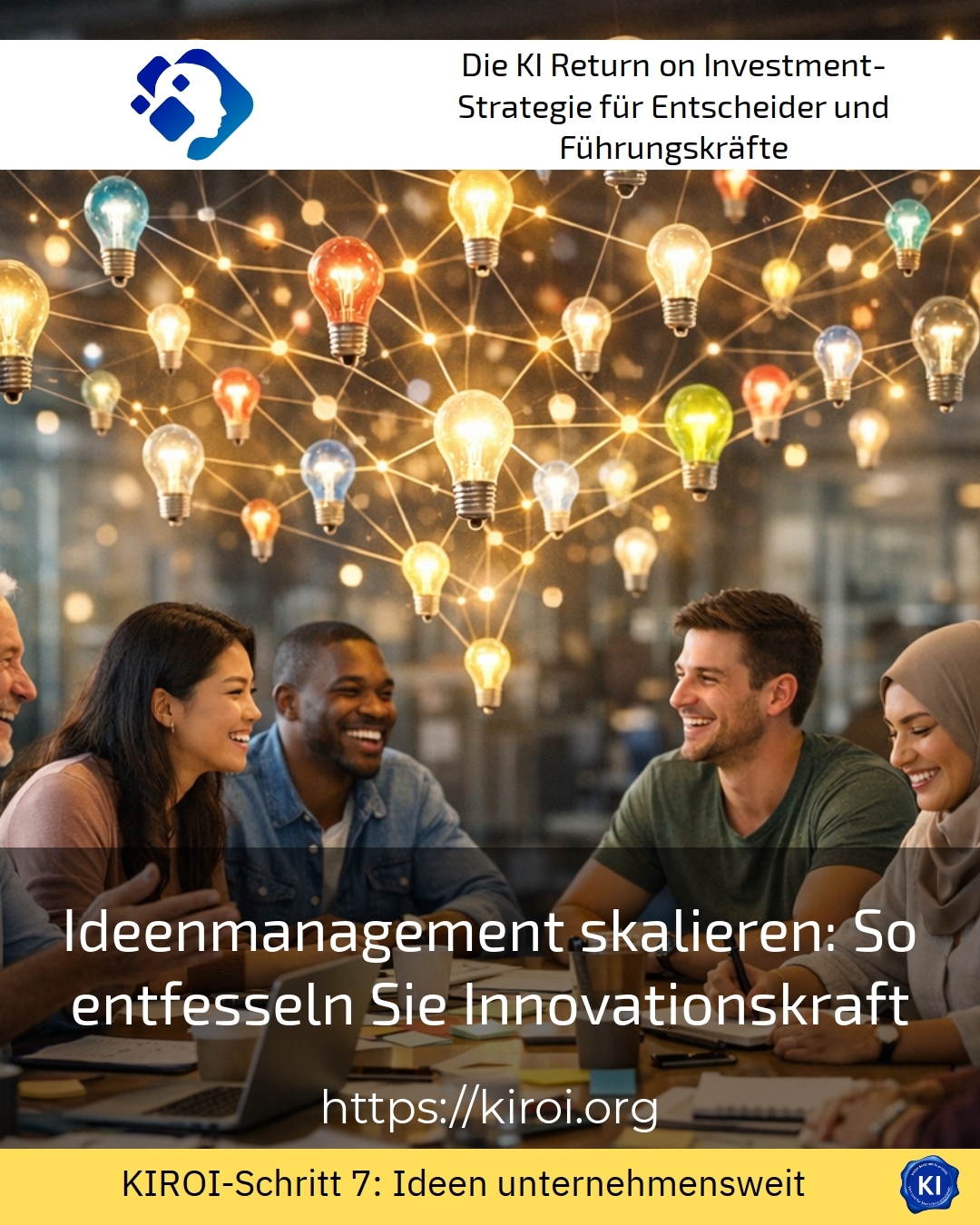
The answer lies in the ability to, Scaling ideas management To be able to innovate. Many companies start with enthusiasm in creative processes. They collect suggestions, promote employee participation, and hope for a breakthrough. But as the number of submitted concepts grows, bottlenecks arise. Evaluations take months, feedback remains elusive, and frustration spreads. This is where the crucial question arises: How can you transform a small idea workshop into a powerful innovation engine? In this article, you will learn which strategies, structures, and tools can help you do this. Additionally, concrete practical examples show how other organizations have successfully taken this path.
Understanding the challenge of growing creative processes
As organizations grow, their creative resources also multiply. A medium-sized production company suddenly receives not twenty improvement proposals per quarter anymore, but two hundred. This development sounds initially positive, but it brings structural challenges. The existing evaluation committees are working to the limit. Decision-making processes are significantly extended. Employees wait for months for feedback on their submitted concepts.
A mechanical engineering company from southern Germany faced exactly this situation. The management had introduced a proposal system that initially worked excellently. However, as participation increased, the system collapsed. Similarly, a logistics service provider faced the same problem; its decentralized locations developed different quality standards for submissions. A chemical company was also struggling with the fact that specialist departments stored proposals instead of submitting them centrally. These examples clearly show that without thoughtful scaling strategies, creative potential goes untapped.
Scaling idea management through clear process architecture
The first step is to establish a robust process architecture. This must be flexible enough to accommodate growth. At the same time, it needs solid structures for consistent quality. Clients often report that they initially took a too informal approach. They relied on personal networks instead of documented processes.
An automotive supplier developed a three-stage evaluation system. The first stage automatically filtered proposals based on fundamental criteria. The second stage included expert evaluation by relevant departments. The third stage presented promising concepts to a higher authority. This structure reduced the lead time by sixty percent. A pharmaceutical company, in turn, relied on decentralized evaluation teams with centralized coordination. Each site received its own decision-making authority within defined limits. Overarching issues were escalated to a global committee. At an energy provider, a rotating panel of different levels of hierarchy proved effective. This mix brought different perspectives and increased the acceptance of the decisions.
Best practice with a AIROI customer
An internationally operating manufacturer of industrial components approached us with an urgent request. The existing proposal system produced an impressive number of submissions, but the implementation rate was below five percent. The employees did not feel included, and motivation steadily declined. As part of the transruptive coaching, we analyzed the entire process chain from submission to implementation together. We identified several critical bottlenecks that reinforced each other. The central problem lay in the insufficient categorization of detailed proposals. Everything ended up in a single bucket, regardless of complexity or strategic relevance. We developed together a differentiated classification system with four urgency levels and three complexity levels. Small improvements could now be approved directly by team leaders. Larger projects went through a structured escalation path. After six months, the implementation rate had quadrupled to twenty-four percent, and employee satisfaction increased measurably.
Technological tools as a driver of scale
Modern software solutions can help Scaling ideas management provide essential support. They automate repetitive tasks and create transparency throughout the entire process. However, experts warn against viewing technology as a panacea [1]. Without appropriate processes and culture, even the best software remains ineffective.
A consumer goods manufacturer implemented a cloud-based platform for its proposal management. Employees were able to submit concepts on the go and track their status at all times. Automatic reminders ensured that reviews were not left behind. A telecommunications company used similarity recognition algorithms. The system identified related suggestions and proposed combining them. This significantly reduced duplicate work. At a financial services provider, gamification elements were used. Points, badges, and rankings motivated active participation. The submission rate doubled within a year.
Artificial intelligence as a catalyst
Applications in the field of artificial intelligence are developing particularly excitingly [2]. These systems can automatically categorize and prioritize suggestions. They recognize patterns in large data sets that human reviewers would miss. A technology company is currently testing a virtual assistant for applicants. It helps with the formulation of proposals and points out missing information. The quality of the suggestions has thus increased measurably.
Cultural prerequisites for sustainable growth
All processes and technologies remain ineffective without the right corporate culture. This must value creativity and understand failure as a learning opportunity. Clients often report cultural resistance to scaling initiatives. Executives fear a loss of control, and employees distrust new structures.
A trading company therefore launched a comprehensive communication campaign. The management personally explained the strategic importance of employee suggestions. Success stories were regularly published and celebrated internally. A building material manufacturer introduced so-called innovation ambassadors into every department. These multipliers promoted the system and supported colleagues in submitting proposals. At an insurance company, teams with high participation received additional development budgets. These incentives reinforced intrinsic motivation through extrinsic elements.
Leaders as role models
The role of management cannot be overstated in this context. When executives themselves submit proposals, it signals appreciation. When they provide quick and constructive feedback, it strengthens trust. An electronics manufacturer required its directors to have personal conversations with selected submitters. This direct interaction motivated both parties and significantly accelerated the implementation process.
Best practice with a AIROI customer
A medium-sized business group from the manufacturing sector sought guidance for an ambitious transformation project. The holding company wanted to achieve Scaling ideas management, To leverage synergies between its five subsidiaries. Each subsidiary had previously used its own structures and tools, which made the exchange difficult. In transruptive coaching, we first developed a shared vision for all involved. Workshops with representatives from all locations promoted mutual understanding and removed reservations. We defined common standards for submission and evaluation, without ignoring local specificities. A central digital portal enabled the cross-location exchange of concepts. At the same time, the subsidiaries retained autonomy in operational improvements. After one year, the group saw a significant increase in cross-location collaboration projects. Several product innovations emerged from the combination of proposals from different subsidiaries, which would have been unthinkable before.
Defining measurable success through systematic control
Who Scaling ideas management There is a desire for and need for meaningful metrics [3]. These enable the objective assessment of progress and shortcomings. However, experts warn against overemphasizing quantitative metrics. The mere number of submissions tells little about their quality.
A steel manufacturer developed a balanced set of metrics. It included input metrics such as submission rate and participation breadth. Process metrics measured throughput times and evaluation quality. Output metrics captured conversion rates and economic effects. A medical technology company supplemented these with qualitative surveys. Regular surveys captured the satisfaction of submitters with the process. At a food manufacturer, the metrics were incorporated into the management evaluation. This linkage significantly strengthened the commitment of management.
Recognizing and Avoiding Typical Pitfalls
With scaling projects, certain problems keep cropping up. A common mistake is too rapid expansion. Organizations take on too much and cannot maintain quality standards. A textile company had to temporarily limit its program because its evaluation capabilities did not keep up.
Another stumbling block concerns the neglect of feedback. When submitters do not receive any feedback, motivation rapidly declines. One plant builder lost half of its active participants within two years. The lack of integration into existing processes also causes problems. At a software company, proposal development was isolated from other improvement initiatives. Synergies remained untapped, and duplication of work regularly occurred.
My AIROI Analysis
Scaling creative processes presents organizations with multifaceted challenges. My experience from numerous accompanying projects shows that a holistic approach is crucial. Technology alone does not solve problems, and cultural change takes time and continuous attention. The AIROI-approach combines these dimensions into an integrated transformation concept.
I find it particularly important to realistically assess one’s starting position. Many organizations overestimate their maturity and launch ambitious programs. A step-by-step approach with clear milestones, on the other hand, promises more sustainable success. Companies should always place the human component at the forefront. The best systems fail when employees do not want or are unable to adopt them.
Furthermore, I recommend regular reflection and adaptation. Markets change, and internal structures continue to evolve. What works today can become a hindrance tomorrow. A vibrant creative management therefore needs built-in mechanisms for continuous improvement. Transruptive coaching can provide valuable impulses and serve as an external perspective. It accompanies organizations through transitional phases and helps overcome entrenched patterns. In the long term, this creates a culture that not only allows for innovation but actively encourages it.
Further links from the text above:
[1] Harvard Business Review – Innovation Management
[2] McKinsey – The State of AI
[3] Gartner – Innovation Strategy Research
For more information and if you have any questions, please contact Contact us or read more blog posts on the topic Artificial intelligence here.









 Deutsch
 English (UK)