
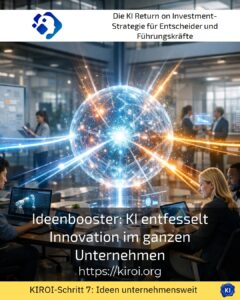
Have you ever wondered why some companies seemingly effortlessly develop revolutionary products, while others have been stagnating for years and can no longer generate fresh impulses? The answer often lies in a crucial difference that manifests itself in the way organizations activate and systematically utilize the creative potential of their employees – and this is exactly where the Idea booster: AI unleashes innovation across the entire company as a transformative force that breaks through traditional paradigms and opens up entirely new horizons. What was once considered science fiction has now become reality: intelligent systems support teams in overcoming creative roadblocks, discovering unconventional solutions, and accelerating the development of ideas at a rapid pace, allowing the entire innovation process to experience a new dynamic.
The transformation of creative processes through intelligent technology
Creativity was long considered a purely human domain. This perception has fundamentally changed. Intelligent systems now function as powerful catalysts for human creativity. They analyze patterns, recognize connections, and generate suggestions. People and machines work together in a productive symbiosis. The technology does not replace the human mind; rather, it significantly expands its capabilities.
In the automotive industry, development teams use intelligent assistants to design new vehicle designs [1]. These systems propose shape variations that optimally combine aerodynamics and aesthetics. Engineers at large manufacturers often report surprising design alternatives. This results in vehicle concepts that traditional approaches would never have produced. The chemical industry uses similar tools for developing new materials [2]. Researchers receive proposals for molecular structures with specific properties. This significantly accelerates the development process. The consumer goods industry also benefits from these possibilities. Product designers generate hundreds of variants for new packaging concepts within hours. The creative scope thus grows exponentially.
Best practice with a AIROI customer
A medium-sized company in the medical technology sector approached us with a challenging situation. Innovation management had become dormant and new product ideas were lacking. The development department had been working for years on incremental improvements to existing devices. Disruptive innovations did not occur, even though the competition became increasingly dynamic. As part of the transruptive coaching, we supported the team in introducing intelligent ideation tools. First, the systems analyzed patent databases and scientific publications. This resulted in initial impulses for entirely new product categories. The employees learned to use these suggestions as a starting point for their own creative processes. Within six months, the team developed three promising concepts for novel diagnostic devices. Two of them are now in the prototype phase. The innovation culture within the company has changed significantly. Employees report a renewed enthusiasm for creative work. The company is now positioning itself as an innovation leader in its market segment.
Idea Booster: AI unleashes innovation through democratized creativity
Innovation was traditionally the privilege of specialized departments. Research and development teams safeguarded the companies’ creative capital. However, this structure significantly limited the available potential for ideas. Intelligent tools fundamentally change this dynamic. They enable employees from all departments to contribute valuable insights. The sales representative with direct customer contact suddenly brings innovative product ideas. The accounting clerk develops proposals for more efficient processes.
This democratization of innovation is evident in various industries. Retail companies use intelligent platforms for company-wide idea competitions [3]. Employees from sales, logistics, and administration departments submit proposals. The systems automatically categorize and evaluate these ideas. Executives receive structured overviews of promising concepts. In the financial sector, banks are experimenting with similar approaches. Customer advisors are collaborating with intelligent assistants to develop new service concepts. The insurance industry is testing tools that help employees develop innovative products. Creativity levels are measurably increasing. At the same time, employees feel more valued and included.
How the Ideas Booster breaks down departmental silos
Traditional corporate structures often promote isolated thinking. Departments work side by side rather than together. Valuable knowledge remains trapped in silos. Intelligent systems can break through these barriers. They connect information from different business areas. This creates surprising connections and new perspectives.
The pharmaceutical industry demonstrates this potential in a particularly impressive way [4]. Research data is combined with insights from sales. Production knowledge is incorporated into the early development phase. The result are medications that take practical requirements into account from the outset. The aerospace industry also benefits from this networking. Designers gain insights into maintenance experiences from flight operations. This allows them to better take into account long-term service aspects in their design decisions. The telecommunications industry uses similar approaches for developing new services. Customer feedback is directly incorporated into the technical design process. The quality of the innovations thus increases significantly.
Practical implementation strategies for a sustainable innovation culture
The introduction of intelligent creativity tools requires more than just technical installation. Companies must adapt their culture and processes accordingly. Employees need training and encouragement. Leaders must demonstrate openness to unconventional ideas. Only then can technology unleash its full potential.
Transruptions coaching accompanies companies through these very same transformation processes. We support teams in developing new working methods. Together, we identify obstacles and develop appropriate solutions. The energy sector exemplifies how such transformations can be successful. Utilities are experimenting with intelligent tools for developing sustainable business models [5]. Employees at all levels of the organization are involved. The construction industry is using similar approaches to optimize planning processes. Architects and engineers are working with generative systems. This results in innovative building concepts with surprising properties.
Best practice with a AIROI customer
An internationally operating logistics service provider was looking for ways to increase its innovation capabilities. Traditionally, the company had invested little in creative processes. The operational business dominated everyday life completely. Employees did not see themselves as innovators, but as executors of established processes. As part of our support, we gradually introduced intelligent idea generation tools. First, we launched a pilot project in delivery logistics. Drivers and dispatchers received access to a simple assistance system. This automatically collected their observations and suggestions for improvement. The system analyzed the inputs and identified patterns. Within a few weeks, concrete optimization ideas emerged. One of them concerned route planning during delivery. A driver’s suggestion led to significant efficiency improvements. The company subsequently expanded the program to other areas. Today, over a thousand employees participate in the company-wide idea platform. The innovation culture has fundamentally changed.
Technology as an engine of ideas: AI unleashes innovation through continuous learning
Intelligent systems improve continuously through use. The more a company works with the tools, the more valuable they become. The system learns the specific requirements and preferences. It increasingly understands the corporate context and the industry dynamics. The quality of the generated suggestions thus increases steadily.
The semiconductor industry demonstrates this effect particularly impressively. Chip designers have been intensively using intelligent assistants for several years. The systems have learned to take into account industry-specific requirements. They propose designs that respect technical limits while being innovative. The textile industry shows similar developments. Fashion designers work with systems that analyze trends and provide creative impulses. These tools now understand subtle stylistic trends and brand identities. The food industry is also using learning creativity tools. Product developers receive suggestions for new flavor combinations. The systems take regional preferences and dietary trends into account.
Challenges and solutions for integration
The introduction of intelligent creativity tools also poses challenges. Employees sometimes fear being replaced. Leaders underestimate the necessary cultural change. Technical integration into existing systems proves complex. However, these obstacles can be overcome with the right approach.
Transparent communication forms the foundation. Companies must clearly convey that technology supports people. It does not replace human creativity, but enhances it. The engineering industry shows successful examples of such communication. Engineers see the tools as helpful assistants, not as a competition. The media industry has undergone similar transformations. Creatives use intelligent tools for research and idea generation. The actual creative output remains human. Game development also integrates these technologies successfully. Designers generate conceptual ideas with intelligent assistants. Selection and refinement are carried out by human expertise.
My AIROI Analysis
The integration of intelligent creativity tools into corporate processes marks a significant turning point in the history of innovation. My analysis shows that organizations that adopt these technologies early and strategically can achieve significant competitive advantages. However, the key lies not only in the technology itself but in the way it is implemented and culturally embedded. Companies must understand that intelligent systems do not provide ready-made solutions. Instead, they provide impulses that can steer human creativity in new directions.
The democratizing effect of these tools particularly strikes me. Employees who previously did not perceive themselves as creative suddenly discover their innovative potential. This development is changing corporate cultures in a lasting and positive way. At the same time, I observe risks that companies should consider. Excessive dependence on technological suggestions can hinder the development of original human creativity. The balance between technological support and autonomous thinking remains crucial. Companies should encourage their employees to critically question proposals. Technology provides raw material that human wisdom and experience must refine. Those who find this balance unlock enormous potential for innovation. The future belongs to organizations that combine people and machines in a productive partnership.
Further links from the text above:
[1] McKinsey Insights on the automotive industry and generative design
[2] Nature Materials Science – Research on intelligent material development
[3] Harvard Business Review – Innovation Management
[4] Pharmaceutical Executive – Innovation trends in the pharmaceutical industry
[5] World Economic Forum – Energy Transition and Innovation
For more information and if you have any questions, please contact Contact us or read more blog posts on the topic Artificial intelligence here.









 Deutsch
 English (UK)