
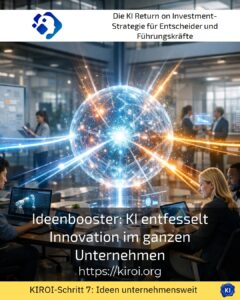
Have you ever wondered why some companies seemingly effortlessly come up with groundbreaking ideas while others falter despite enormous resources? The answer lies in a fundamental transformation that goes far beyond individual creative workshops and permeates the entire organizational structure. A genuine Idea Revolution: How to Scale Innovation Across the Entire Organisation It requires systematic action, cultural change, and the right technological support. In a time when disruptive changes can transform entire industries within just a few years, the ability to continuously innovate becomes the decisive factor for survival. This article shows you how to sustainably embed creative processes in your organization and avoid common pitfalls along the way.
The fundamental transformation of creative thinking in organizations
Creative breakthroughs rarely occur in an empty void. They require an ecosystem of enabling structures, motivated people, and supportive technologies. Many leaders report the challenge of translating isolated flashes of inspiration into systematic renewal processes. This transformation begins with a fundamental shift in thinking at all levels of the hierarchy.
This is exemplified in the automotive industry. Traditional manufacturers face the task of adapting their decades-old structures to new mobility concepts. For example, a leading European vehicle manufacturer has established internal innovation labs that are free to operate independently of existing business divisions. Similarly, in mechanical engineering, medium-sized companies are increasingly implementing digital platforms for internal idea exchange. The pharmaceutical industry is also experimenting with open research collaborations to accelerate the development cycle of new active ingredients.
Best practice with a AIROI customer
A medium-sized company in the precision engineering sector faced a particular challenge. The management recognized that valuable improvement suggestions from production workers often did not make it to the decision-making bodies. As part of the transruptions coaching program, we developed a multi-stage platform for the continuous flow of ideas together. This platform enabled each employee to submit suggestions and receive immediate feedback. Within six months, over three hundred ideas were submitted, twelve percent of which were implemented. The implemented suggestions led to measurable efficiency improvements in production. Particularly noteworthy was the fact that many of the most valuable ideas came from employees without leadership responsibilities. The company also recorded a significant increase in employee satisfaction because people felt more involved. The support provided by transruptive coaching helped constructively address resistance at the middle management level.
Cultural prerequisites for a sustainable idea revolution: How to scale innovation across the entire company
Technical systems alone do not create a culture of continuous renewal. Rather, a profound change is needed in the way organizations deal with mistakes, experiments, and unconventional ideas. Clients often report that formal innovation programs fail in the face of informal power structures. This observation highlights the need for a holistic approach.
The financial services industry offers insightful insights in this regard. Traditional banks have recognized that they need to partially loosen their risk-averse culture in order to compete with agile fintech companies [1]. Some institutions have therefore established separate units where other rules apply within the core business. In retail, on the other hand, companies are experimenting with decentralized decision-making structures that allow branch managers to more quickly adapt to local market conditions. The energy sector faces similar challenges because the transition to renewable sources requires entirely new business models.
Psychological security forms the foundation of any true renewal culture. People must have the certainty that they will not be mocked or punished for unusual proposals. This security cannot be imposed; it must be built over time through consistent leadership behavior. Leaders who admit they do not know all the answers are signaling openness to new perspectives.
The role of leaders as facilitators of creative processes
Modern leadership in the context of organizational renewal differs fundamentally from classic management paradigms. Instead of control and direction, empowerment and support take center stage. Leaders become gardeners who create favorable conditions for the growth of ideas.
In software development, the concept of servant leadership has already largely taken hold [2]. Team leaders there often see themselves as facilitators who enable the creative flow of their teams. The construction industry, however, still struggles with hierarchical traditions that can hinder rapid adaptation. In the food industry, interesting hybrid forms are emerging, in which creative product development teams operate relatively autonomously, while production remains more structured.
Best practice with a AIROI customer
An international logistics service provider approached us because the senior management faced conflicting expectations. On the one hand, executives were expected to ensure efficiency and adherence to deadlines, while on the other hand, they were required to create creative leeway for process improvements. Through transruptive coaching, we developed a model of time-limited experimentation spaces. Executives received clear guidelines on when and how to grant their teams freedom. This structure paradoxically reduced uncertainty significantly. The executives reported increased confidence in their role as facilitators. At the same time, operational excellence remained at a high level. The company subsequently implemented a rotation program in which executives temporarily worked in the innovation department. This experience changed her perspective permanently and promoted the transfer of knowledge between different organizational areas.
Technological levers for scalable renewal processes
Digital tools can significantly accelerate organizational renewal when used correctly. However, they never replace the human factor; rather, they at best support and enhance it. Therefore, selecting and implementing appropriate technologies requires a deep understanding of organizational needs.
Artificial intelligence This is playing an increasingly important role. In the chemical industry, companies are using machine learning to identify promising molecular structures more quickly [3]. The media industry is using AI-powered systems to predict audience reactions to new format ideas. Intelligent algorithms are also helping to analyze trends in the textile industry, significantly accelerating the design process.
Collaboration platforms form the digital backbone of modern idea management systems. They enable geographically distributed teams to work on common concepts synchronously and asynchronously. Ease of use is crucial here, because complex systems quickly become forgotten. Successful implementations are characterized by low entry barriers and intuitive operation.
Integration of idea management into existing workflows
Creative processes must not appear as foreign elements in organizational everyday life. Rather, they must be seamlessly integrated into existing work routines in order to achieve lasting impact. This integration requires careful planning and continuous adaptation.
The insurance industry is experimenting with incorporating ideas into regular team discussions. Telecommunications companies have incorporated renewal goals into their performance evaluation systems. The mechanical engineering industry is increasingly using digital twins to evaluate new product ideas more quickly. All these examples show that successful integration must always be context-specific.
Measurability and continuous improvement of the idea revolution: This is how you scale innovation across the entire company
What is not measured cannot be systematically improved. At the same time, quantitative metrics carry the risk of leading behavior in unintended directions. Developing meaningful metrics for creative processes therefore represents a particular challenge.
In the consumer goods industry, metrics such as the number of new product launches per year have become established [4]. The aviation industry measures the share of revenue that comes from recent developments. Consulting firms are increasingly capturing qualitative indicators such as perceived openness to new ideas in employee surveys. These different approaches illustrate that there is no universal solution.
Iterative improvement cycles are at the heart of any sustainable renewal system. Organizations must regularly reflect on which elements of their innovation architecture work well and which should be adapted. This reflection requires honesty and an openness to questioning even cherished practices.
Best practice with a AIROI customer
A technology company in the field of sensor technology had already established extensive innovation processes, but was dissatisfied with their effectiveness. The existing metrics were only insufficiently reflective of actual creative performance. In the context of the transruptive coaching process, we jointly developed a multidimensional evaluation system. This system took into account both quantitative and qualitative aspects of idea generation and implementation. Particular attention was paid to early indicators that can predict future renewal capability. The introduction of quarterly retrospectives enabled the company to react more quickly to misdevelopments. The transparency of the new metrics also motivated many employees to participate more actively in creative processes. The company subsequently recorded a significant increase in the quality of submitted proposals.
Overcoming typical obstacles on the path to regenerative capacity
Any organizational change encounters resistance that must be taken seriously and addressed. In the context of creative transformation, this resistance is often particularly complex because it touches upon deeply rooted beliefs and power structures. Successful change projects are characterized by a constructive approach to these challenges.
The steel industry, for example, struggles with the legacy of a highly hierarchical tradition. In healthcare, regulatory requirements often make rapid experimentation difficult. The tourism industry, in turn, must account for seasonal fluctuations that can affect ongoing renewal processes.
Communication plays a key role in overcoming resistance. People need to understand why changes are necessary and what personal benefits they can derive from them. Abstract strategic arguments are less convincing than concrete examples and personal conversations. Involving multipliers at all levels of the hierarchy can significantly accelerate the change process.
My AIROI Analysis
The systematic scaling of creative processes presents organizations with one of the most complex management tasks of our time. My analysis shows that successful companies address three dimensions simultaneously: cultural prerequisites, structural frameworks, and technological support. None of these dimensions can achieve lasting impact on their own.
The experiences from numerous accompaniment projects illustrate that patience and perseverance are indispensable virtues on this path. Rapid successes are possible, but profound transformation takes time and consistent action over several years. Leaders who have unrealistic expectations regarding the speed of change risk disappointment and the premature discontinuation of promising initiatives.
The Idea Revolution: How to Scale Innovation Across the Entire Organisation It is not a one-time project, but a lasting journey. Organizations that successfully embark on this journey develop a kind of organizational fitness that equips them for future challenges. Transruptive coaching can provide valuable insights and serve as a guide in navigating complex change processes. However, personal commitment and the willingness to question conventional thinking remain crucial.
The presented examples from various industries show that there is no universal blueprint for successful renewal. Rather, each organization must find its own path that suits their specific culture, history, and strategic orientation. This individualization requires both analytical precision and creative flexibility.
Further links from the text above:
[1] McKinsey – Culture change at banks
[2] Harvard Business Review – Servant Leadership
[3] Nature – AI in Chemical Research
[4] BCG – Most Innovative Companies Report
For more information and if you have any questions, please contact Contact us or read more blog posts on the topic Artificial intelligence here.








 Deutsch
 English (UK)