
Have you ever wondered why some organizations seem to develop breakthrough products effortlessly, while others, despite significant investments, stagnate and lose their momentum?
The answer often lies not in a lack of resources or a shortage of creative minds. Rather, a systematic approach is lacking that would enable the development of a sustainable and long-term strategy. Idea revolution understood as a strategic tool. Many executives come to us with exactly this challenge. They report on stagnating development processes and frustrated teams. They wish for impulses that will sustainably transform their innovation culture. transruptions coaching accompanies companies in overcoming these hurdles and opening up new paths.
Why traditional approaches reach their limits
The classic methods of product development originated in a time of linear markets. Back then, companies planned their portfolios over years. Today, customer needs change in months or even weeks. This speed regularly and sustainably overwhelms rigid structures.
A technology company in the semiconductor production sector invested significant sums in research. Nevertheless, promising concepts did not reach commercial maturity. The reason was a culture that prioritized perfection over speed. We see a similar phenomenon in mechanical engineering companies that, despite excellent engineering, have failed to embrace the digital transformation. Software companies also report a bottleneck in innovation because departmental boundaries hinder the flow of ideas.
These examples highlight a fundamental problem. Innovation does not arise from isolated efforts by individual departments. It requires an ecosystem that systematically fosters and leverages creativity.
Establishing the Ideas Revolution as a strategic foundation
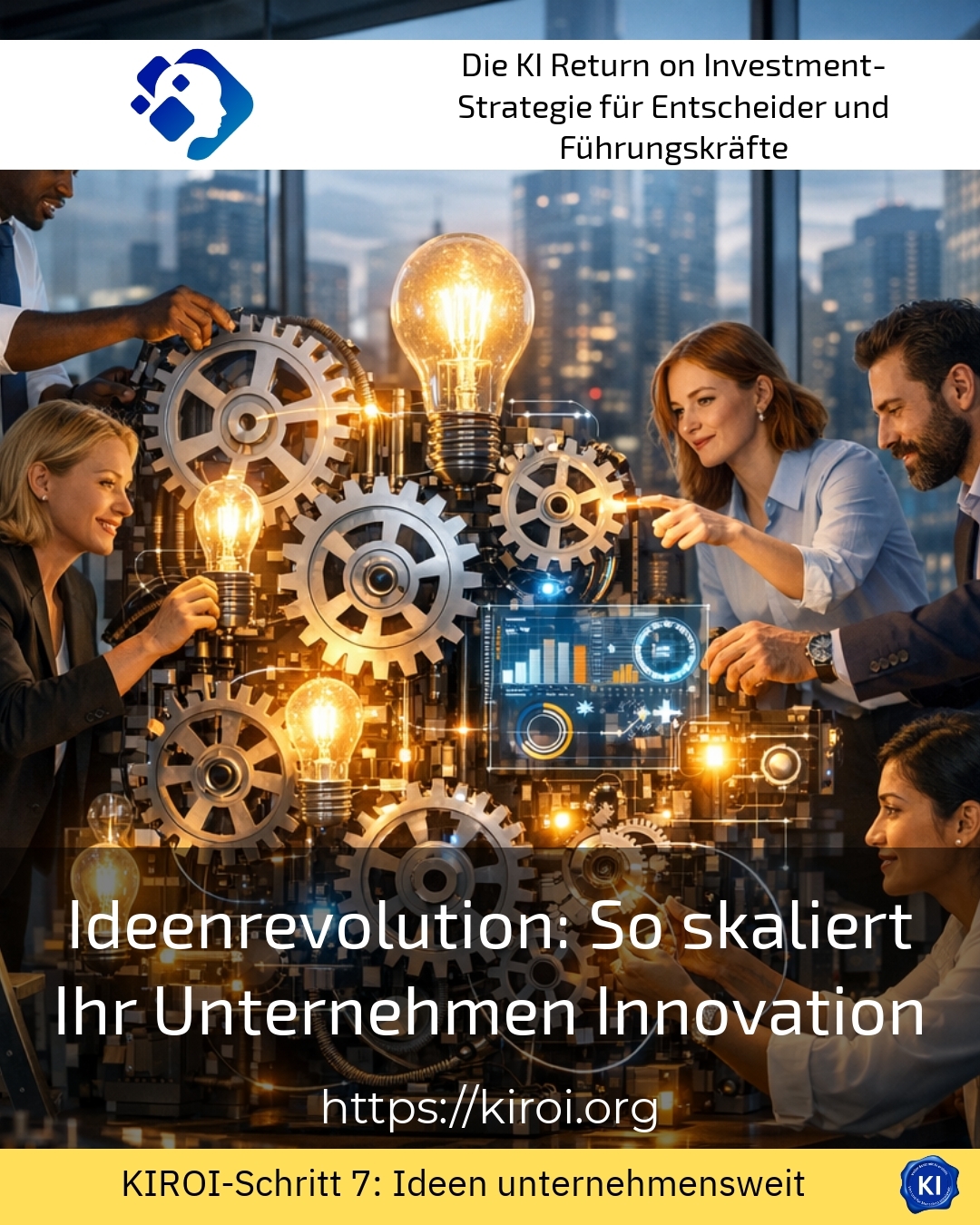
A real Idea revolution It begins with a fundamental change in leadership. Leaders must understand that creative processes do not disrupt day-to-day operations; they are, in fact, the engine for future growth and long-term competitiveness.
An automotive supplier transformed its development department by introducing innovation sprints. Employees from different departments worked on radical concepts for short periods of time. A pharmaceutical company set up virtual idea labs where scientists could experiment across departments. A logistics service provider implemented a digital proposal system that generated thousands of improvement ideas within a few months.
Best practice with a AIROI customer
A medium-sized company in the medical technology sector came to us with a complex challenge. The management reported that there was an increasing discrepancy between market demands and internal development capabilities. Despite highly skilled engineers and significant research budgets, product innovations had stagnated for several years, a worrying situation. As part of the transruptive coaching, we first analyzed the existing processes and identified critical gaps in communication between sales, development, and production. Together, we developed a three-stage innovation model that integrated regular cross-functional workshops and established clear responsibilities for the evaluation of ideas. Within six months, the number of product concepts released for implementation tripled. Employees often reported increased motivation and a better understanding of customer needs. This example impressively demonstrates how systematic support can help to facilitate transformative change.
Overcoming cultural barriers and promoting openness
The biggest obstacles to scalable innovation are rarely of a technical nature. They are rooted in cultural patterns that prevent risk-taking through a fear of failure. Many organizations unconsciously punish failure through subtle signals and career disadvantages.
One financial services provider introduced so-called failure celebrations. Teams presented failed projects and openly shared their findings. A consumer goods manufacturer established a rule that encouraged every employee to submit at least one crazy idea per month. An energy provider created protected spaces where teams could work on unconventional solutions without the pressure of justification.
These cultural interventions create a psychologically safe space for creative thinking. Employees dare to express even imperfect ideas. This creates a rich pool of ideas from which breakthrough innovations can emerge.
Building scalable structures for the idea revolution
A successful Idea revolution It requires more than good intentions and motivated employees. It requires robust structures that support the flow of ideas from initial inspiration to market launch.
A telecommunications company implemented a multistage innovation pipeline system. Each idea went through defined evaluation phases with clear criteria and resource allocations. A chemical company created decentralized innovation hubs in different regions that combined local market knowledge with global scalability. A trading company used artificial intelligence to automatically categorize submitted ideas and link them with similar concepts.
These structural measures prevent promising ideas from being lost in the day-to-day business. They create transparency about the innovation process and enable data-based decisions regarding resource allocation.
Using technology as a catalyst for creative processes
Modern technologies can significantly accelerate and expand the innovation process. However, they never replace human creativity and entrepreneurial judgment.
An insurance company used predictive analytics to identify promising market trends early on. A mechanical engineering company used virtual reality for rapid prototype development and customer validation. A food manufacturer implemented collaborative platforms that supported teams distributed worldwide in the development of ideas [1].
The intelligent use of these tools multiplies the effectiveness of human creativity. Teams can iterate faster, incorporate broader perspectives, and make informed decisions.
Best practice with a AIROI customer
A traditional family business in the industrial manufacturing sector sought ways to rejuvenate its innovation capabilities. The second generation of management realized that tried-and-tested methods were no longer sufficient to survive in the dynamic market environment. In transruptive coaching, we initially worked on the vision of a future-proof innovation culture that combines tradition and progress. We supported the introduction of an internal startup program in which employees could develop and implement their own business ideas. The management provided dedicated budgets and mentors without taking on operational responsibility. After a pilot phase, three promising business models emerged, one of which already generated revenue. Particularly noteworthy was the change in the corporate culture, which encouraged employees of all ages to take more initiative. This case illustrates how targeted mentoring can lead established companies to new levels of innovation.
Redefining the role of leadership in the idea revolution
Leaders must fundamentally rethink their role in the innovation process. Traditionally, they made decisions about resources and directions. In a scalable innovation organization, they become facilitators and cultural creators.
The CEO of a technology company spent one day a week in the innovation labs. He listened, asked questions, and signaled the strategic importance of creative work. A sales manager from an industrial company regularly brought customer feedback into the development teams. A production manager from an automotive manufacturer actively promoted the exchange of knowledge between his shift teams and the research department [2].
These behaviors shape the innovation culture more than any formal directive. Employees are guided by what leaders do, not by what they say.
Ensuring measurability and continuous improvement
What is not measured cannot be systematically improved. This also applies to creative processes, which long ago were considered unquantifiable.
A software company developed a dashboard that made the time from idea submission to market launch transparent. A pharmaceutical company tracked the number of cross-functional collaborations as an indicator of knowledge exchange. A retail company measured the share of revenue that came from products introduced in the last three years [3].
These metrics enable evidence-based decisions regarding investments in the innovation process. They show progress and identify areas with potential for improvement.
Expanding the idea revolution with external partners
No company alone possesses all the necessary competencies and perspectives for continuous innovation. Strategic partnerships significantly expand the pool of ideas.
One automotive manufacturer collaborated with universities for fundamental research in battery technology. A financial services provider invested in fintech startups, thereby gaining access to disruptive business models. A consumer goods manufacturer invited customers to innovation workshops and directly integrated their needs into the development process.
These open innovation approaches accelerate development and reduce risks. However, they require clear governance structures and intellectual property management.
My AIROI Analysis
The systematic scaling of innovation represents one of the central challenges for organizations of all sizes and industries. Our experience from numerous support projects shows that successful companies must consistently address several factors. First, they need a clear commitment from the leadership level to the strategic importance of creative processes. This commitment must manifest itself in concrete resource allocations and behavioral changes.
Furthermore, sustainable innovation requires structural integration into organizational design. Ad-hoc initiatives and isolated projects rarely produce lasting effects. Only the integration of innovation processes into the operational business creates the necessary continuity and scalability.
The cultural dimension deserves special attention in any transformation initiative. Technical systems and formal processes can only work if they are supported by a culture that rewards experimentation and understands productive failure as a learning opportunity. These cultural changes require time, patience, and consistent leadership from leaders at all levels.
Ultimately, we recommend an iterative approach when implementing new innovation structures. Small pilot projects allow for learning experiences without excessive risks. Successful elements can then be scaled gradually and adapted to different organizational areas. transruptions coaching helps companies navigate this complex transformation path and achieve sustainable results.
Further links from the text above:
[1] Harvard Business Review – Innovation Management
[2] McKinsey – The Eight Essentials of Innovation
[3] Forbes – Innovation Insights
For more information and if you have any questions, please contact Contact us or read more blog posts on the topic Artificial intelligence here.









 Deutsch
 English (UK)