
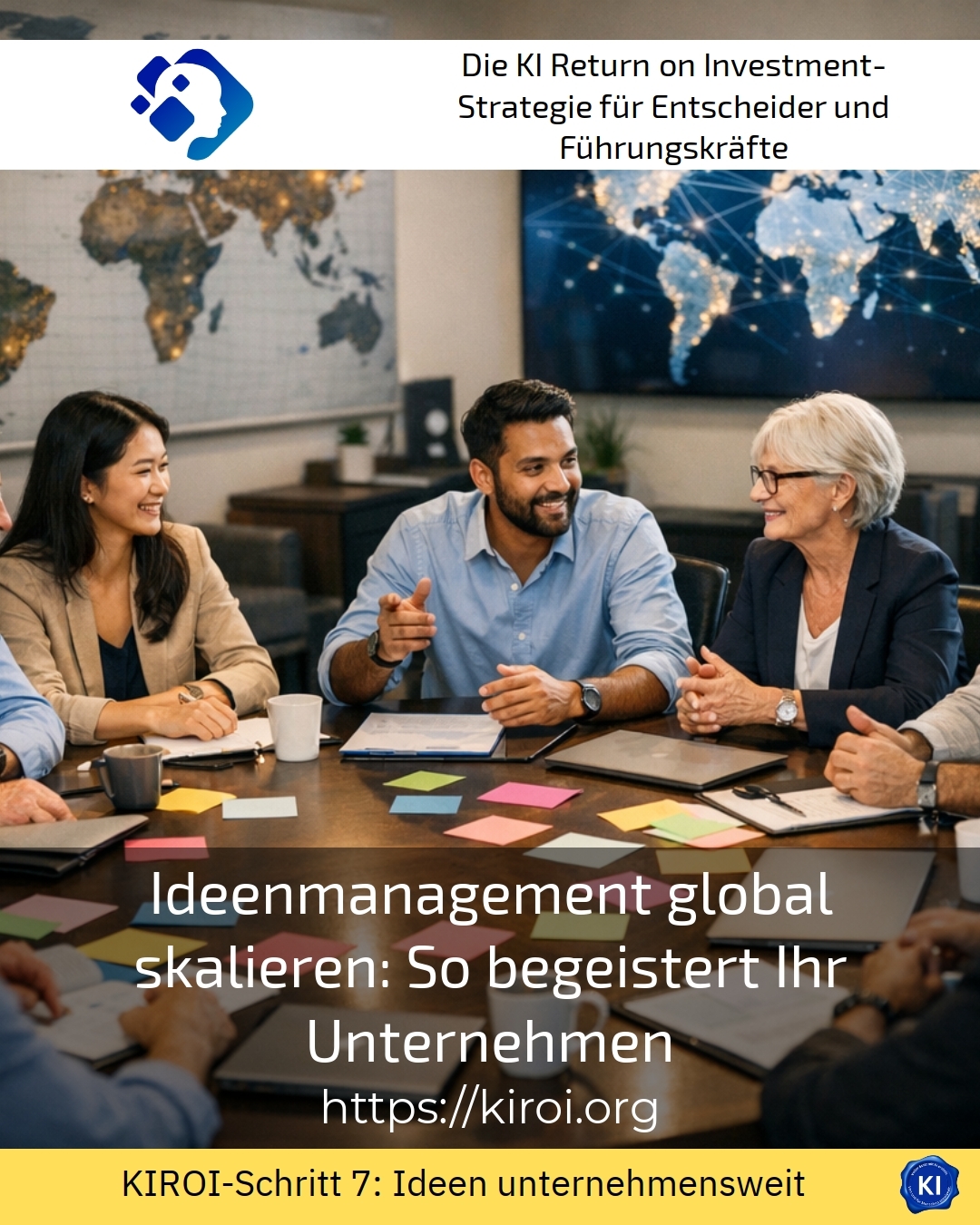
How do international corporations manage to harness the creative energy of tens of thousands of employees on all continents simultaneously, while leaving no one behind?
This question concerns executives worldwide, because that Scaling idea management globally It presents companies with complex challenges that go far beyond technical solutions. In a world where innovation has become the decisive competitive factor, it is no longer enough to simply collect and evaluate good ideas centrally. Instead, organizations need thoughtful strategies, cultural sensitivity, and smart processes to truly unlock the potential of their global workforce. It involves much more than simply digitizing existing processes. It is about inspiring people and making them active contributors to the company’s future.
Understanding and utilizing the cultural dimension
Anyone who wants to bring together creative impulses from different cultural backgrounds must first consider the different communication styles and hierarchies. In Asian locations, employees often show a different reluctance to offer suggestions for improvement than their European or American colleagues. These differences are not due to a lack of commitment. They reflect cultural nuances that companies can respect and utilize productively.
A automotive supplier with plants in Germany, Mexico and China reported initial difficulties in introducing a unified proposal system. While German employees submitted their ideas directly, Chinese colleagues preferred the route via team leaders. Mexican locations, in turn, spontaneously developed informal group submissions. The solution did not lie in imposing a single process. Instead, the company enabled various submission paths while simultaneously standardizing the evaluation criteria.
A pharmaceutical company integrated local innovation ambassadors into its structure. These ambassadors knew both the corporate culture and the regional specifics. They bridged language barriers and helped to understand proposals in the right context. Another chemical company used regular virtual exchange formats between locations. This allowed teams to learn from each other and develop better approaches together.
Best practice with a AIROI customer
A globally operating machinery manufacturer with production sites on four continents approached us because the existing structures for involving the workforce in improvement processes were no longer functioning. The headquarters received hardly any input from the Asian and South American plants, even though dedicated teams were working there. As part of a transruptive coaching process, we accompanied the management team over several months in redesigning the global processes. Together, we analyzed the cultural barriers and identified local multipliers who could act as bridge builders. We developed a multi-stage concept that linked regional autonomy with centralized evaluation. The individual sites received their own budgets for implementing smaller proposals, thereby gaining more motivation. Larger projects underwent a standardized evaluation process that took cultural differences in presentation into account. After twelve months, the company recorded a significant increase in the number of proposals submitted from all regions, with the quality of the submissions also improving.
Scaling technological infrastructure for idea management globally
The right technical platform forms the backbone of a global creative process. Factors such as multilingualism, accessibility, and user-friendliness play crucial roles in this. A system that only works on desktop computers barely reaches production workers in factories. Mobile applications and intuitive interfaces significantly lower the barrier to participation.
An international food manufacturer implemented a cloud-based solution that integrated automatic translation functions. Employees could submit suggestions in their native language, while reviewers read them in their preferred language. The quality of machine translations has improved significantly in recent years and now enables such applications [1]. A logistics company combined its platform with speech recognition technology, allowing employees without regular access to a computer to easily contribute their thoughts.
Data privacy requirements vary significantly worldwide and require careful planning. The European General Data Protection Regulation (GDPR) imposes different requirements than Asian or American regulations [2]. Companies must design their systems to comply with all relevant regulations. One technology company solved this problem by deploying regional server structures with centralized analysis capabilities that aggregated anonymized data.
Integration into existing workflows
Successful global systems seamlessly integrate into the workday. They require no additional effort; they become part of the natural workflow. A consumer goods company linked its proposal system to the internal communication system. Employees could submit ideas directly from their usual chat program. An energy provider integrated the platform into its shift handover processes, so that improvement suggestions emerged as a natural part of daily communication.
The integration with project management tools accelerates the implementation of promising proposals. Approved ideas are automatically converted into project assignments and assigned to the relevant teams. One electronics company reported a halving of the average implementation time after introducing such automations. This speed, in turn, motivates further submissions.
Designing incentive systems intelligently
Monetary rewards do not work equally well as a motivational factor everywhere. In some cultures, public recognition is more effective than financial rewards. Other employees value additional leisure time or further training opportunities more highly. Smart companies therefore offer flexible reward options that employees can choose from.
A construction company implemented a points system that took into account both individual and team performance. Collected points could be exchanged for various rewards, ranging from gifts to experiences and donations to non-profit organizations. This variety appealed to different types of motivators. An insurance company complemented material incentives with career opportunities. Particularly dedicated ideators received access to leadership mentoring or international project teams.
Gamification elements can increase engagement when used appropriately culturally [3]. Leaderboards and competitions are highly motivating in some environments. In others, however, they can encourage competitive thinking that harms collaboration. A telecommunications provider tested various approaches in pilot groups and adapted its system based on the results regionally.
Best practice with a AIROI customer
A globally operating financial services provider struggled with a highly uneven distribution of participation in its proposal across different regions. While European branches participated actively, Asian and African locations fell far short of expectations. As part of our transruptive coaching support, we first conducted extensive discussions with employees at all levels in the affected regions. It emerged that the existing incentive system was based on Western assumptions and did not take local needs into account. Together with the client team, we developed a differentiated model that enabled regional adjustments. In some countries, we introduced team bonuses instead of individual rewards because collective recognition was valued higher there. Other locations were given the option to donate bonuses to local social projects. After the switchover, submission rates in previously weak regions increased by more than three times, and the quality of the proposals also improved measurably.
Leadership culture as a success factor in the global scaling of idea management
Without active support from leaders at all levels, even the best systems remain ineffective. Managers must not only approve proposals but also act as role models. They should also contribute ideas themselves and publicly acknowledge their teams’ contributions. This visible appreciation signals to the entire organization that creative impulses are desired and important.
A steel manufacturer trained its management teams worldwide in appreciative communication and constructive feedback. The quality of the feedback on submitted proposals improved noticeably as a result. Employees felt taken seriously even when their ideas were not implemented. A trading company included the promotion of employee creativity in the goals agreed upon by its managers. This linkage with personal success metrics significantly increased the commitment of the management level.
Transparency about decision-making processes creates trust and encourages further participation. A software company regularly published reports on the status of all submitted proposals. Employees could see which ideas had been implemented, which were still under review, and why some had been rejected. This openness reduced frustration and strengthened trust in the system.
Organizing knowledge transfer between locations
The most valuable insights often arise in one location and can be of great benefit elsewhere. Successful companies establish mechanisms to systematically share such knowledge. A chemical company established virtual expert groups on various subject areas. These groups met regularly and discussed promising approaches from all regions of the world.
A medical technology manufacturer documented implemented improvements in a searchable knowledge database. Other locations were able to assess whether similar solutions were suitable for their challenges. The original ideators were available for questions and supported the adaptation to local conditions. A textile company organized annual innovation conferences where employees from different countries presented their most successful projects and built personal networks.
Measurability and continuous improvement
Only what is measured can be systematically improved. This involves more than just the number of submissions; it also involves the actual added value for the company. Key performance indicators such as the implementation rate, the average processing time, and financial benefits provide insight into the effectiveness of the system. At the same time, qualitative aspects such as employee satisfaction and the innovation culture should be regularly monitored [4].
An industrial company developed a dashboard that displayed all relevant metrics in real time. Executives were able to track the performance of their departments and benchmark them with other locations. A service company supplemented quantitative data with regular employee surveys. This combination enabled a comprehensive view of the system’s performance.
Regular reviews help identify weaknesses and guide improvement measures. A mobility provider conducted quarterly retrospectives with all site managers. Together, they analyzed successes and challenges and developed concrete measures. This continuous development ensured the long-term effectiveness of the global system.
My AIROI Analysis
The Scaling idea management globally It requires a holistic approach that takes into account the technical, cultural, and organizational dimensions alike. My experience from numerous accompaniment projects for international companies shows that success depends less on the chosen software than on the willingness to initiate real changes in corporate culture. Leaders play a crucial role in this because through their behavior they set the standards that others follow.
I observe the greatest progress in organizations that treat their employees as true partners in the innovation process. These companies invest time in understanding local peculiarities and adapt their approaches accordingly. They accept that a uniform approach is not always the best solution and allow for regional flexibility within clear frameworks.
Technology can support and accelerate the process, but it never replaces human relationships or genuine interest in the ideas of others. The best systems combine digital efficiency with personal appreciation, creating an environment where creativity can flourish. Those who find this balance unlock enormous potential for innovation and competitiveness on a global scale.
In the context of transruptive coaching projects, I regularly witness how companies successfully master this transformation. The guidance in developing appropriate structures and processes provides the impetus for sustainable changes. Clients often report a noticeable improvement in collaboration across borders as the most important side effect of their efforts to achieve better Scaling idea management globally.
Further links from the text above:
[1] DeepL Blog on machine translation
[2] EU Commission on data protection
[3] Harvard Business Review on Innovation
[4] McKinsey Insights on innovation management
For more information and if you have any questions, please contact Contact us or read more blog posts on the topic Artificial intelligence here.






 Deutsch
 English (UK)