
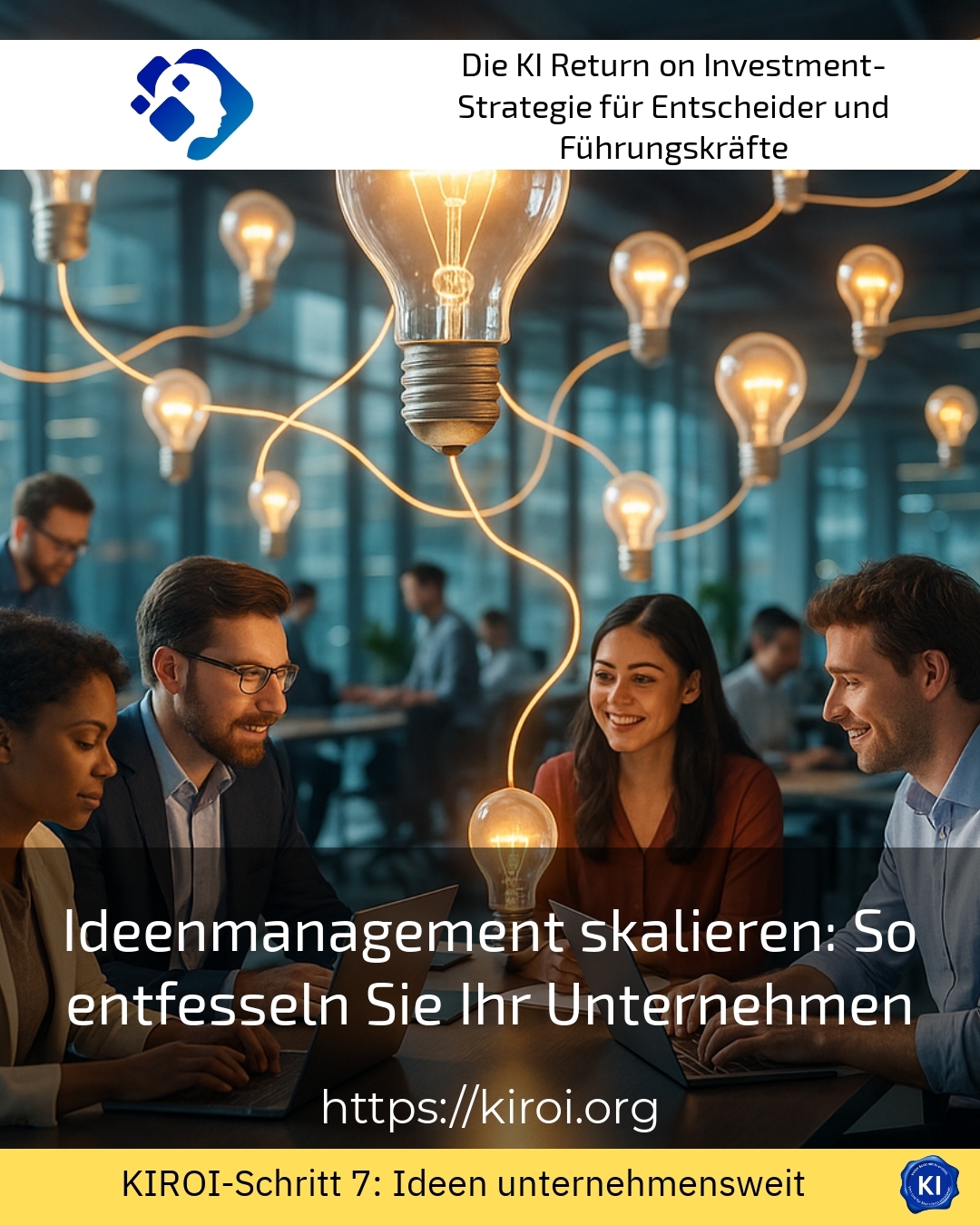
Have you ever wondered why some companies seemingly effortlessly achieve innovative breakthroughs while others, despite great efforts, stagnate? The answer often lies in the ability to systematically harness creative potential and scale idea management so that every voice in the company is heard and can contribute to value creation. In an economy that is rapidly changing, it is precisely this competence that determines the long-term success and competitiveness of entire organizations.
Discovering the hidden power of collective creativity
Every company possesses an enormous treasure trove of untapped knowledge that lies dormant in the minds of its employees and is waiting to be tapped. Many executives systematically underestimate the creative potential of their teams, thereby missing valuable opportunities for development. In production environments, for example, machine operators often know optimization possibilities that remain hidden from the engineering teams. Service workers in the hospitality industry observe daily customer needs that management could never read from statistics. Nursing staff in healthcare facilities develop intuitive solutions for everyday problems that would significantly improve processes.
The challenge lies in systematically making this distributed intelligence accessible and transforming it into concrete improvements. Traditional suggestion systems with physical letterboxes are no longer sufficient, as they operate too slowly and are too little transparent. Modern approaches instead rely on digital platforms that enable employees to submit their ideas at any time and from anywhere. One logistics company was able to collect over three thousand improvement suggestions within a few months through such an approach. A retail chain uses similar systems to collect and evaluate feedback from hundreds of branches.
Best practice with a AIROI customer
A medium-sized automotive supplier faced the challenge that valuable improvement suggestions from production regularly surfaced in day-to-day business operations. The management therefore decided to provide comprehensive support through transruptive coaching to fundamentally rethink existing structures. As part of the project, a digital platform was initially implemented that allows all employees to submit suggestions directly at the workplace using tablets. Additionally, the company established so-called innovation scouts in each department who act as bridge builders between the operational teams and management. These scouts received special training to identify potential and to support colleagues in formulating their ideas. Within six months, the number of submitted suggestions increased from an average of twelve per month to over one hundred and fifty. What was particularly noteworthy was the quality of the submissions, as many of the proposals concerned concrete process improvements with measurable potential for savings. One single proposal to optimize a assembly step led to annual savings of several tens of thousands of euros.
Scaling idea management through intelligent structures
However, the mere collection of proposals represents only the first step in a longer journey, because without thoughtful evaluation and implementation processes even the best approaches quickly fall through the cracks. Employees lose their motivation when they do not receive feedback or their proposals are seemingly ignored. Therefore, companies need clear structures and transparent communication channels that accompany the entire life cycle of an idea.
For example, a pharmaceutical company has introduced a three-stage evaluation system that categorizes proposals based on feasibility and strategic relevance. In the energy sector, utilities use regular innovation workshops to jointly develop promising concepts. Technology companies rely on internal crowdfunding mechanisms, where employees can use virtual budgets to support preferred projects. These different approaches show that there is no one right way, but that companies must develop individual solutions.
Involvement of all levels of the hierarchy is crucial for success, because only then can a real innovation culture emerge. Leaders must act as role models and actively participate in the process themselves. One insurance company reports significantly higher participation, since board members are also regularly submitting their own proposals. In the construction industry, some companies promote interdisciplinary exchange through mixed teams from different trades.
Scale technological support for idea management
Modern software solutions can significantly accelerate and simplify the entire innovation process by automating administrative tasks and creating transparency. Artificial intelligence already supports the categorization and initial evaluation of more complex proposals today. Algorithms can recognize and combine similar or redundant submissions, drastically reducing the processing time. A telecommunications provider uses machine learning to automatically assign appropriate experts for evaluation.
Mobile applications also enable the submission of ideas directly at the point of origin, which is particularly valuable for field service employees. Service technicians in the elevator industry can, for example, document improvement suggestions immediately after a customer appointment. Sales teams in the wholesale sector can capture market observations directly during their customer visits. Assembly teams in the plant construction industry share their findings on-site with the development team.
Best practice with a AIROI customer
An international hotel chain sought ways to better utilize the expertise of its employees distributed worldwide and to turn cultural differences into a competitive advantage. Collaboration with transruptions coaching enabled a systematic analysis of the existing communication channels and their weaknesses. It quickly became apparent that language barriers and different time zones significantly hindered the exchange. As a solution, a multilingual platform was implemented that offers automatic translation capabilities and supports asynchronous collaboration. Each hotel also received a local ambassador who mediated between the headquarters and the teams on the ground. These ambassadors meet monthly in virtual conferences to identify cross-country trends and exchange best practices. One initiative to reduce food waste was particularly successful; it was originally initiated by a chef in Asia. Implementing his suggestions in other regions led to measurable cost savings while simultaneously improving the sustainability performance of the entire group.
Cultural transformation as the foundation for sustainable success
Technology alone, however, can never be enough to unleash the full potential of a company; the decisive factor always remains the human being. A true innovation culture requires psychological safety, which allows employees to express even imperfect ideas without fearing negative consequences. Unfortunately, many organizations still have a culture of error, which stifles the spirit of experimentation and prevents people from being creative.
For example, banks have begun introducing so-called fail-forward programs that recognize failed experiments as learning opportunities. Chemical companies are now celebrating not only successful patents but also bold experiments that did not lead to the desired outcome. In the media industry, innovation labs are emerging where teams, without immediate pressure to achieve success, are allowed to try out new formats and business models. These examples show that a change of mindset is possible and is already taking place.
The recognition of contributions plays a central role here, because it creates motivation and inspires others to imitate. Financial rewards do not always have to be the primary focus, as employees often report that even public recognition can be enormously motivating. One mechanical engineering company has established an internal “Innovator of the Month” program that makes successful ideas visible. Hospitals honor innovative caregivers in team meetings and internal publications.
Scale measurable results through systematic idea management
The success of innovation initiatives can be measured using various indicators that should take into account both quantitative and qualitative aspects. The number of submitted proposals provides initial indications of employee engagement. The implementation rate shows how well the filtering process works and whether realistic expectations exist. The average processing time is an indicator of the efficiency of the evaluation processes.
Ultimately, however, what matters most is the economic value added that implemented improvements generate. A food manufacturer was able to reduce its packaging costs by several percent thanks to employee suggestions. A logistics service provider optimized its route planning thanks to driver ideas and significantly reduced fuel consumption. A textile company improved material yield through production suggestions, thereby reducing raw material consumption.
Best practice with a AIROI customer
A traditional furniture manufacturer recognized that digital transformation requires new approaches to engaging its employees. The long-standing experience of the employees in the trades and manufacturing sector represented an enormous wealth of knowledge that had not yet been sufficiently utilized. Through transruptive coaching as a support for this change project, a multi-stage approach was developed that combined both digital and analog elements. Special input terminals were installed in the production halls for employees without daily access to computers, enabling easy operation. In parallel, monthly innovation breakfasts were held, where suggestions were discussed and developed together. This combination of technical infrastructure and personal exchange proved particularly effective because it took into account different preferences and work styles. Within a year, participation in the proposal process tripled, and several ideas have already been developed into patentable innovations. Particularly noteworthy is a proposal to optimize surface treatment, which improved product quality while simultaneously reducing energy consumption.
My AIROI Analysis
The systematic use of collective intelligence has proven to be a crucial success factor for companies of all sizes, with the specific implementation forms strongly dependent on the respective corporate culture and industry. Based on my experience in numerous consulting projects, I can confirm that organizations that take creative potential seriously operate more successfully in the long term. The biggest obstacles are rarely technical issues, but rather cultural and organizational factors that are often underestimated.
What seems particularly important to me is the realization that innovation is not an innate trait but can be systematically developed. Companies should therefore take small steps and learn from their experiences, rather than waiting for perfect solutions. The examples presented impressively show what results are possible when leaders have the courage to question established structures and to embark on new paths.
My recommendation is therefore to first conduct an honest assessment of the current situation and together with the employees to launch initial pilot projects. Transruptive coaching can provide valuable impetus and accompany companies on their individual development path. Experience shows that investing in a vibrant innovation culture pays off multiple times, both in the form of concrete improvements and through higher employee satisfaction and increased employer attractiveness.
Further links from the text above:
[1] McKinsey: The Eight Essentials of Innovation
[2] Harvard Business Review: Insights on Innovation
[3] World Intellectual Property Organization
[4] European Commission: Innovation in industry
For more information and if you have any questions, please contact Contact us or read more blog posts on the topic Artificial intelligence here.







 Deutsch
 English (UK)