
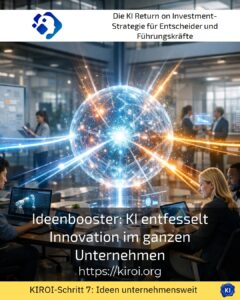
Imagine your organisation turning into a living organism that absorbs new impulses daily and systematically transforms them into growth. The Idea revolution does not begin with spectacular individual inventions, but with the systematic empowerment of all employees for creative participation. Companies that undergo this transformation often report a completely new dynamic in their teams. The question is therefore no longer whether you want to be innovative, but how you can systematically unleash this power throughout the entire operation.
Understanding the bedrock of the ideas revolution
Creative processes rarely happen in a vacuum. They require fertile ground, characterised by clear structures and open communication channels. Many organisations underestimate the importance of psychological safety for their workforce. Employees need to feel that their suggestions are welcome and taken seriously. Only then do they dare to voice unconventional thoughts and propose supposedly crazy concepts.
For example, an automotive supplier from southern Germany established monthly idea markets in its production halls. There, skilled workers present their suggestions for optimisation directly to managers without bureaucratic hurdles. A mechanical engineering company introduced digital idea boards where suggestions can be submitted anonymously. This anonymity significantly lowers the threshold and also encourages critical contributions for improvement. In addition, a chemical plant has decentralised innovation budgets and given individual departments direct authority over them.
Best practice with a AIROI customer
A medium-sized manufacturing company with around four hundred employees faced the challenge of fundamentally transforming its innovation culture. The management noticed that valuable suggestions for improvement often disappeared in the department heads' bottom drawers. The transruptions coaching accompanied the company over a period of six months during the implementation of a new idea management system. Initially, all managers were trained in appreciative communication to establish an open feedback culture. Subsequently, interdisciplinary teams developed a digital portal for submitting and evaluating suggestions for improvement. The employees were given the opportunity to enrich their ideas with multimedia content and directly propose prototypes. Within the first quarter after introduction, more than two hundred high-quality suggestions were received. Of these, sixty percent were directly transferred into pilot projects and showed measurable improvements in production. Staff turnover in the business demonstrably decreased because the workforce felt more involved and valued.
Developing scaling as a core strategic competence
The true art does not consist in producing isolated flashes of genius. Rather, it is about systematically unleashing creative energy across all areas of the business. The Idea revolution therefore requires a well-thought-out infrastructure that goes far beyond traditional suggestion schemes. Scaling in this context means expanding successful innovation practices from pilot areas to the entire organisation.
An electronics manufacturer has deliberately decentralised its research department and established innovation cells in every branch [1]. These cells work autonomously, but exchange ideas regularly in virtual conferences. A logistics company, on the other hand, uses an internal innovation competition in which teams compete against each other. The best concepts receive immediate funding and are put into implementation within a few weeks. A pharmaceutical company has introduced so-called innovation sabbaticals, where employees can temporarily shadow staff in other departments.
Overcoming resistance and building momentum
Change processes naturally encounter scepticism and sometimes open resistance from those involved. Some managers fear a loss of control, while employees worry about an increased workload. These concerns deserve serious attention and must not simply be brushed aside. Successful transformations take the emotional needs of all stakeholders into account right from the start.
A packaging manufacturer has therefore recruited and trained innovation ambassadors from its own ranks [2]. These multipliers enjoy the trust of their colleagues and are able to address concerns credibly. A textile company organises regular success-story sessions in which successful projects are celebrated. Public recognition motivates other teams to also become active and contribute their own proposals. In addition, a steel producer has developed transparent decision-making criteria so that everyone understands why certain ideas are prioritised.
Accelerating the idea revolution with digital tools
Modern technologies offer a wide range of possibilities to support and accelerate creative processes. Artificial intelligence, for instance, can recognise patterns in submitted proposals and reveal synergies. Collaboration platforms enable location-independent teamwork on complex problems in real time. In this context, digital tools by no means replace human ingenuity, but rather amplify it significantly.
A food manufacturer uses AI-powered analysis tools to comb through customer feedback for potential improvements. The software identifies recurring points of criticism and automatically suggests solutions, which are then evaluated by humans. A building materials company uses virtual reality to make new product concepts experienceable in three dimensions. Development teams can thus gather early feedback from sales and customers before physical prototypes are created. An energy supplier has developed an internal chatbot that supports employees in developing their ideas [3].
Best practice with a AIROI customer
An internationally operating consumer goods corporation wanted to significantly increase its innovation speed. Management recognised that traditional hierarchies were hindering the creative flow between locations. Transruptions coaching worked together with the client to develop a hybrid innovation ecosystem that combined physical and digital elements. Innovation labs equipped with state-of-the-art prototyping facilities were established at every location. In parallel, a global platform was created where employees from different countries could collaborate on joint projects. The platform used AI algorithms to bring together suitable team members based on skills and interests. The introduction of innovation sprints, in which international teams developed functional prototypes within two weeks, proved particularly effective. The number of market-ready product ideas doubled within one year of implementation. At the same time, employee satisfaction increased measurably because the workforce experienced themselves as an active part of the company's development.
Ensuring measurability and continuous improvement
What is not measured cannot be systematically improved. Therefore, innovation programmes require clear metrics and regular evaluation cycles. The Idea revolution thrives on the balance between creative freedom and result-oriented management. Successful organisations develop bespoke metrics that take both quantitative and qualitative aspects into account.
For example, a tool manufacturer records not only the number of submissions received, but also their implementation rate. In addition, employees are surveyed on how they subjectively perceive and evaluate the innovation culture. A cosmetics company has developed a dashboard that transparently presents the innovation performance of each department [4]. This transparency fosters healthy competition and motivates teams to achieve higher performance. A manufacturer of precision instruments conducts quarterly retrospectives to identify obstacles in the innovation process.
Cultural change as the foundation of the ideas revolution
Technical systems and processes alone are not enough to bring about sustainable change. The most profound transformation takes place at the level of corporate culture and shared values. Leaders must act as role models and actively participate in innovation processes themselves. Only when the workforce feels that creativity is desired and rewarded at all levels will their full potential be unlocked.
An industrial robot manufacturer has radically changed its fail-safe culture and now even celebrates failed experiments. This practice signals to the workforce that a willingness to take risks is valued and need not fear negative consequences. A semiconductor manufacturer regularly invites external keynote speakers to bring fresh perspectives into the organisation. A furniture manufacturer has established cross-generational innovation tandems in which experienced specialists work together with young talent [5].
My AIROI Analysis
After intensive examination of the topic, it becomes clear that successful transformation must address multiple levels simultaneously. Although technical solutions form important enablers, their effects quickly fizzle out without cultural change. Experience from numerous accompanying projects shows that companies frequently underestimate the complexity of change. They implement isolated measures without taking the interplay of all factors into account.
Particularly successful are organisations that exercise patience and view change as a marathon rather than a sprint. While quick wins provide short-term motivation, lasting change takes time and continuous attention. Transruption coaching can provide valuable momentum along the way and reveal blind spots. External perspectives often help to break through entrenched mindsets and identify new paths.
The coming years will show which companies Idea revolution master successfully and which will fall behind. Competitive pressure is constantly increasing, and only agile organisations will survive in the long term. The good news is: every company can embark on this path, regardless of size or industry. The decisive factors are the will to change and the readiness to invest in people and structures.
Further links from the text above:
[1] Harvard Business Review – Innovation Management
[2] McKinsey – The Eight Essentials of Innovation
[3] World Economic Forum – Innovation Insights
[4] Forbes – Innovation Section
[5] IDEO – Design Thinking and Innovation
For more information and if you have any questions, please contact Contact us or read more blog posts on the topic Artificial intelligence here.









 Deutsch
 English (UK)