
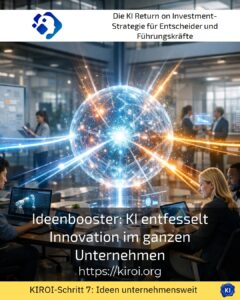
Imagine your company transforming into a living organism where every employee becomes an initiator and creative sparks ignite new potential every day. The Idea revolution does not begin in isolated development departments, but precisely where people come together, communicate with each other and jointly look for solutions. Many leaders are wondering how they can initiate this change, and it is precisely this question that accompanies us through this article.
Change begins in the mind
Before new structures can emerge, a fundamental shift in the mindset of everyone involved in the company is required. Clients frequently report that proposals peter out or get bogged down in bureaucratic processes. Therefore, transruptions coaching helps to identify mental barriers and dismantle them step by step. A medium-sized mechanical engineering company, for example, realised that its engineers had brilliant suggestions for improvement, but never voiced them. The fear of rejection or criticism had inhibited the creative flow for years.
A logistics company established weekly idea sessions where every voice counts equally. Within a few months, this generated over fifty concrete suggestions for improvement to route plans. A pharmaceutical company introduced anonymous feedback channels because employees were initially hesitant to speak openly. Interestingly, after this measure, the number of submitted proposals tripled, which demonstrates the importance of psychological safety.
Best practice with a AIROI customer
A long-established family business in the automotive supply industry was faced with the challenge that younger employees hardly contributed and experienced colleagues did not question their tried-and-tested methods. As part of the transruption support, we jointly developed a multi-stage programme that initially focused on building trust between the generations. We organised moderated workshops in which mixed teams of trainees and master craftsmen worked together on real production problems. The results surprised even the most sceptical managers, as seventeen concrete process improvements were developed within three months. Particularly remarkable was a suggestion from a young employee who saved twenty minutes of setup time every day by simply rearranging the material supply. Management realised that the Idea revolution must not be a one-off initiative, but requires continuous care and attention. Today, the company meets monthly for structured creative sessions, and employee satisfaction has measurably increased.
Creating structures that foster creativity
Without the right framework, even the best intention remains ineffective, which is why companies should consciously create spaces for experimentation. A software company reserved every Friday afternoon for its developers' personal projects, and out of these free hours came several successful product extensions. A retail group set up small innovation corners in its branches where employees can visualise ideas for improvement. A chemical company established so-called sandbox areas in its laboratories where researchers are allowed to experiment without pressure to succeed.
The physical environment influences creative thinking more than many suspect, which is why successful companies make targeted investments in inspiring workplaces. Open communal areas encourage spontaneous exchange between departments that would otherwise rarely communicate with one another. An insurance company redesigned its canteen as an idea workshop, with whiteboards on the walls and flexible seating options. An energy supplier created an internal coworking space where employees from different business areas can work together on projects.
Amplifying the idea revolution through digital tools
Modern technologies can significantly accelerate and democratise the creative process if used correctly [1]. Idea management platforms enable suggestions from all locations to be pooled and further developed collaboratively. A telecommunications provider uses such systems to collect and evaluate hundreds of employee suggestions every month. A construction company implemented an app allowing site managers to submit improvement ideas directly from the construction site.
Artificial intelligence is increasingly assisting in identifying patterns in proposals and bringing together similar ideas [2]. In this way, companies avoid duplicated work and can discover synergies between different approaches. A food corporation uses machine learning to automatically assign incoming proposals to the relevant specialist departments. This considerably accelerates processing times and shows employees that their input is taken seriously.
Leaders as enablers
The role of senior management is undergoing a fundamental shift when companies want to establish a culture of continuous improvement. Managers are becoming mentors who recognise and nurture potential rather than simply issuing instructions. A bank board member began participating in his teams' creative workshops himself and contributing his own ideas. This gesture clearly signalled that hierarchies should play no role in the generation of ideas.
Fault tolerance is developing into a decisive success factor because experiments cannot and are not always allowed to succeed. A medical technology company celebrates its failed projects in so-called Failure Fridays in order to learn from mistakes. A fashion company established the principle that every failed initiative must provide at least three insights for future projects. This approach reduces the fear of failure and encourages bold experimentation.
Best practice with a AIROI customer
An international technology corporation approached us because, despite high investments in research and development, their innovation rate was stagnating. The analysis revealed that managers were unconsciously blocking their employees' ideas by asking critical questions too early. In the transruptions coaching process, we worked intensively with middle management on changing the communication culture. We established the rule that during creative phases, only constructive questions may be asked, and critical evaluations may only take place in later phases. The effect of this seemingly small change was remarkable, as the number of submitted ideas doubled within a quarter. Employees reported that for the first time they felt truly heard and that their proposals were valued. The company developed this approach into a comprehensive management training programme, which is now used in all subsidiaries worldwide.
Cross-departmental networking
The most valuable insights frequently arise at the interfaces between different specialist areas and disciplines. A consumer goods manufacturer organises regular exchange meetings between marketing, production and customer service in order to connect perspectives. An electrical engineering company temporarily rotates employees into other departments to encourage fresh viewpoints. A tourism group has accountants take part in product development meetings because their analytical perspective often yields surprising insights.
External impulses considerably enrich the internal flow of ideas, which is why open collaborations are gaining increasing importance [3]. University partnerships enable access to current research and young talent with fresh perspectives. A steel group maintains close relationships with several technical universities and integrates student projects into its development work. A food producer regularly invites startups to work together on new product concepts.
Making the ideas revolution measurable
What is not measured cannot be systematically improved, which is why clever key performance indicators should accompany the innovation process. The number of submitted proposals alone says little, as what is decisive is their quality and degree of implementation. An automotive supplier developed an innovation index that combines various factors such as participation, implementation rate and economic impact. A retail company links bonus payments to the successful implementation of employee suggestions.
Regular feedback closes the loop and shows those who submitted ideas what has become of their proposals. A logistics service provider publishes a monthly internal newsletter showcasing implemented improvements and their impact. An insurance company invites employees whose ideas have been realised to give presentations to the management board. This recognition motivates others to get involved too and share their thoughts.
Sustainability in the change process
The biggest challenge lies in turning initial enthusiasm into lasting behavioural change. Many initiatives fail because they are designed as one-off projects and fizzle out after the project ends. Transruption coaching therefore supports companies over longer periods to anchor sustainable changes. A chemical company invested three years in cultural change before the new way of working became second nature.
Setbacks are part of the change process and should not be interpreted as failure. After initial euphoria, a mechanical engineer experienced a significant drop in participation and had to adapt his approach. By analysing the causes and targeted readjustment, they succeeded in Idea revolution to revive and permanently establish. Patience and perseverance are proving to be more important factors than perfect plans or large budgets.
My AIROI Analysis
The Idea revolution is not a utopia, but an achievable reality for companies of all sizes and industries. My experience from numerous projects shows that the decisive success factor lies not in technologies or structures, but in human interaction. Companies that place genuine trust in their employees and create spaces for creative thinking develop a dynamic that is self-reinforcing. The technical tools support this process, but can never replace it.
I find it particularly striking how different the paths to success can be, depending on the corporate culture and starting point. Some organisations benefit from structured processes and clear rules, whilst others gain more from informal approaches. The AIROI methodology helps to identify the right approach for each organisation and implement it step by step. It remains important to recognise that genuine change takes time and that short-term successes should not be the goal.
Leaders bear a special responsibility because, through their behaviour, they set the framework for everyone else. Those who are themselves open to new ideas and view mistakes as learning opportunities send a powerful signal to the entire organisation. The Idea revolution therefore often starts right at the top and then spreads organically. I advise companies not to view this change as a completed project, but rather as an ongoing journey that requires continuous attention and care.
Further links from the text above:
[1] Harvard Business Review – Innovation Management
[2] McKinsey – The Eight Essentials of Innovation
[3] Forbes – Innovation Insights
For more information and if you have any questions, please contact Contact us or read more blog posts on the topic Artificial intelligence here.








 Deutsch
 English (UK)