
What distinguishes companies that grow in turbulent times from those that stagnate and ultimately fail?
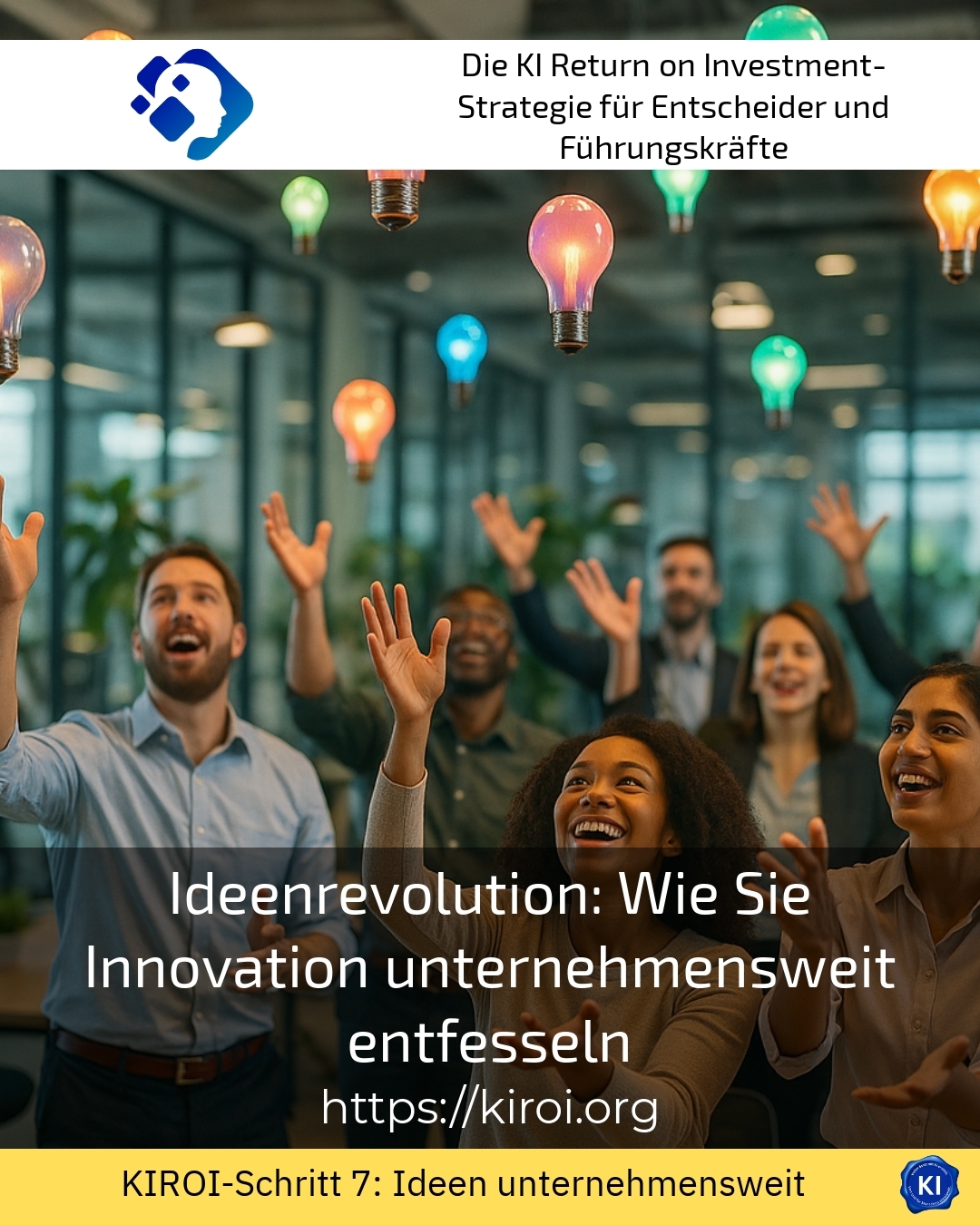
The answer often lies hidden in the minds of one's own employees, whose creative potential is lying dormant like an untapped treasure. A real Idea revolution does not begin in executive suites or strategy departments, but arises where people grapple daily with challenges and intuitively develop solutions. Clients frequently report that their best innovation impulses came from unexpected corners of the company. The crucial difference lies in whether organisations systematically capture these creative sparks or whether they get lost in the noise of everyday operations. In transruption coaching, we accompany companies in building precisely these structures and establishing a culture that not only permits the new, but actively promotes and values it.
The hidden barriers on the path to the idea revolution
Many organisations believe they are open to new thoughts and fresh perspectives. The reality, however, paints a different picture. Invisible barriers block the free flow of creativity through all hierarchical levels. For example, a medium-sized mechanical engineering firm realised that its engineers had been holding back suggestions for improvement for years. The reason lay in an unconsciously established blame culture. Every deviation from the standard was critically questioned. A logistics service provider found that innovative ideas regularly petered out in endless coordination loops. The time span between submission and implementation averaged eighteen months. A financial services provider had to acknowledge that its strict compliance orientation stifled every creative impulse in the bud.
These examples illustrate a fundamental pattern that can be seen across all industries. Structural and cultural barriers often act subtly, yet have a devastating impact on innovation potential. Leaders frequently underestimate the extent to which their own behaviours reinforce these blockages. A critical comment in a meeting can be enough to silence employees for months. An offhand remark about tight resources signals that new projects are unwelcome.
Best practice with a AIROI customer
A traditional retail company with over two thousand employees turned to us because, despite high investments in digital transformation projects, hardly any genuine innovations were emerging. The analysis as part of the transruption coaching revealed a deeply rooted culture of fear. Employees feared negative consequences if their proposals failed. Together, we developed a multi-stage programme for cultural transformation. First, we introduced protected spaces for experimentation where ideas could be tested without risk. At the same time, we trained managers in appreciative communication and constructive feedback. After nine months of intensive support, the number of submitted improvement suggestions increased sixfold. However, even more important was the qualitative change. The proposals became bolder, more visionary and strategically more relevant. The company successfully brought several of these ideas to market, thereby achieving significant additional revenue in a previously stagnant business area.
Systematic promotion of creativity as a strategic competitive advantage
True innovative power does not come about by chance or through brilliant individuals. It is the result of consciously designed processes and structures. Companies that Idea revolution take seriously, invest in the systematic promotion of creativity. For example, an energy supplier established quarterly innovation days where employees from all areas came together. The participants worked jointly on real challenges facing the company. A pharmaceutical company set up interdisciplinary innovation labs that operated far removed from day-to-day business. These teams were given the freedom to pursue radical approaches. A technology corporation implemented a digital idea management system with transparent evaluation.
The systematisation of creativity may at first seem paradoxical. In fact, however, experience shows that clear structures support the unleashing of innovation potential. People need orientation in order to deploy their creative abilities to the full. They require knowledge of which subject areas are strategically relevant. They benefit from defined timeframes in which they are allowed to focus on new things. The right balance between freedom and structure makes all the difference.
Methods for unleashing creative potential
Various methodological approaches have proven effective in systematically activating creativity. Design Thinking, for example, puts employees into the perspective of customers and users. An insurance company used this method to develop completely new product concepts. The results exceeded all the executive board's expectations. Open Innovation opens companies up to external impulses and collaborations. An automotive supplier successfully initiated partnerships with startups and universities. Lean Startup principles enable rapid experimentation with low risk. A media company used this to test digital business models in the shortest possible time.
In transruptive coaching, we support organisations in selecting the appropriate methods for their specific situation. Not every approach is suited to every corporate culture. The art lies in the intelligent combination of different elements. We provide impetus on how existing structures can be adapted step by step. In doing so, we pay particular attention to ensuring that changes are anchored sustainably.
Leadership as a catalyst for the ideas revolution
The role of leaders in the innovation process can hardly be overestimated. Through their behaviour, they set the standards for the entire organisation. A construction company experienced a dramatic turnaround after the managing director began talking publicly about his own failures. This transparency encouraged employees to take risks themselves. A retail group systematically trained all levels of management in innovation-promoting behaviour. The investment paid off through measurably higher employee engagement scores. A consulting firm established the principle of psychological safety across all teams.
Leaders must learn to switch between their different roles. Sometimes they are decision-makers who set clear directions. In other moments, they act as coaches who guide through questioning. Occasionally, they step up as facilitators who provide resources and attention. Developing this flexibility requires conscious reflection and continuous learning. Many leaders come to transruptions coaching with precisely these issues.
Best practice with a AIROI customer
A manager in the food industry sought support because her team had not produced any truly new product ideas for years. During the coaching process, we realised together that she was unconsciously vetting every suggestion for feasibility and risks immediately. This analytical mindset had been essential in her previous role as a quality manager, but was now inhibiting innovation. We worked on techniques to first receive creative impulses appreciatively and develop them further before asking critical questions. The leader learned to consciously switch between different conversation modes and to communicate this transparently as well. She now clearly signalled to her team when it was ideation time and when it was evaluation time. The result surprised everyone involved. Within a quarter, three marketable product concepts were created, one of which is now among the company's most successful new launches. The employees reported increased motivation and a new sense of appreciation.
How the idea revolution is embedded in everyday life
Sustainable change comes about through consistent integration into the working day. A telecommunications company reserved fixed time slots for creative work. These slots were treated like important customer appointments and protected. A healthcare provider introduced daily short innovation rituals in its team meetings. Every meeting began with the question about new observations or ideas for improvement. An industrial company made innovation contributions a fixed part of performance appraisals [1].
Embedding this in everyday life requires patience and persistence. New habits do not form overnight. Leaders must continually model and demand the desired behaviours. Relapses into old patterns are normal and should not be discouraging. The important thing is to use these moments as learning opportunities and to stay the course. Successes, even small ones, should be visibly celebrated [2].
Technological support for creative processes
Modern technologies can significantly accelerate and democratise innovation processes. A chemical company uses artificial intelligence to search patent databases for innovation potential. The results inspire research teams to adopt new approaches. A fashion company uses collaboration platforms to gather ideas from all stores worldwide. The best proposals are identified through community voting. A mobility provider is experimenting with virtual reality environments for creative workshops [3].
Technology alone, however, does not create a culture of innovation. It is a tool that must be deployed correctly. Many companies invest in digital idea management systems that then remain unused. The reason usually lies in a lack of integration into the company culture. In transruption coaching, we support you in combining technological solutions with cultural changes.
My AIROI Analysis
Guiding numerous organisations on their journey to genuine Idea revolution has yielded central insights. Innovation is not a matter of chance, but the result of consciously shaping culture, structure, and leadership. Companies that want to be sustainably innovative must pull all three levers simultaneously. Isolated measures such as individual workshops or new software tools usually fizzle out without effect.
The greatest leverage lies in leadership development. When leaders learn to create psychological safety and value creative impulses, the entire system changes. Employees intuitively sense whether new ideas are genuinely welcomed. They respond to authentic behaviour, not programmatic announcements. That is why in transruptions coaching we often begin with the individual development of leaders.
At the same time, structural changes are needed to enable creative work. Time, space and resources must be explicitly allocated for innovation activities. Without these material prerequisites, all cultural efforts remain lip service. Experience shows that companies that consistently address both dimensions achieve progress significantly faster. They develop a self-reinforcing dynamic in which successes trigger further innovations. Initiating and supporting this positive spiral is the core of our work with organisations that strive for real change and want to secure their future viability.
Further links from the text above:
[1] Harvard Business Review – Innovation Management
[2] McKinsey – The Eight Essentials of Innovation
[3] Forbes – Innovation Insights
For more information and if you have any questions, please contact Contact us or read more blog posts on the topic Artificial intelligence here.








 Deutsch
 English (UK)