
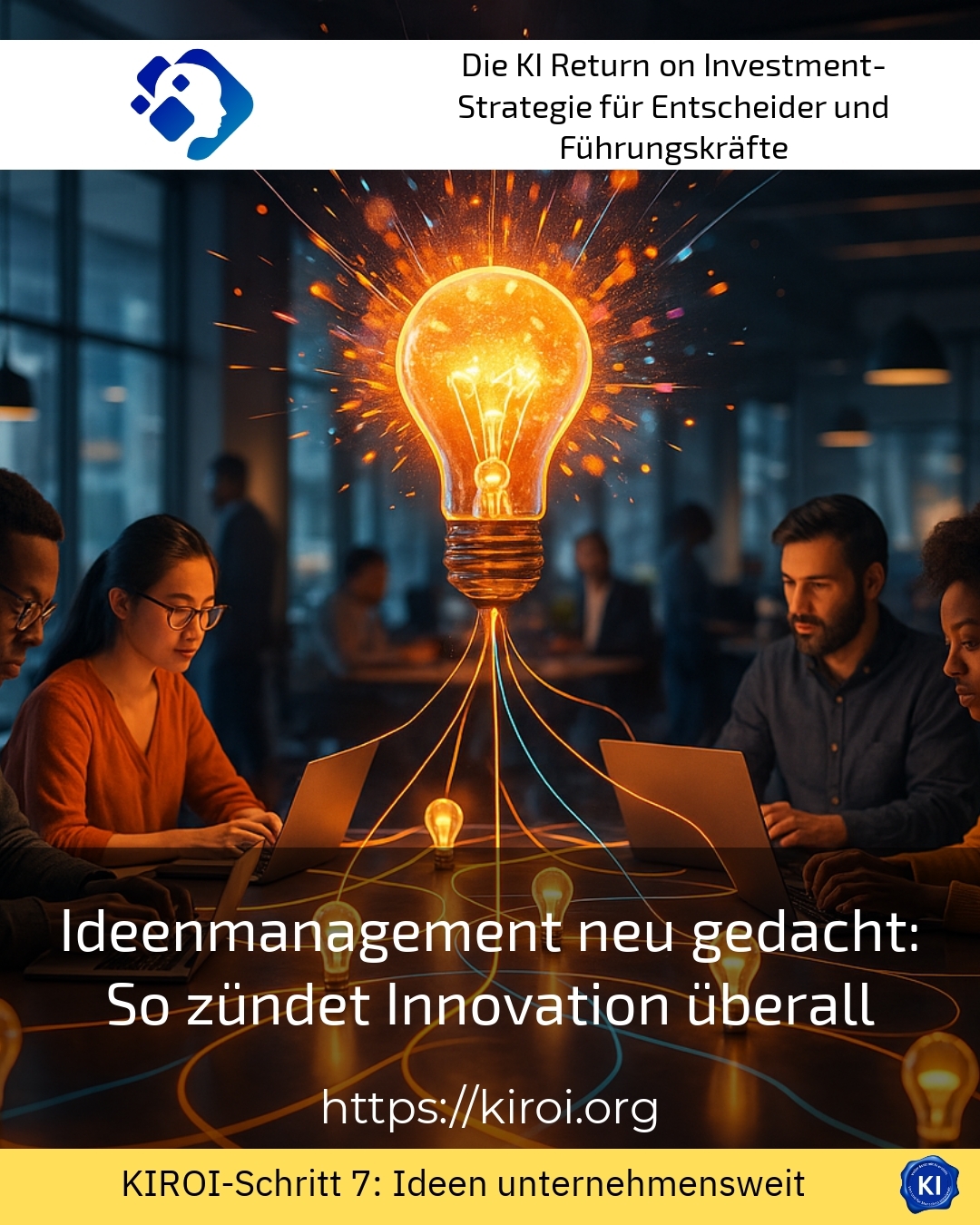
Imagine your organisation's best ideas are lying dormant in your employees' minds, just waiting to be awakened. That's precisely where Rethinking Idea Management: How to Ignite Innovation Everywhere Because in a rapidly changing world, traditional suggestion schemes are no longer sufficient. Companies need fresh approaches to unleash creative potential. The following paragraphs will show you how to achieve this.
Why traditional approaches are no longer sufficient
Many organisations still rely on dusty suggestion boxes or complicated forms. Employees are expected to submit their suggestions and then wait. Weeks go by before any feedback is received. This stifles enthusiasm at its root. The result is frustration on all sides. People don't feel heard. Their motivation plummets. Yet, enormous creative potential slumbers within every team.
A medium-sized mechanical engineering company from the Rhineland experienced precisely this situation. The company had introduced a digital suggestion system. However, the response remained disappointingly low. Management wondered why. An analysis revealed: the processes were too complicated. Furthermore, there was a lack of a real feedback culture. No one knew what happened to the submitted suggestions.
A car parts supplier from Southern Germany had similar experiences. There, engineers came up with brilliant optimisation suggestions for production processes. However, these got bogged down in bureaucratic loops. Management realised: no system works without a cultural change. Technology alone does not solve problems.
A logistics company from Hamburg also reported difficulties. Drivers and warehouse workers had improvement ideas daily. But they didn’t dare to voice them. The hierarchies seemed intimidating. Things only changed when the management actively approached the teams.
Rethinking Idea Management: How to Spark Innovation Everywhere in Everyday Life
A modern approach focuses on low barriers to entry and rapid feedback. Employees must be able to share their thoughts unproblematically. Digital platforms make this possible today without issue. However, the underlying culture is even more important. Managers must be role models. They should contribute ideas themselves and encourage others.
A pharmaceutical company from the Frankfurt area took this path consistently. The management launched regular innovation rounds. All employees could present their suggestions there. The format was deliberately kept informal. This created an atmosphere of openness. Within a few months, the number of submitted ideas tripled.
An energy supplier from North Rhine-Westphalia used a different approach. The company set up so-called innovation labs. There, employees could experiment across departments. The results were presented at short intervals. This transparency provided additional motivation.
A trading group from Munich relied on playful elements. The HR department developed an app with gamification features. Points, badges and leaderboards provided additional incentives. Younger employees in particular responded enthusiastically to this approach.
Best practice with a AIROI customer
An international industrial group was faced with a particular challenge. The company employed several thousand people at various locations around the world. Despite existing digital systems, participation in innovation processes remained low. The management commissioned transruption coaching to analyse the situation in depth and provide new impetus. Together, the participants developed a multi-stage approach that took both technical and cultural aspects into account. Firstly, focus groups were conducted in various departments in order to understand the actual obstacles. This revealed that many employees were afraid of negative consequences if their ideas did not work. The coaching helped managers to establish a new error culture. Regular workshops taught methods for creative problem-solving and strengthened trust between the teams. Within six months, the number of suggestions for improvement submitted quadrupled and several of them led to measurable cost savings in production. There was a demonstrable increase in employee satisfaction, which was also reflected in the annual surveys.
The role of leaders in change
Leaders significantly shape how open an organisation is to new ideas. Their behaviour sends strong signals to the entire workforce. If superiors dismiss or ignore ideas, employees quickly fall silent. Conversely, genuine interest is contagious. People want to be seen and valued.
A construction company from Berlin experienced this dynamic impressively. The new managing director began walking through the construction sites every Monday morning. He spoke with foremen, tradespeople, and apprentices. His question was always the same: What can we do better? Initially, the employees reacted reservedly. But after a few weeks, they opened up. The resulting improvements saved the company significant resources.
An IT service provider from Düsseldorf took a similar path. The team leaders received special training in appreciative communication. They learned to constructively pick up and develop ideas. Transruption coaching accompanied this process over several months. The results were convincing: Lower staff turnover and higher innovation rates.
An insurance company from Cologne established regular retrospectives based on agile principles. Teams would jointly reflect on completed projects. What went well, what didn't? What ideas could improve future endeavours? This structured reflection quickly became an integral part of the company culture.
Technology as a catalyst for creative processes
Digital tools can significantly accelerate innovation processes. They enable cross-location collaboration and rapid exchange. However, they never replace the human factor. Technology is a means to an end, and nothing more. The best platforms are of little use without committed people.
A chemical company from Ludwigshafen implemented a cloud-based innovation platform [1]. Employees could submit, comment on, and rate ideas there. The system allowed for transparent tracking of each individual suggestion. Acceptance was high from the outset. The employees particularly appreciated the option to post anonymously.
A telecommunications provider from Bonn used artificial intelligence for idea evaluation [2]. Algorithms analysed submitted suggestions according to various criteria. The most promising were automatically prioritised. This saved the company valuable time during the initial selection process. At the same time, the final decision always remained with humans.
A food manufacturer from Hamburg linked its innovation system with the corporate strategy. Every idea submitted was automatically assigned to the strategic goals. This way, everyone involved immediately recognised how their proposal contributed to the bigger picture. This sense of purpose noticeably increased motivation.
Rethinking Idea Management: How to Ignite Innovation Everywhere, Even in Small Teams
Not just large corporations benefit from systematic approaches. Smaller companies can also gain enormously. Often, the structures there are even more flexible. Decision-making processes are shorter, and hierarchies flatter. This favours the rapid implementation of good ideas.
An advertising agency from Leipzig introduced weekly creative sessions. Everyone on the team was allowed to present wild ideas there. There was no judgement, only further development. A prize-winning campaign concept emerged from a spontaneous idea. The agency won a significant industry award.
A craft business from the Black Forest used brief morning meetings. In just ten minutes, the employees exchanged ideas about current challenges. Practical solutions regularly emerged from these discussions. The master craftsman took these on board and implemented them swiftly.
A software startup from Berlin established a special tradition. Every Friday afternoon, everyone worked on their own projects. These so-called hack days fostered creativity and a spirit of experimentation. Several product features that are successful today originated in precisely these hours.
Best practice with a AIROI customer
A medium-sized family business in the metalworking industry approached transruptions coaching with a specific concern. The management noticed that younger employees were hardly submitting any suggestions for improvement, while their older colleagues were making active use of the existing system. This generation gap deeply concerned those responsible. In the coaching process, the participants first analysed the different communication habits of the age groups. It emerged that the younger employees favoured mobile solutions and expected quick feedback. Together, the team developed a hybrid solution that utilised both traditional and digital channels. A modern app made it possible to submit ideas via smartphone while retaining the tried-and-tested analogue channels. Mentoring tandems consisting of experienced and young employees also promoted cross-generational dialogue. Coaching provided close support during the introductory phase and helped to overcome initial resistance. After one year, the participation rate of those under thirty had tripled and the company benefited from fresh perspectives on long-standing challenges.
Sustainable embedding in day-to-day business operations
The biggest mistake is to view innovation initiatives as one-off projects. True transformation requires continuous commitment. Routines must be established and maintained. Only then will creative thinking become an inherent part of the company culture.
A hospital operator from Dresden integrated innovation time directly into rotas. Nurses and doctors were regularly allocated hours for improvement work. This time was protected and could not be used for operational tasks. The message to the staff was clear: your ideas are valuable.
A textile company from Baden-Württemberg linked innovation performance with its remuneration system. Particularly effective suggestions were financially rewarded. The management paid attention to fair and transparent criteria. This resulted in healthy competition for the best ideas.
A media house from Munich celebrated successes publicly and regularly. Every implemented suggestion for improvement was acknowledged on the intranet. The idea generators received recognition in front of the entire workforce. This visibility motivated others to emulate them [3].
Overcoming resistance and winning over sceptics
Not all employees welcome change with open arms. Some see new approaches as a threat to their usual routines. Others doubt the benefit of additional initiatives. It is crucially important to take these reservations seriously.
A steelworks in the Ruhr region initially encountered considerable resistance. Long-serving employees feared their experience would be devalued. The management reacted cleverly to this. They emphasised that precisely the knowledge of the experienced was indispensable. Older colleagues were appointed as mentors and given special responsibilities.
A financial services provider from Frankfurt countered sceptics with pilot projects. Small teams initially tested new methods within a protected environment. The positive results then convinced the doubters. The company gradually extended the approach to other areas.
A tourism company from Bavaria focused on personal conversations. Human resources development conducted individual interviews with dissenting voices. Concerns were heard and taken seriously. Often, behind the resistance lay legitimate worries that could be constructively addressed.
My AIROI Analysis
The engagement with systematic creativity promotion clearly shows: it is about far more than processes and tools. At its core is the question of how organisations wish to deal with the knowledge and ideas of their people. Technology can support this, but it never replaces genuine appreciation and open communication. The most successful companies combine digital tools with a culture of trust and psychological safety.
Particularly noteworthy is the importance of leaders in this context. They act as both multipliers and role models. Their behaviour shapes the entire climate of an organisation more strongly than any sophisticated software. Therefore, investments in this area should always include leadership development.
The practical examples also illustrate that there is no one-size-fits-all solution. Each company must find its own path that suits its specific culture and existing structures. Professional support, such as transruption coaching, can provide valuable impulses and accelerate the process. The key remains: change takes time, patience, and consistent persistence.
The concept Rethinking Idea Management: How to Ignite Innovation Everywhere Ultimately, this describes a cultural shift. This is only successful if all parties involved support it and actively shape it. The reward is enormous: more engaged employees, better solutions, and sustainable competitive advantages. The investment is undoubtedly worthwhile.
Further links from the text above:
[1] HYPE Innovation Management Platform
[2] Fraunhofer Initiative for Artificial Intelligence
[3] Expert Blog Ideas Management Germany
For more information and if you have any questions, please contact Contact us or read more blog posts on the topic Artificial intelligence here.







 Deutsch
  English (UK)