
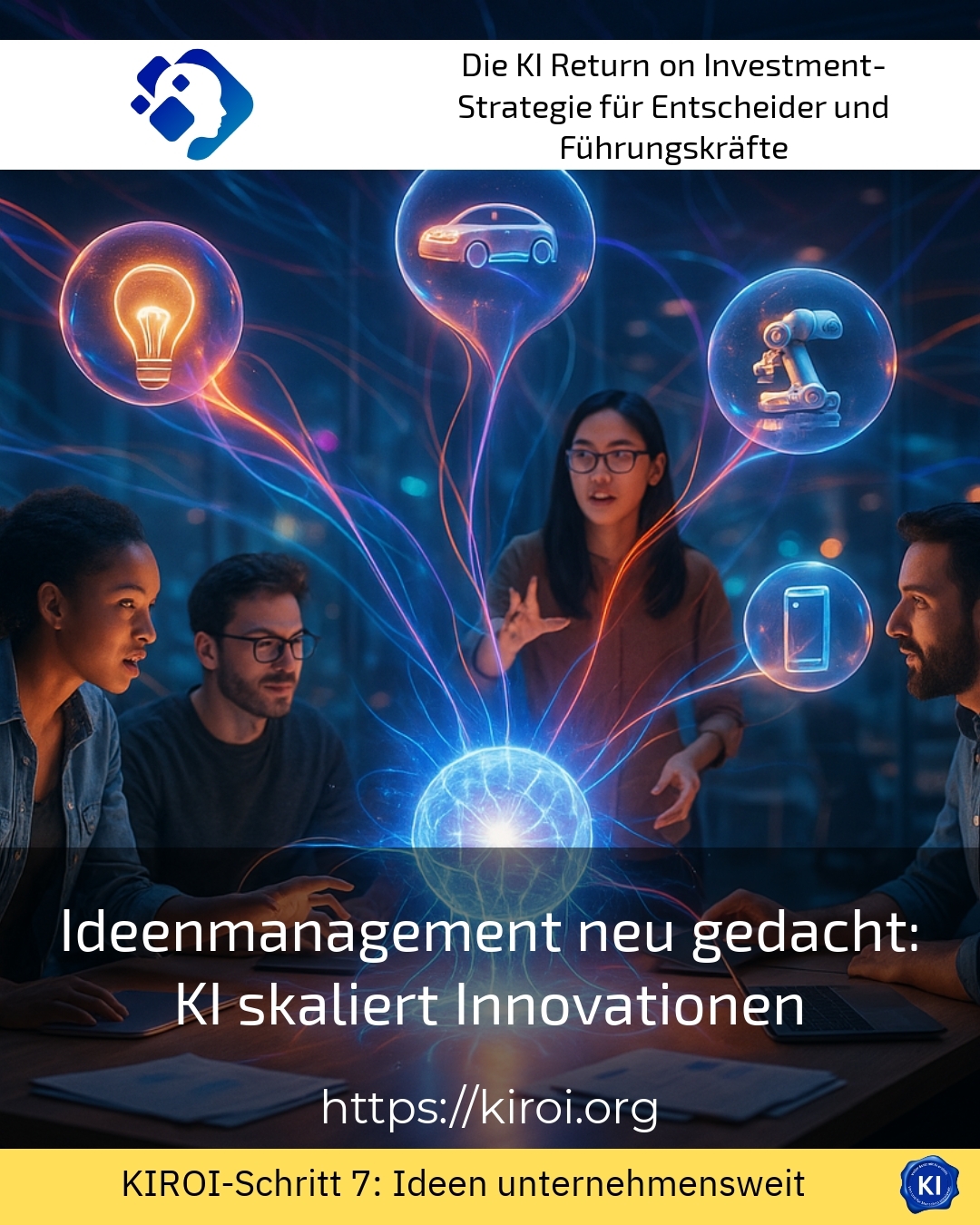
Imagine thousands of employees submitting their suggestions for improvement simultaneously. How do companies keep track of this? The answer lies in a technological revolution that Rethinking Ideation Management: AI Scales Innovation enables. Traditional methods have long reached their limits. Algorithms, on the other hand, work tirelessly and precisely. They recognise patterns that humans would overlook. This creates completely new possibilities for creative processes. This article shows how intelligent systems are transforming the culture of innovation.
The limits of classical approaches and why change becomes necessary
Traditional evaluation processes for employee suggestions often take months. A committee meets regularly, discusses, and prioritises. Valuable ideas are lost in the process. Many suggestions gather dust in digital inboxes. The motivation of those submitting them noticeably decreases. This is exactly where modern technological solutions come in. They speed up processes and create transparency. Furthermore, they recognise connections between different submissions. This creates synergies that remained undiscovered previously.
A medium-sized mechanical engineering company received over three thousand suggestions annually. Processing took an average of eight weeks. Many employees lost interest in participating. After the introduction of intelligent analysis tools, processing time decreased significantly. The participation rate increased considerably within a few months. Companies in the automotive supply industry report similar experiences. There, digital assistants support the categorisation of submissions. Production employees thus experience faster feedback on their ideas.
Remarkable developments are also emerging in the logistics sector. Freight forwarders are using algorithmic systems to assess process improvements. Warehouse employees can submit suggestions for improvement via voice assistant. The system immediately analyzes the potential impact on lead times. This creates a continuous improvement process without administrative effort.
Rethinking Ideas Management: AI Scales Innovations Through Intelligent Analysis
Modern algorithms are getting better and better at understanding natural language. They grasp the core of a suggestion within seconds, taking into account the context of the respective department. A suggestion from production will be assessed differently than one from sales. This contextual intelligence makes the crucial difference. It enables fair comparisons between different subject areas. Furthermore, the system automatically identifies duplicates and similar submissions.
A chemical company implemented such a system for its research department. Scientific staff submit new hypotheses there daily. The system immediately identifies overlaps with ongoing projects, thereby avoiding duplicate research efforts for the company. At the same time, the automatic linking generates new interdisciplinary approaches. Pharmaceutical companies use comparable technologies for their development departments. There, algorithms analyse submitted drug combinations for their potential, with the evaluation being based on extensive scientific databases.
Best practice with a KIROI customer
An international consumer goods manufacturer was faced with a particular challenge in the area of product development. The company received over five hundred suggestions from various national companies every month. The submissions were made in different languages and formats. Previously, regional teams had coordinated the evaluation independently and without centralised coordination. This resulted in redundancies and valuable synergies remained unutilised. As part of a transruption coaching project, we supported the introduction of an intelligent analysis system. The system automatically translates submitted proposals and categorises them according to thematic clusters. Within the first six months, the technology identified twelve per cent of all submissions as potential duplicates. At the same time, it combined previously isolated ideas into promising overall concepts. Employees report a significant increase in transparency throughout the entire process. The average processing time was reduced from eleven weeks to less than three weeks. Particularly noteworthy was the increased participation in the Asian locations, as language barriers were removed by automatic translation.
Practical application areas in various company divisions
The potential applications of intelligent systems extend across all business areas. In human resources, they support the collection of onboarding improvements. New employees provide valuable input on the induction phase. The system recognises recurring points of criticism and prioritises appropriate measures. In customer service, algorithms automatically analyse submitted service improvements. They relate these to current customer satisfaction scores. This creates a data-driven basis for investment decisions.
Financial service providers use comparable technologies for their compliance departments. Employees can submit suggestions for improvement to regulatory processes there. The system automatically checks compliance with applicable regulations [1]. Insurance companies use intelligent analyses for their claims processing. Case workers submit suggestions for optimisation of checking processes. The technology assesses the potential impact on processing times and customer satisfaction.
Promising use cases are also emerging in retail. Store employees observe customer behaviour and process weaknesses on a daily basis. Their suggestions are fed into a central system. Algorithms recognise cross-location patterns and recommend site-wide implementations. A drugstore chain implemented such a system for its product presentation. The results showed measurable improvements in customer flow and sales figures.
The human component remains indispensable
Despite all technological advances, people remain at the core. Algorithms can offer support and provide impetus. However, experienced leaders continue to make the final decisions. Creativity arises in the minds of employees. Technology merely serves as a catalyst and amplifier. This understanding is fundamental for successful implementations. Companies that view technology as a substitute for human judgment often fail. The right approach combines machine efficiency with human intuition.
A telecommunications provider had this experience during its digital transformation. The company introduced a fully automated assessment system. Employees perceived the decisions as opaque and arbitrary. Participation in the suggestion scheme dropped dramatically. It was only the combination of algorithmic pre-selection and human final assessment that brought about a breakthrough. Energy providers report similar learning processes. There, interdisciplinary teams critically accompany the system's decisions. This hybrid approach promotes both efficiency and acceptance.
In healthcare, the importance of human expertise is particularly evident. Nursing staff submit valuable suggestions for improving workflows. Algorithms can only capture medical contexts to a limited extent. Therefore, expert committees finally assess the practicality of the suggestions. Hospital operators expressly emphasise the importance of this combination.
Rethinking Idea Management: AI Scales Innovation in Corporate Culture
The introduction of intelligent systems is also profoundly changing the culture of innovation. Employees experience faster feedback on their submissions. This prompt response significantly boosts motivation to participate. Furthermore, transparency builds trust in the fairness of the process. Many companies report a noticeable cultural shift. Innovation is no longer seen as the task of a few specialists. Instead, an awareness of collective creativity is emerging.
Best practice with a KIROI customer
A long-established industrial company in the precision mechanics sector wanted to fundamentally modernise its culture of innovation. The workforce consisted largely of long-serving specialists with a wealth of experience. This knowledge had hardly been systematically recorded or utilised to date. As part of a transruptions coaching programme, we jointly developed a multilingual platform for suggestions for improvement. The intelligent system analyses submitted suggestions and links them to existing documentation. Experienced employees can thus contribute their implicit knowledge in a structured way. Younger colleagues benefit from this institutional memory. The platform identified over two hundred process-relevant improvement potentials within the first year. The high level of participation among older employees was particularly noteworthy because the system enables simple voice input. The company management reports a noticeable increase in cohesion between the generations. In addition, several patentable further developments of existing products were created through the systematic networking of knowledge.
Craft businesses are increasingly discovering the benefits of digital assistants. Journeymen and master craftspeople possess enormous practical knowledge. Mobile applications enable simple documentation of improvement ideas. Algorithms recognise industry-wide trends and promote exchange between businesses. Construction companies use similar systems for their building sites. Foremen and site managers submit optimisation suggestions directly from the worksite [2].
Implementation strategies for sustainable success
The successful introduction of intelligent analysis systems requires careful planning. Technical aspects only form part of the challenge. Involving employees from the outset is at least as important. Change management processes are essential to accompany the technical implementation. Training provides the necessary understanding of the new tools. Furthermore, pilot projects should be launched in selected areas before widespread rollout.
A media company started with its editorial department as a pilot area. Journalists and editors intensively tested the system for six months. Their feedback was directly incorporated into further development. Following successful piloting, there was a gradual rollout to other departments. Advertising agencies report similar approaches in their implementations. There, creative teams were the first user group to start. The playful approach of these teams fostered innovative application scenarios.
Specific challenges and opportunities are emerging in the public sector. Authorities possess extensive knowledge for improving administrative processes. Intelligent systems can systematically evaluate citizen feedback. Municipal utility companies are using corresponding technologies for their employee suggestion schemes. Experience shows significant efficiency gains in processing submissions [3].
My KIROI Analysis
The transformation of the employee suggestion scheme through intelligent technologies marks a fundamental turning point in corporate management. My analysis shows that companies with a systematic approach achieve significantly better results than those with isolated technology projects. Success depends largely on three factors: technical excellence, cultural embedding and continuous development. Organisations should view the introduction of intelligent systems as a long-term investment in their ability to innovate. Technology alone does not solve problems, but it helps people to realise their full creative potential. I find the cross-generational impact of well-implemented systems particularly remarkable. Older employees with a wealth of experience can contribute their knowledge in a structured way, while younger colleagues benefit from this institutional intelligence. Hybrid collaboration between humans and machines is becoming a decisive success factor. Companies that consistently pursue this approach often report a stronger culture of innovation and higher employee satisfaction. In the future, I expect further refinement of analytical capabilities so that systems will not only reactively evaluate, but proactively identify areas of innovation. The journey has only just begun.
Further links from the text above:
[1] BaFin – Supervision of FinTech and Digital Innovation
[2] VDI – Digitalisation in Technology and Industry
[3] Competence Centre for Public IT – Digital Administration
For more information and if you have any questions, please contact Contact us or read more blog posts on the topic Artificial intelligence here.











 Deutsch
  English (UK)