
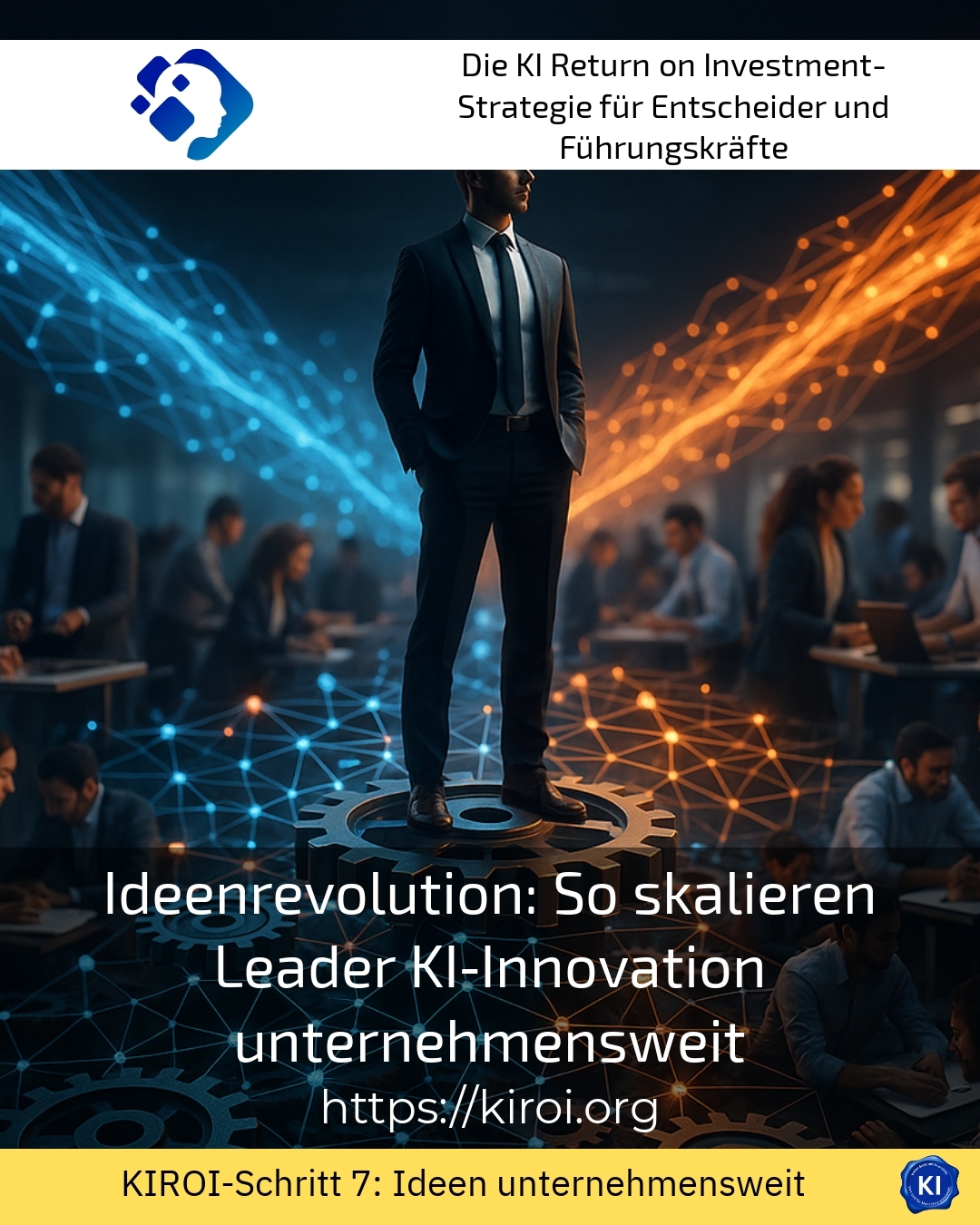
Imagine a groundbreaking idea is born in your research department, but it gets bogged down in endless alignment loops and bureaucratic hurdles. This is precisely where the Idea Revolution: How leaders scale AI innovation company-wide and is changing the way organisations turn creative impulses into measurable results. In an economic world that is transforming rapidly, the best idea alone no longer decides between success and failure. Rather, those companies win that can systematically tap innovation potential and consistently carry it into all areas of business. This article shows you tried-and-tested ways how leaders can orchestrate this change while achieving sustainable value creation.
Understanding the fundamentals of a company-wide ideas revolution
Before companies can deploy intelligent technologies across the board, they must first critically examine their organisational structures and, if necessary, fundamentally realign them. Many organisations do not fail due to a lack of ideas, but rather due to a lack of mechanisms for the systematic translation of these ideas into concrete business processes. The challenge lies in establishing a culture in which a willingness to experiment and structured implementation can go hand in hand. Managers frequently report that isolated pilot projects deliver impressive results, yet the transfer into everyday operations regularly stalls. A medium-sized mechanical engineering company, for instance, developed an intelligent quality control system that reduced scrap rates by thirty percent. Nevertheless, it took eighteen months before this solution was running productively across all plants. A chemical corporation, in turn, implemented predictive maintenance algorithms in a single facility with outstanding results. However, the rollout to other sites was delayed considerably by incompatible data formats and resistant workforces. A logistics company also experienced similar challenges when it sought to modernise its route optimisation [1].
The role of leaders in the idea revolution
Leaders bear the crucial responsibility of ensuring that innovative impulses do not remain trapped in silos, but rather can unfold an impact across the organisation. They must act as bridge-builders between technical experts and specialist departments. At the same time, it is incumbent upon them to constructively address resistance and transform it into productive energy. Transruption coaching supports managers in fulfilling this complex role with confidence and embodying it authentically. For example, a retail group established an innovation board at executive board level that consults on scaling decisions on a quarterly basis. An insurance company, on the other hand, relied on decentralised innovation ambassadors in every department who act as multipliers. A telecommunications provider, in turn, linked innovation metrics directly to its managers' target agreements [2].
Best practice with a AIROI customer
An international automotive supplier with over twelve thousand employees faced the challenge of transferring its innovation projects from the research department into series production. The company had already developed several promising approaches for automated defect detection that achieved excellent results in laboratory environments. However, the transfer to the production halls repeatedly failed due to a lack of acceptance by plant managers and inadequate integration into existing manufacturing systems. As part of the transruptions coaching, we jointly developed a multi-stage scaling strategy that systematically addressed both technical and human factors. First, we identified three pilot plants with particularly receptive site managers to serve as internal references. Subsequently, we developed a structured training programme for shift supervisors that took their concerns seriously and demonstrated concrete added value. The results significantly exceeded expectations, and within nine months the solution was in productive use at seven of the twelve production sites. The defect rate fell by an average of twenty-seven percent, and acceptance among employees increased measurably.
Idea Revolution: How Leaders Scale AI Innovation Through Structured Processes
The systematic scaling of innovative technologies requires clearly defined processes that foster creativity while establishing accountability. Without these structural frameworks, even brilliant ideas remain without consequence and peter out in the operational hustle and bustle of day-to-day business. Successful companies therefore establish dedicated innovation processes that range from the initial concept sketch to complete implementation. A pharmaceutical corporation, for example, uses a three-stage evaluation procedure for new automation projects, in which technical feasibility, economic benefit and strategic relevance are systematically assessed. An energy supplier, on the other hand, relies on agile development sprints that last a maximum of six weeks and must each conclude with concrete prototypes. A financial services provider, in turn, combines classic stage-gate processes with flexible experimental spaces in which employees are allowed to explore freely [3].
Technological infrastructure as an enabler of the ideas revolution
A powerful technological base forms the foundation for any successful scaling of intelligent applications across departmental boundaries. Without unified data platforms, standardised interfaces and flexible computing capacities, even ambitious innovation projects fail due to trivial technical hurdles. Astute managers therefore invest early on in a future-proof architecture that enables organic growth and avoids lock-in effects. A retail company, for example, migrated its entire data landscape to a cloud-based environment that can be scaled as needed. An industrial enterprise, in turn, established a central data catalogue that gives all specialist departments access to relevant information. A healthcare provider invested in secure interfaces that permit the exchange of sensitive patient data while maintaining all compliance requirements [4].
The importance of a well-conceived infrastructure becomes particularly clear during the company-wide rollout of solutions that were originally developed for a specific use case. Clients frequently report that they had to carry out significant rework because initial pilot projects were designed without regard for later scalability. This mistake not only costs time and money, but also frustrates the teams involved and permanently endangers the culture of innovation. transruptions coaching supports organisations in designing scalable architectures right from the start and avoiding typical pitfalls.
Bringing people along: The cultural aspect of the ideas revolution
Technology alone does not transform an organisation; rather, it is the people who understand, accept and can productively use that technology who do. The cultural dimension of scaling is frequently underestimated and only addressed once resistance has already become entrenched. Forward-looking leaders therefore invest from the very beginning in change management measures that turn those affected into participants. For instance, a media company actively involves editorial staff in the development of automated text generation rather than presenting them with finished solutions. A construction group intensively trained its site managers in the use of digital planning tools and systematically rewarded their suggestions for improvement. A mobility provider, in turn, established an internal ambassador programme in which tech-savvy employees train and support their colleagues [5].
Best practice with a AIROI customer
A traditional family-owned mechanical and plant engineering company headquartered in southern Germany was looking for support with the cultural transformation of its organisation. The technical department had already developed impressive prototypes for predictive maintenance, which were able to significantly reduce downtime. However, the factory workers reacted with considerable scepticism and feared being replaced or monitored by intelligent systems. As part of our support, we jointly developed a transparent communication concept that provided open information about the goals, limitations and impacts of the new technology. We organised dialogue formats in which experienced machine operators could contribute their expertise and actively help shape the system. This participatory approach turned initial rejection into genuine enthusiasm, as the employees realised that their experience was valued and that the system made their work easier rather than replacing them. After six months, the adoption rate exceeded all forecasts, and the employees independently contributed suggestions for improvement that further optimised the system.
Skills development as the key to the sustainable ideas revolution
The qualification of the workforce is a decisive factor in whether intelligent technologies reach their full potential or end up as expensive white elephants. Companies must therefore systematically invest in the further development of their employees and offer learning paths that cater to varying levels of prior knowledge. One consumer goods manufacturer, for instance, established an internal academy with modular training programmes for different target groups and competency levels. A technology company, in turn, specifically supports career changers who combine subject-matter expertise with a technical interest and can act as bridge-builders. A service corporation relies on tandem programmes in which experienced professionals and young digital experts learn from one another and develop solutions together [6].
Idea Revolution: How leaders scale AI innovation through strategic partnerships
Hardly any company possesses all the competencies and resources required for successful enterprise-wide scaling of intelligent applications. Strategic partnerships with specialised service providers, research institutions and technology vendors can close critical gaps and accelerate the transformation process. The key is to select partners carefully and design the cooperation in such a way that internal know-how is built up rather than creating permanent dependencies. A logistics group, for example, is cooperating with a technical university to develop advanced optimisation algorithms for its supply chains. A retail company, in turn, is working with a specialised start-up that has developed innovative approaches to demand forecasting. An insurance company is using the expertise of an established consultancy to fundamentally modernise its claims processing [7].
Transruption coaching guides companies in identifying suitable partners and establishing productive collaboration models that ensure sustainable knowledge transfer. Clients frequently report that external impulses can break through entrenched thinking patterns and bring fresh perspectives into the organisation. At the same time, they emphasise the importance of maintaining internal ownership and viewing external support as an accelerator rather than a replacement for their own skills development.
Measurement of success and continuous improvement in the idea revolution
What is not measured cannot be systematically improved, which is why clear key performance indicators and regular evaluations of success represent indispensable components of any scaling strategy. This is not only about technical metrics such as accuracy or throughput, but also about business indicators such as cost savings, increases in revenue or customer satisfaction. A manufacturing company, for example, developed a balanced scorecard framework specifically for its innovation initiatives, which equally considers financial and non-financial aspects. A financial institution, in turn, uses ongoing A/B testing to continuously validate the added value of new features and readjust if necessary. A retailer implemented a feedback system that systematically captures user experiences and integrates them into improvement cycles [8].
Learning from setbacks and building resilience
Not every initiative succeeds at first attempt, and clever organisations establish a culture of error that learns from setbacks instead of looking for culprits and stifling innovative impulses in the bud. This resilience is crucial for long-term success because it encourages a willingness to experiment and empowers the organisation to react quickly to changing framework conditions. A consumer goods company, for example, conducts systematic retrospectives after each completed project, the insights of which are documented and shared across the organisation. A technology corporation, in turn, explicitly celebrates failed experiments as long as valuable learning effects have been achieved and the insights gained are incorporated into future ventures. An industrial enterprise established an internal wiki in which teams transparently document their experiences and can warn colleagues about known pitfalls.
My AIROI Analysis
The company-wide scaling of intelligent technologies represents one of the most demanding leadership tasks of our time and requires a nuanced interplay of technical, organisational and human factors. My experience from numerous support projects clearly shows that success depends less on the brilliance of individual ideas than on the ability to systematically roll out these ideas across the board and anchor them sustainably. Leaders who want to successfully shape this transformation process must be willing to question traditional structures and forge new paths. They must understand technological possibilities without getting lost in details, while at the same time taking the needs of their employees seriously and actively addressing them.
What seems particularly important to me is the realisation that Idea Revolution: How leaders scale AI innovation company-wide is not a one-off project, but a continuous journey that is never truly finished. Technology is evolving rapidly, and organisations must remain capable of learning and adaptable in order to stay relevant. Transruption coaching provides valuable impetus here and supports leaders in finding and maintaining this complex balance. I regularly observe how companies that invest early in scalable infrastructures and cultural transformation are clearly ahead of their competitors and are able to systematically build on this advantage. The future belongs to those organisations that do not view innovation as the isolated activity of individual specialists, but establish and nurture it as an integral part of their corporate DNA.
Further links from the text above:
[1] McKinsey: Scaling AI in Organisations
[2] Harvard Business Review: Leadership and Managing People
[3] Gartner: Innovation Management Insights
[4] IDC: Digital Transformation Research
[5] Prosci: Change Management Resources
[6] World Economic Forum: Future of Work
[7] MIT Sloan: Digital Transformation
[8] Forrester: AI Research and Insights
For more information and if you have any questions, please contact Contact us or read more blog posts on the topic Artificial intelligence here.









 Deutsch
 English (UK)