
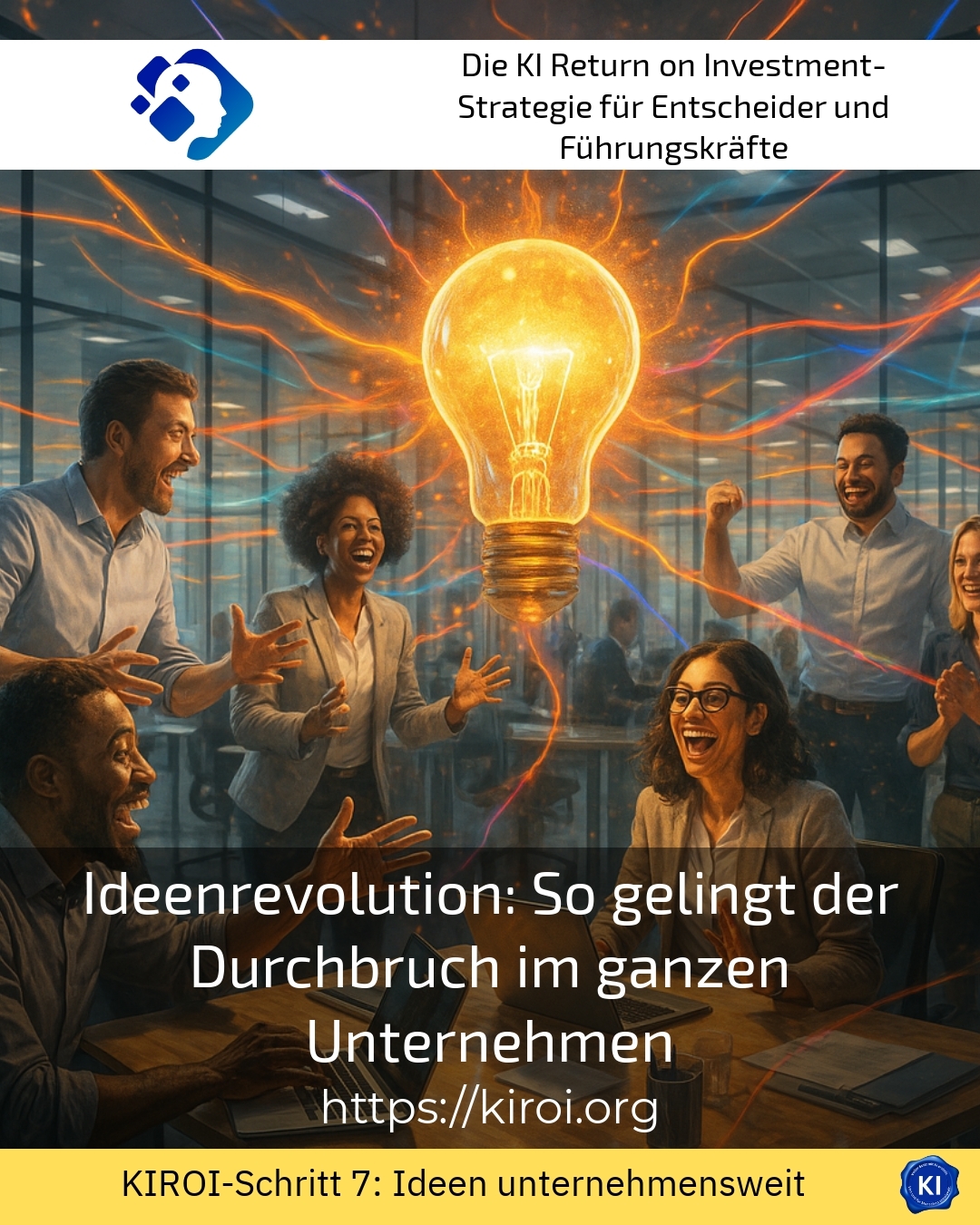
Imagine a single creative spark could fundamentally transform your entire business and ignite a true Ideas revolution: How to achieve a breakthrough across the entire company spark. Many leaders dream of innovative thoughts no longer trickling away in individual departments, but moving like a powerful current through all levels of the organisation. However, reality often looks different because traditional structures and entrenched processes slow down precisely this dynamic. Yet, in every team, every department, and at every hierarchical level, there lies dormant potential just waiting to be awakened. In this article, you will learn how to systematically create the conditions for groundbreaking concepts to emerge and become sustainably anchored throughout the entire business.
Why classical structures hold back the revolution of ideas
In many organisations there is still a pronounced silo mentality that massively hinders the free exchange of thoughts and concepts. Departments work in isolation from one another and only communicate via formal channels. As a result, valuable impulses are lost before they can even reach the right decision-makers. A production manager in a medium-sized mechanical engineering company recently reported that his best suggestions for improvement regularly peter out in bureaucratic approval processes. A retail sales team experiences similar difficulties, with customer feedback rarely reaching product development. In hospitals, too, nursing staff frequently find that their practical ideas for optimisation get lost in the administrative thicket.
The causes of these blockages are varied and range from rigid hierarchies to a lack of appreciation for creative contributions. Clients frequently report that they do not dare to voice unconventional suggestions because they fear negative consequences. In banks, for instance, a risk-averse culture often dominates, which rejects experimental approaches from the outset. Logistics companies, in turn, struggle with the time pressure of day-to-day business, which leaves hardly any room for creative thinking. And in the hospitality industry, the structures are simply lacking to systematically capture and pursue good ideas.
The fundamental pillars of a successful idea revolution in the company
To achieve a genuine breakthrough, more is needed than just well-intentioned appeals to the workforce's creativity. Rather, leaders must actively create the framework conditions in which innovative thoughts can flourish. Transruptions coaching accompanies projects revolving around this fundamental transformation and provides valuable impetus for change. A first fundamental pillar is the establishment of an open communication culture in which every voice is heard. In an automotive supplier business, the introduction of regular cross-departmental workshops led to a noticeable increase in usable improvement suggestions. A software company, in turn, implemented digital idea platforms where employees could easily share their ideas. Even a traditional craft enterprise experienced a remarkable revitalization of its innovation culture through weekly creative meetings.
The second pillar consists of the systematic evaluation and further development of submitted concepts. Many organisations do not fail due to a lack of good ideas, but rather due to their consistent implementation. A pharmaceutical company therefore established a transparent evaluation process that guaranteed feedback within two weeks. A hotel chain set up an innovation committee which selected the most promising proposals for piloting every quarter. And an energy supplier linked its suggestion scheme with an attractive bonus system that appropriately rewarded successful originators of ideas.
Best practice with a AIROI customer
A medium-sized company in the food industry was faced with the challenge that innovative ideas regularly fizzled out in middle management and never reached the executive board. Production staff had daily valuable insights into potential for optimisation, yet there was no functioning channel to pass on these findings. As part of intensive support through transruptions coaching, the company developed a three-stage system for recording, evaluating and implementing suggestions for improvement. First, digital data entry terminals were installed in all production halls where employees could easily input their thoughts. Subsequently, a rotating team from various departments evaluated the submitted concepts according to clear criteria such as feasibility, cost savings and strategic relevance. The most promising proposals then received a dedicated budget and a responsible project sponsor from the management level. Within eighteen months, the number of submitted proposals quadrupled, and the implementation rate almost doubled. It was particularly noteworthy that employee satisfaction also measurably improved, because for the first time the workforce had the feeling of truly being heard and being able to actively contribute to the company's development.
Cultural change as the foundation of the ideas revolution
Technical systems and processes alone are not enough to achieve a lasting breakthrough. Rather, what is needed is a profound cultural change that anchors creative thinking as a core competency. In an insurance company, this change began with managers themselves regularly submitting unconventional proposals and thus setting an example [1]. A telecommunications provider conducted so-called failure culture workshops in which failed projects were analysed without assigning blame. And a construction company established an annual innovation award that publicly honoured not only the winners, but all participants.
The cultural shift is also manifesting itself in the way meetings are organised. Instead of purely status reports, meetings should offer space for creative discussions. A chemical company reserved the first fifteen minutes of every team meeting for so-called wild-ideas sessions. A fashion company introduced walking meetings, where managers and employees went for a walk together to exchange thoughts informally. Even a conservative financial services provider experimented with design-thinking formats, which initially met with scepticism but delivered astonishing results.
Practical tools for company-wide breakthrough
The implementation of a Ideas revolution: How to achieve a breakthrough across the entire company requires concrete tools and methods that work in everyday life. Digital platforms for brainstorming have proven successful in numerous industries and support the systematic innovation process. For example, a media company uses a gamified app where employees can submit suggestions and vote for each other's ideas [2]. An industrial corporation relies on artificial intelligence to automatically categorise submitted concepts and link them with similar proposals. And a supermarket chain implemented a crowdsourcing tool that also allows customer feedback to flow directly into the innovation process.
Alongside digital solutions, analogue formats also play an important role in fostering creative impetus. Hackathons, where teams develop prototypes in a short space of time, have become established across industries. A hospital organised a three-day hackathon to improve patient communication with impressive results. A logistics service provider hosted regular innovation days where all employees were released from their regular duties. And a technology company set up permanent innovation labs where interdisciplinary teams could work on forward-looking projects.
The Role of Leaders in the Ideas Revolution
Without the active commitment of senior management, any initiative to foster innovation is doomed to fail. Managers must act as enablers and supporters, not as controllers and pessimists. The transruptions coaching helps leaders to redefine their role and create an innovation-friendly atmosphere. The managing director of a medium-sized mechanical engineering company reported how he consciously began to ask more questions than to provide answers [3]. A head of department in a publishing house established regular one-to-one meetings in which she specifically asked for unconventional thoughts. And a board member of a bank made it a habit to work alongside staff in different departments once a week while listening attentively.
The role model function of managers also extends to how they deal with setbacks and failed experiments. In a consumer goods corporation, the executive board introduced so-called 'Failure Fridays', where failed projects were openly discussed. A software company even celebrated failed experiments with small team events to encourage a willingness to take risks. And a retail company internally published a monthly newsletter that consciously also reported on projects that had not brought the hoped-for success.
Best practice with a AIROI customer
An internationally active service company had already made several attempts to establish a vibrant culture of innovation, but all previous initiatives had petered out after a short time. The analysis as part of the transruption coaching revealed that, above all, middle management was blocking creative impulses from the grassroots because it feared for its position. In close cooperation with the executive board, a comprehensive programme was then developed that specifically addressed this level of management. The managers first received intensive training in innovation management and creative leadership techniques, which expanded their competencies and strengthened their self-confidence. Subsequently, their performance agreements were adjusted so that the promotion of employee ideas was explicitly anchored as a performance criterion. In addition, the company established a mentoring programme in which experienced managers supported their younger colleagues in building an innovation-friendly team culture. The results exceeded all expectations: within a year, the number of implemented improvement suggestions tripled, and the employee survey showed a significantly increased satisfaction with direct supervisors. Middle management, previously perceived as a stumbling block, developed into an active driver of change and contributed significantly to the successful transformation.
Sustainability and long-term embedding of change
Many companies experience that initial enthusiasm for innovation initiatives subsides after a while and old patterns return. To prevent this, systematic measures are needed for the long-term embedding of cultural change. A retail group established a permanent innovation department that acted as an internal consultancy for all business areas. A technology company established quarterly reviews in which the progress of the innovation culture was systematically measured and evaluated. And a healthcare provider integrated innovation competence as an integral part of its staff development programmes.
The Ideas revolution: How to achieve a breakthrough across the entire company becomes sustainable when it becomes part of the organisational DNA. That requires continuous attention and regular impetus to keep the flame alive. One mechanical engineering company introduced annual innovation conferences where successful projects were celebrated and new priorities defined. An insurance company linked its innovation programme with the corporate strategy and actively communicated this connection to all employees. And an automotive supplier established a network of innovation ambassadors who acted as multipliers in their respective areas.
My AIROI Analysis
Accompanying numerous transformation projects has shown that the successful breakthrough of innovative concepts throughout the entire company is not a matter of chance, but the result of systematic work on structures, processes and, above all, corporate culture. Clients frequently report that they initially underestimated how profound the necessary change actually is and how much perseverance it requires. transruptions coaching accompanies projects tackling this complex challenge and provides impulses that go far beyond superficial measures.
Of particular importance is the realisation that technical solutions alone will never be sufficient to establish a vibrant culture of innovation. Rather, leaders must be prepared to fundamentally rethink their own role and see themselves as enablers. The examples from various sectors demonstrate impressively that this transformation is possible, regardless of company size or the respective industry. What is decisive is the genuine willingness to change and the readiness to acknowledge uncomfortable truths about one's own organisation.
For companies wanting to embark on the path to greater innovation, a step-by-step approach with clearly defined milestones is recommended. First, it is important to carry out an honest stocktake of the current situation and identify the biggest roadblocks. Targeted pilot projects can then be launched, the successes of which then serve as a blueprint for company-wide rollout. Continuous support from experienced coaches can help to avoid typical pitfalls and anchor the change sustainably.
Further links from the text above:
[1] Harvard Business Review – Innovation Management
[2] McKinsey – The Eight Essentials of Innovation
[3] Forbes – Leadership and Innovation
For more information and if you have any questions, please contact Contact us or read more blog posts on the topic Artificial intelligence here.







 Deutsch
 English (UK)